The elusive Elizabeth Strutt

Jedediah Strutt by Wright of Derby

There’s a common misconception that few people travelled before the nineteenth century, due to the state of the roads. In fact, the economic and agricultural progress of the eighteenth century would have never happened without extensive journeying, as illustrated by the letters of Jedediah and Elizabeth Strutt, who both grew up in Derbyshire in the mid-eighteenth century. Due to the survival of some of their personal correspondence from the early years of their marriage we can gain a glimpse of the movements of some (at that time) quite ordinary folk.

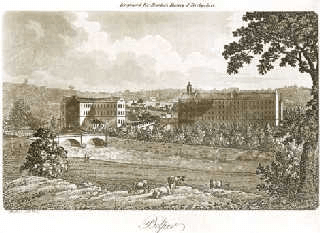
Strutt’s Belper mills in the nineteenth century

Jedediah was born in 1726, and was apprenticed as a wheelwright at the age of 14 in Findern, while his future wife Elizabeth, born in 1729, started her career as servant to a Dr Latham in Derby. It is notable that both were part of the Non-Conformist world, and both were fully literate; in fact their letters reveal a rich enjoyment of language. Their courtship, as shown by their correspondence, was lengthy and intermittent; this was no sudden infatuation but rather a stately and respectable dance.

In 1749 Betty moved to London and became servant to another well-respected Non-Conformist minister, Dr George Benson, a man who was so impressed by her qualities that he left her £40 in his will (worth over £5,000 today). Jed, (or Jerry as she called him) had meanwhile inherited some livestock from his uncle and set up as a farmer at Blackwell, northeast of Alfreton. On the strength of this they married in 1755, when he was 29 and she 26.

Their letters from 1757 reveal some details of their travels. They were trying to raise money to finance his ambitions in the hosiery business, and Jed had been to Derby:

I did not get home till fryday. I stayed at Derby on Wednesday night and came on Thursday to Heage before it began to snow so I stayd there all night …

The unseasonal weather also affected Betty, who had gone to London to visit her ex-employer:

I reechd London a bout 3 O Clock on Satturday, when we reechd Glen, 6 miles from Leicester I was so sick I was not able to travel further but staid behind ye waggon mor then an hour, & then walked 5 miles before I came up with it, we staid none at market harborough, but went forward to Germage Inn, where we lay, we never Dined, only just beat ye next day at Northampton and lay at Lathborough, ye next day we beat at Hockley and lay at redfearn 4 miles short of St Albans, it has been very windy bad weather & Rained and snow’d all Day on Thursday, and I caught a very Bad Cold …

(NB ‘beat’ = ‘ate’)

Both journeys illustrate the slowness and perils of travel at that time: it is notable that Betty was travelling by the cheapest method, the lumbering wagon, rather than the faster and more comfortable coach. The waggon took five days to make the trip. Despite her significant contribution to both the marriage and their business, and bearing five children, she seems to have been pretty much written out of Strutt history: no portrait of her survives. Elizabeth died in 1774 at the age of 45, Jedediah went on to re-marry, and lived to 1797.

Crossroads Crich

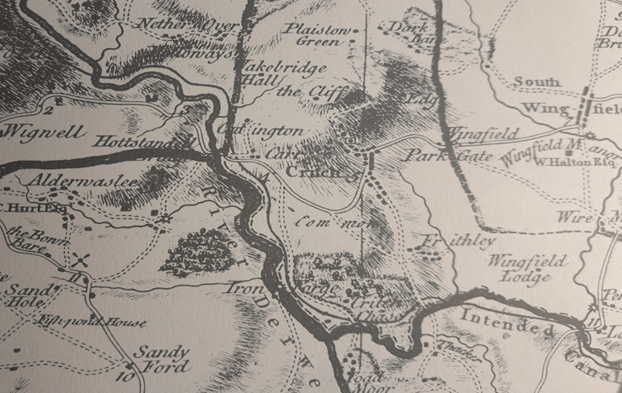
Burdett’s map (above), first published in 1767, is the earliest large-scale map of the roads around Crich, but even the  revised 1791 version fails to show the Cromford/Langley Mill turnpike of 1766. The Oakerthorpe/ Ashbourne road is marked by a double solid line with mileages, minor roads are shown by double broken lines, but footpaths are not marked. Crich grew up at the junction of two ancient routes: one running roughly east-west from Alfreton to Ashbourne and the other north-south, from Belper to Cromford and Matlock. The fords (and later bridges) at Whatstandwell, Bullbridge, South Wingfield and Cromford determined the road pattern; in the past rivers were wider, wilder and more of an obstacle than they are today. Given the steep climbs, for example at Bullbridge, most of the freight traffic until the mid-eighteenth century would have been by packhorse. Other distinct routes fanned out from the river crossings but avoided Crich, such as the track from Whatstandwell Bridge which still climbs up through Duke’s Quarries to Wakebridge, and then higher to Shuckstone Cross and possibly on to Ashover or Chesterfield.

Toll keeper’s cottage at Bullbridge

Little changed in this scenario until the arrival of turnpike roads in the second half of the eighteenth century. Turnpike trusts were allowed to charge road users (except travellers on foot) a toll, and in return had to improve and maintain the road surface to a suitable standard for wheeled traffic such as carts and coaches. The Cromford Bridge and Langley Mill turnpike, for example, was divided into six sections, with gates at Burgin Lane, Holloway, Hartsay and Peasehill Lane, plus chains at Codnor and Langley Mill. Although the tolls were widely resented, these upgraded routes encouraged the growth of industry, and travel generally in the period of the early Industrial Revolution.

Cast iron marker at Bullbridge on Cromford to Langley Mill turnpike

By the mid-nineteenth century the improved roads had transformed life in Crich. Carriers ran a regular service of carts or waggons to Derby, Nottingham and Wirksworth. Several coaching inns, notably the Bulls Head (opposite St Mary’s) and the White Swan offered daily coach services throughout the north: The Champion to Manchester at 10.30 a.m., The Peak Guide to Buxton at 4.30 p.m., another service to Nottingham at the same time and to Derby at 5 p.m. When the Midland railway opened, an ‘omnibus’ ran four times a day to Ambergate station. Despite the new possibilities, most men in Crich still worked in the quarries, as lead miners, as framework knitters or in agriculture. However, Pigot’s Directory for 1835 lists two wheelwrights in the town, Thomas Hunt and John Smith, while Ralph Taylor was a sadler, while others worked as inn keepers.

Crich Cross with Jovial Dutchman pub on left (now a private house)

Despite the centre of the town being called the Market Place, there is little evidence that a regular market was held there. However, Crich Fair was held twice a year, on the 6th of April (Lady Day) and 11th October (Old Michaelmas Day). It was originally for livestock, and was held on the Cromford Road above the Cross. By the early twentieth century it had become more of a fun fair with swings and roundabouts, but would still have generated local travel.