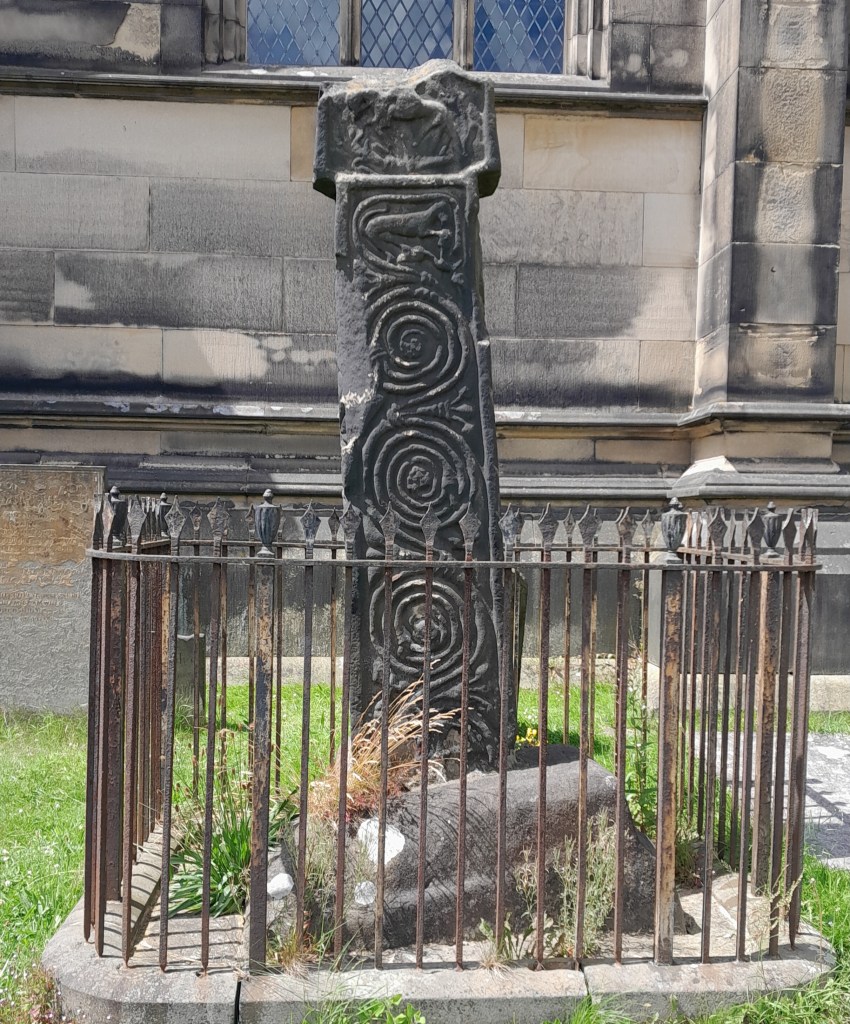
There are a surprising number of pre-Conquest stone crosses in Derbyshire, but Bakewell churchyard must be unique in having two. The larger one can be seen above, near the eastern end of the church, with carvings on all four sides, but with the cross head missing. The carvings are both worn and defaced, but on the eastern side scrolls of vines can be seen, while on the reverse are some scenes from the Christian tradition, such as the Annunciation. There is an interpretation panel in the church which claims that the cross has a Pagan side and a Christian side, so that the western face has the figure of Woden at the top.
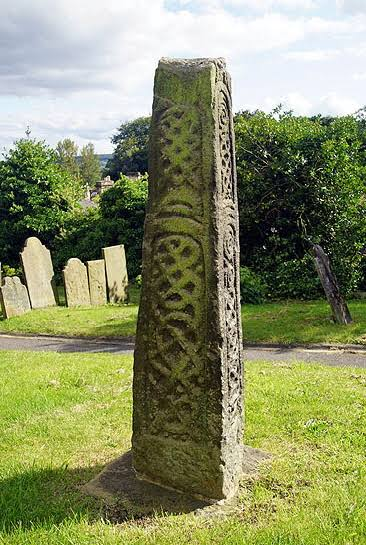
The second cross is near the south door, is a little shorter and has never had a cross head. According to the panels in the church this cross is Anglo-Scandinavian, while the larger one is Anglo-Saxon, but the carvings are really quite similar. The crosses are generally dated to between 800 and 1000 CE, but there was clearly a local tradition of carving which may have persisted for centuries, making dating difficult. In 2012 Archaeological Research Services (ARS) of Bakewell were funded to survey the sculpture of Bakewell churchyard, and their research can be studied in two reports. See:
archaeologicalresearchservices.com/projects/bakewellcross.htm
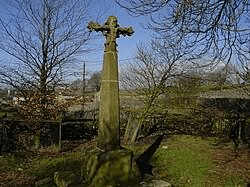
There is good evidence that both crosses were moved to Bakewell churchyard for protection, possibly in the nineteenth century, when an appreciation of antiquities developed. In the early medieval period travel on the Derbyshire moors would have been difficult and even dangerous, and the sight of a richly carved cross conveying the familiar Christian message would have comforted lonely travellers. Even today, rural roads in Catholic regions such as Bavaria have their wayside shrines, often decorated with flowers. But in England in the seventeenth century Puritan fanatics defaced what they saw as Popish images, both in churches and by the wayside. This explains why in-situ survivals like the Wheston cross are so rare. As part of their research ARS excavated a site near the old Hassop station, hoping to find evidence that the taller cross had been moved from there, but the findings were inconclusive. They did, however, establish that the cross had had a different location before arriving in the churchyard (see report). There is better evidence for the movements of the other cross. In the nineteenth century it was displayed in the garden of Holt House, Darley Dale, having apparently been found buried on the moor above Beeley, northwest of Screetham House Farm, on the line of the Chatsworth to Alfreton trackway. What we can never know is how many other crosses have been buried, broken up or used for construction over the last few centuries.