Riding through the glen …

The man who never was

When I was a young boy in Nottingham, in what now seems the Middle Ages but was actually the 1950s, we loved playing at Robin Hood. Inspired by the TV serial and song (Robin Hood, Robin Hood, Riding through the glen) we could make a primitive bow and arrows ourselves, and finding a green cap with a feather was not so difficult. Even today, when kids may have better things to do, the man remains a popular icon thoughout the North Midlands, not only in Nottinghamshire but in Yorkshire and Derbyshire too. How to account for the persistence of this medieval figure who is world-famous for such improbable behaviour as robbing the rich to give to the poor?

A man in tights

He is a man extraordinarily difficult to pin down, historically. But it appears that stories of his deeds were known by the fourteenth century, at first as an oral tradition and then appearing in written form. The stories vary over the centuries; all they have in common is an outlaw figure living in the forest, leading a group of men who rob passers-by. Some versions have him as a victim of corruption, a yeoman whose lands have been stolen, engaged in guerilla warfare with the sinister Sheriff. It seems likely he would focus on travellers on the Great North Road (Stamford, Newark, Bawtry), but forested routes as far west as the Erewash valley may have provided useful cover. Assuming Robin Hood was a composite character, composed of many outlaws in different times and places, it’s still worth trying to explain his remarkable survival and popularity throughout the region, including Derbyshire.

Quite a stride

Robin Hood’s Stride, between Youlgreave and Birchover (and right on the Portway) is one of the most famous sights in the region, but there are many other places in Derbyshire linked to the hero/villain. These include two Robin Hood’s Wells, an Inn, a Cross, a Chair, a Leap and two hamlets, one near Whatstandwell and one west of Chesterfield. There is also Little John’s Grave in Hathersage churchyard, while Robin is alleged to have married under the Doveridge Yew. The outlaw’s name brought prestige and glamour to the ordinary, while providing sardonic humour to others. One eighteenth century writer even had a repentant Robin becoming a hermit in Deepdale, near Dale Abbey, grafting him onto an older legend.

The hermitage at Dale Abbey

The legends remind us of the perils of travel in the Middle Ages, but also reflect an almost universal sympathy for the outlaw who has the courage to break free from the common lot. They portray a fantasy world, in which the sun is always shining in the greenwood, and only the rich are robbed.

Source:

https://www.derbyshirefolklore.org/robin-hood-in-derbyshire.html
The travels of the Bakewell Crosses

The western face

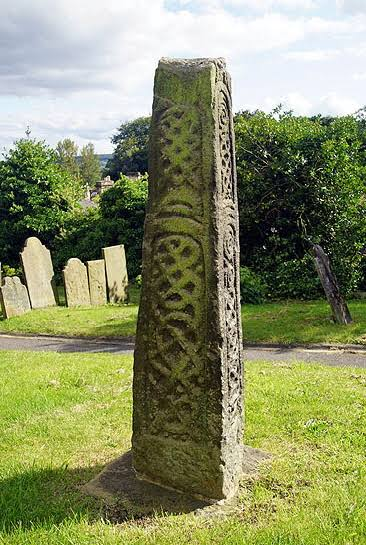
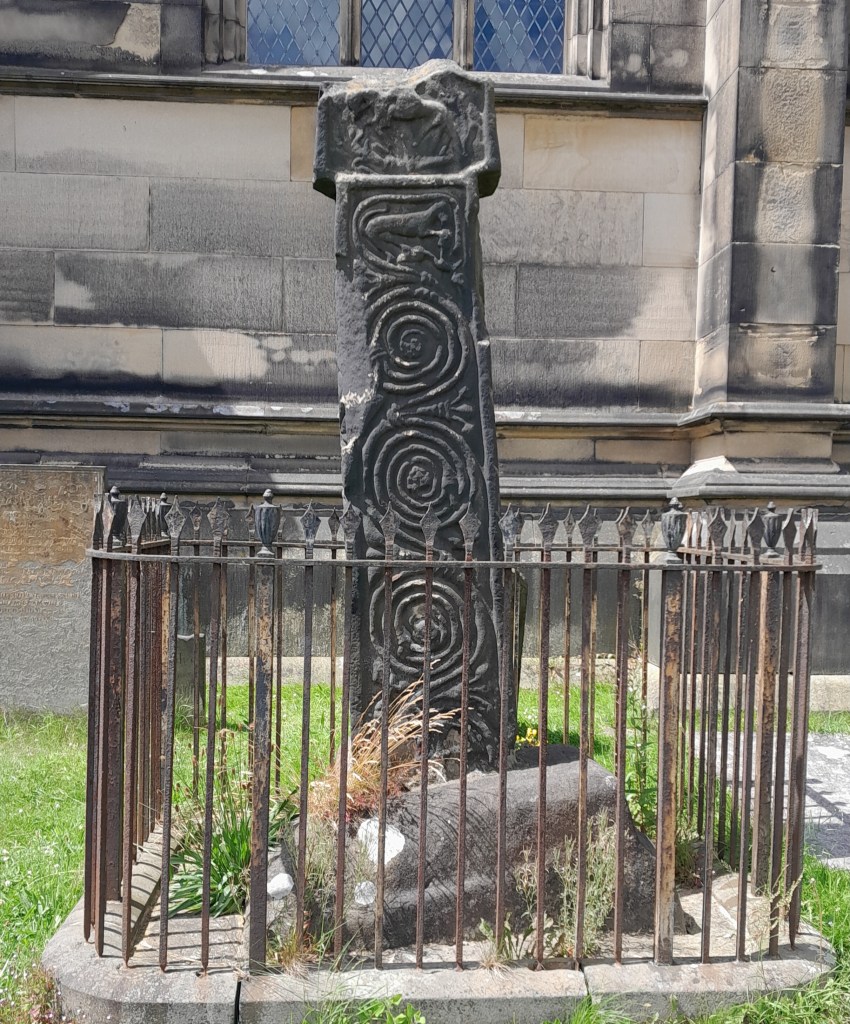
There are a surprising number of pre-Conquest stone crosses in Derbyshire, but Bakewell churchyard must be unique in having two. The larger one can be seen above, near the eastern end of the church, with carvings on all four sides, but with the cross head missing. The carvings are both worn and defaced, but on the eastern side scrolls of vines can be seen, while on the reverse are some scenes from the Christian tradition, such as the Annunciation. There is an interpretation panel in the church which claims that the cross has a Pagan side and a Christian side, so that the western face has the figure of Woden at the top.

The Anglo-Saxon cross

The second cross is near the south door, is a little shorter and has never had a cross head. According to the panels in the church this cross is Anglo-Scandinavian, while the larger one is Anglo-Saxon, but the carvings are really quite similar. The crosses are generally dated to between 800 and 1000 CE, but there was clearly a local tradition of carving which may have persisted for centuries, making dating difficult. In 2012 Archaeological Research Services (ARS) of Bakewell were funded to survey the sculpture of Bakewell churchyard, and their research can be studied in two reports. See:

archaeologicalresearchservices.com/projects/bakewellcross.htm

A survivor: Wheston cross near Tideswell

There is good evidence that both crosses were moved to Bakewell churchyard for protection, possibly in the nineteenth century, when an appreciation of antiquities developed. In the early medieval period travel on the Derbyshire moors would have been difficult and even dangerous, and the sight of a richly carved cross conveying the familiar Christian message would have comforted lonely travellers. Even today, rural roads in Catholic regions such as Bavaria have their wayside shrines, often decorated with flowers. But in England in the seventeenth century Puritan fanatics defaced what they saw as Popish images, both in churches and by the wayside. This explains why in-situ survivals like the Wheston cross are so rare. As part of their research ARS excavated a site near the old Hassop station, hoping to find evidence that the taller cross had been moved from there, but the findings were inconclusive. They did, however, establish that the cross had had a different location before arriving in the churchyard (see report). There is better evidence for the movements of the other cross. In the nineteenth century it was displayed in the garden of Holt House, Darley Dale, having apparently been found buried on the moor above Beeley, northwest of Screetham House Farm, on the line of the Chatsworth to Alfreton trackway. What we can never know is how many other crosses have been buried, broken up or used for construction over the last few centuries.