Inn with the inn-crowd

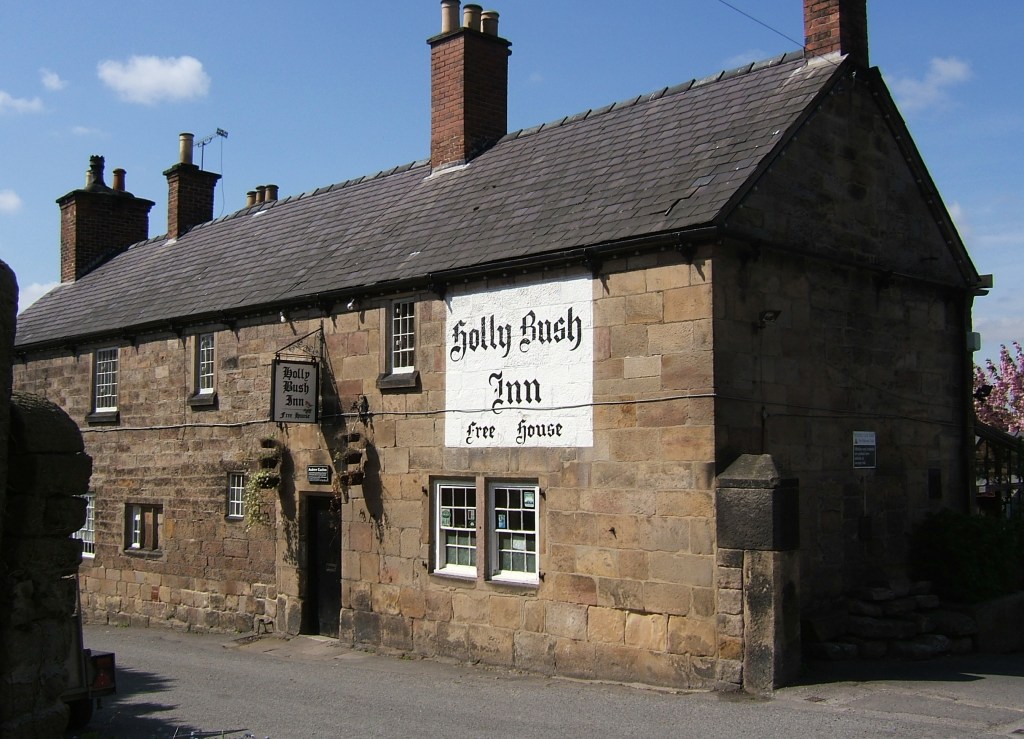
The Holly Bush Inn at Makeney

As turnpike roads made travel more comfortable in the eighteenth century, roadside inns had to provide more services for coach teams as well as refreshments for the passengers. Previously they would have catered for travellers on horseback, or jaggers with their packhorse trains, but by the mid-century they might need stabling for 80 horses, as well as feeding a dozen hungry passengers. Older inns such as The Holly Bush (above) had to expand, while others were developed at strategic locations, like the Peacock at Oakerthorpe, which is at the junction of two turnpike routes (its website claims it is 11th century, which seems unlikely). As the name suggests, this hostelry was once owned by the Duke of Rutland, as was the Peacock at Rowsley: this bird being the family crest.
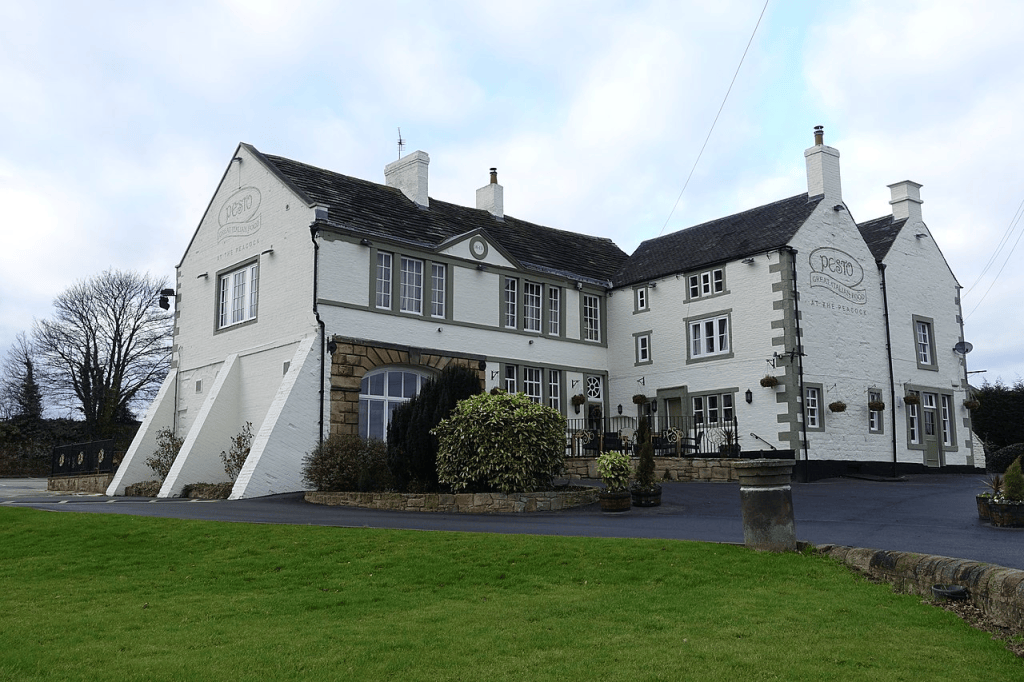
Hospitality at the crossroads: The old Peacock at Oakerthorpe

The heyday of the coaching inn was in the early nineteenth century, when mail coaches joined stage coaches on the roads, and most towns were on the coaching network. This was almost always run from an inn, where seats on board could be booked. These new or expanded inns must have been major employers: horses had to be changed every 10-15 miles, so ostlers and stable lads were needed in the yard to harness the teams, while indoors maids, cooks and waiters served the diners, who had to be fed quickly, before the coach set off again. Dickens provides a lively description of his ideal inn, The Marquis of Granby, in The Pickwick Papers. Oddly, although Dickens sets this perfect pub near Dorking, the Marquis of Granby is a title used by the Manners/Rutland family:

The Marquis of Granby in Mrs Weller’s time was quite a model of the roadside public house of the better class – just large enough to be convenient, and small enough to be snug. On the opposite side of the road was a large sign-board on a high post, representing the head and shoulders of a gentleman with an apoplectic counternance, in a red coat with deep blue facings, and a touch of the same blue over his three-cornered hat, for a sky. Over that were a pair of flags; beneath the last button of his coat were a couple of cannons; and the whole formed an expressive and undoubted likeness of the Marquis of Granby of glorious memory.
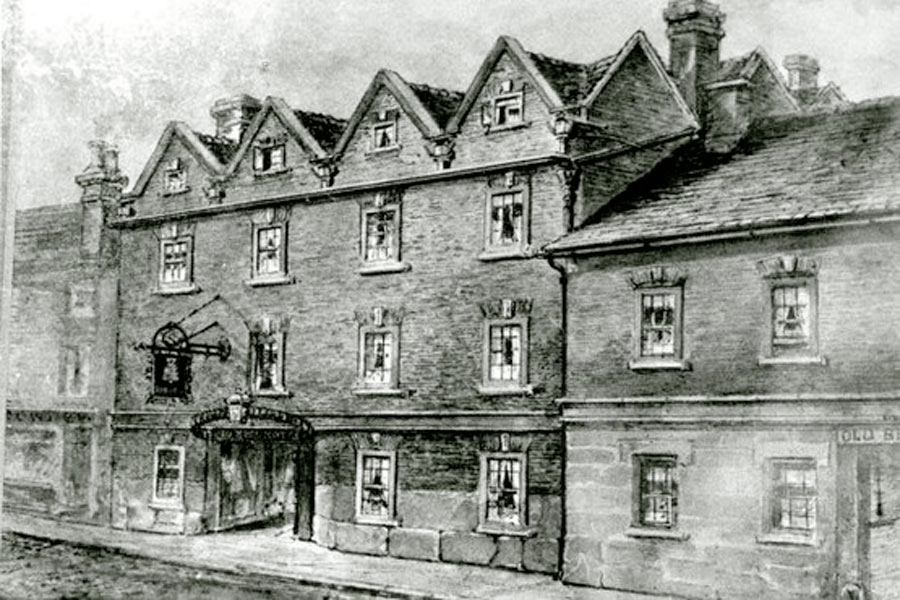
The Old Bell, Sadler Gate, Derby

The Old Bell (above) is a rare example of a coaching inn which has more or less survived, although its facade is now covered in fake half-timbering. Claiming a date of 1650, the drawing shows the elaborate iron sign hanging over the entrance, which led to the stable yard. Most coaching inns had a similar pattern, often with an arched entrance and balconies around the yard, where bedrooms were located. Burdett’s map of Derbyshire (1791 edition) shows all the parks and mansions of the gentry, but only four inns: The Brown Bear near Alderwasley, The New Inn near Quorn, the New Inns (sic) on the Ashbourne to Buxton turnpike, and the New Inn at Hardwick Hall (this last in Nottinghamshire, but still on the map!) Clearly a random collection, but suggestive of the growth of the inn business at that time, especially near the great houses, such as Kedleston. But by 1850 most roadside inns were in decline as the railways took their passengers, and we rely on the nostalgia of Dickens to imagine the lost glories of their golden era.
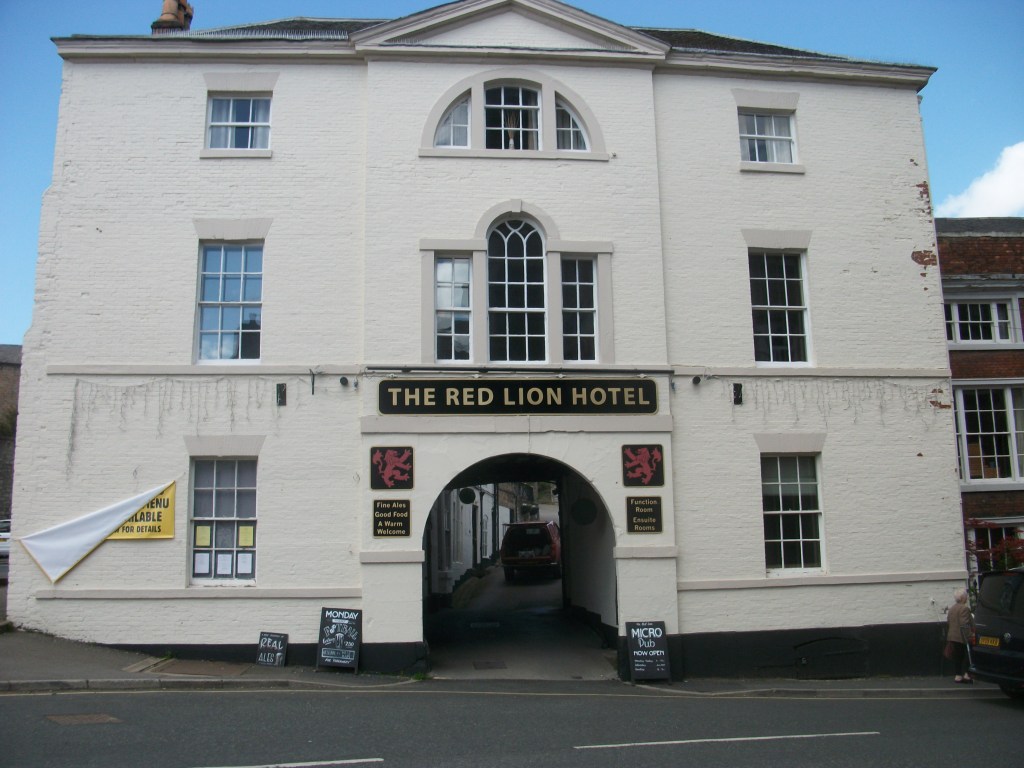
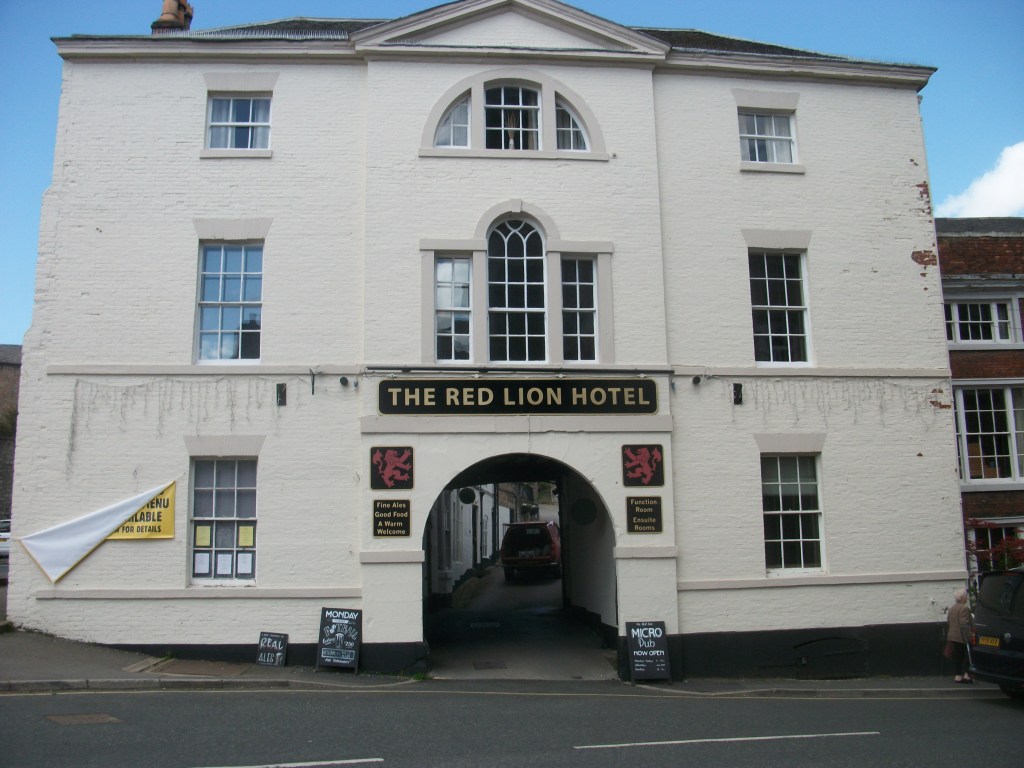
The Red Lion, Wirksworth

The lost fords of the Derwent – 2

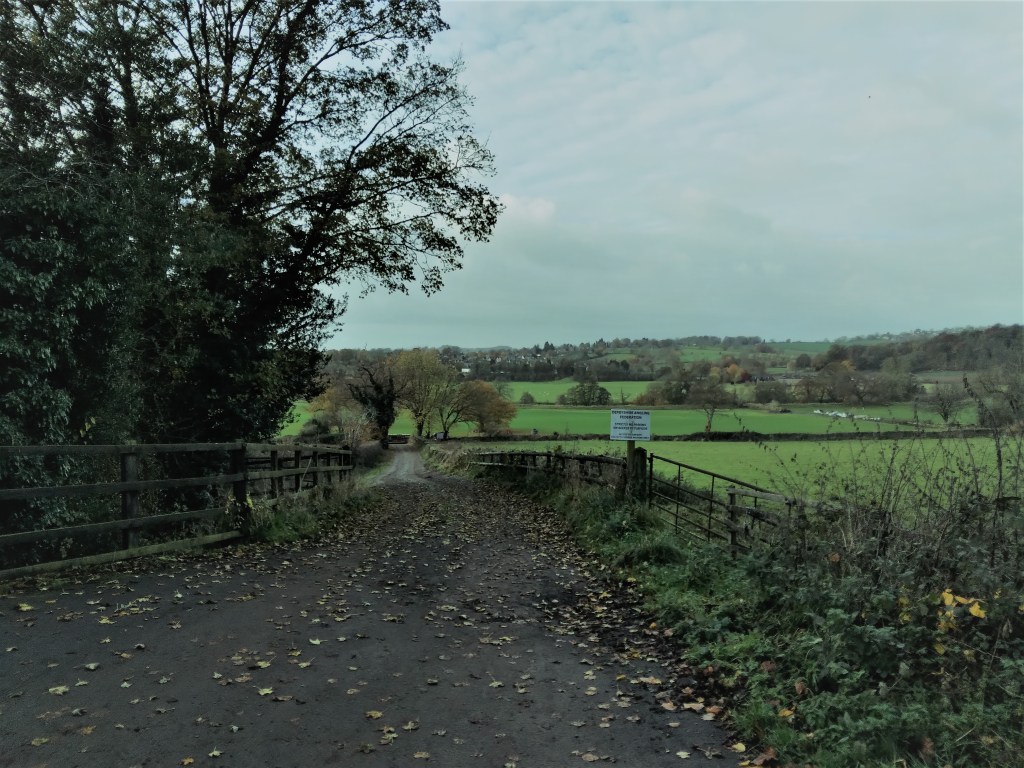
Savepenny Lane looking towards Duffield on the opposite bank

The road layout south of Belper has changed hugely in the past 230 years. Before the Strutts built Milford bridge in about 1790 there were no bridges between Belper bridge and Duffield bridge. Milford was only a hamlet, and its name was originally ‘Muleford’, but with the growth of industry a better all-weather crossing was needed, as well as the construction of the impressive weir. Downstream the Derwent was forded at a point near the current railway station, as shown on Burdett’s map of 1791, and then near the church Duffield bridge is thought to have been built as early as the thirteenth century. In the eighteenth century this crossing was part of the Derby-Chesterfield-Sheffield turnpike route, and so would have been quite busy.

Burdett’s map showing river crossings near Duffield

The Duffield ford must have been more convenient for villagers, especially those going to Makeney or Belper, as well as for drovers moving cattle. In the eighteeenth century and earlier Makeney was a more important settlement than Milford, and it lay on the route of the Portway, which is thought to have crossed the Derwent nearby. The Holly Bush Inn claims to be one of the oldest in the county, and may have served long-distance travellers as well as locals. It may be significant that a holly bush is one of the earliest inn signs, as in the saying ‘A good wine needs no bush’.

The Holly Bush at Makeney

The route from Makeney to Duffield via the ford was once known as Savepenny Lane, since it allowed users to avoid paying the toll which the Strutts charged on their new bridge. However, this route was blocked by the Strutts; deepening the river at that point and blocking the lane on the west bank. The curious result is that today the lane still exists on the east bank, and in fact has recently been confirmed as a BOAT (byway open to all traffic), although it is a cul de sac. An ideal stroll, perhaps, before moving on to a lunchtime pint at the Holly Bush?

Inn or ale-house?

The Red Lion at Wirksworth

How long have inns offered roadside refreshment to travellers? Not an easy question to answer, since many claim to be the ‘Oldest Pub in England’ or something similar. Nottingham has at least two claimants, The Trip to Jerusalem and The Bell, while in Derbyshire the Holly Bush at Makeney has clearly served a few pints over the centuries. The pilgrims in ‘The Canterbury Tales’, written in the late fourteenth century, stayed at the Tabard Inn in Southwark, so clearly inns were part of medieval travel.

However, the early eighteenth century saw a significant growth in travel, due to road improvement by the turnpike trusts and the invention of coaches with steel springs, cutting journey times and making travelling a little more comfortable. To cater for the expansion of stagecoach routes coaching inns were built or developed, often with the characteristic arched entrance to allow the coach and horses to enter the interior yard, where stabling was provided. To maintain good timing, horses had to be changed regularly, and grooms and ostlers were needed for their care.

The Holly Bush at Makeney

There was an important distinction between inns and ale houses. The former offered accommodation as well as food and drink, while the latter were more down market and, as the name suggests, dealt mainly in (possibly home-brewed) beer. But even in the inns there were class distinctions: gentry in their private carriages or on horseback were more welcome than the occupants of stage coaches, while those on foot were often turned away. The owners of inns were frequently caricatured as greedy and grasping, in particular landladies, while the chambermaids were often portrayed as warm-hearted and generous.

This is the situation shown in Fielding’s humorous novel ‘Joseph Andrews’ (1742), which vividly portrays life on the road. Joseph, the hero, is robbed at the roadside, but is rescued by a passing coach and taken to the nearest inn, the Dragon. The company are sitting in the kitchen by the fire:

The discourse ran altogether on the robbery, which was committed the night before, and on the poor wretch, who lay above, in the dreadful condition, in which we have already seen him. Mrs Tow-Wouse said, ‘she wondered what the devil Tom Whipwell meant by bringing such guests to her house, when there were so many ale-houses on the road proper for their reception? But she assured him, if he died, the parish should be at the expense of the funeral.’