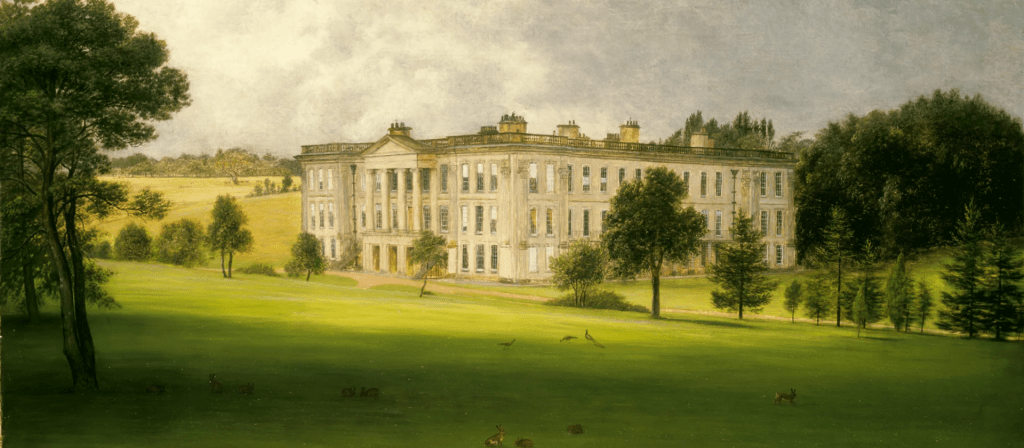
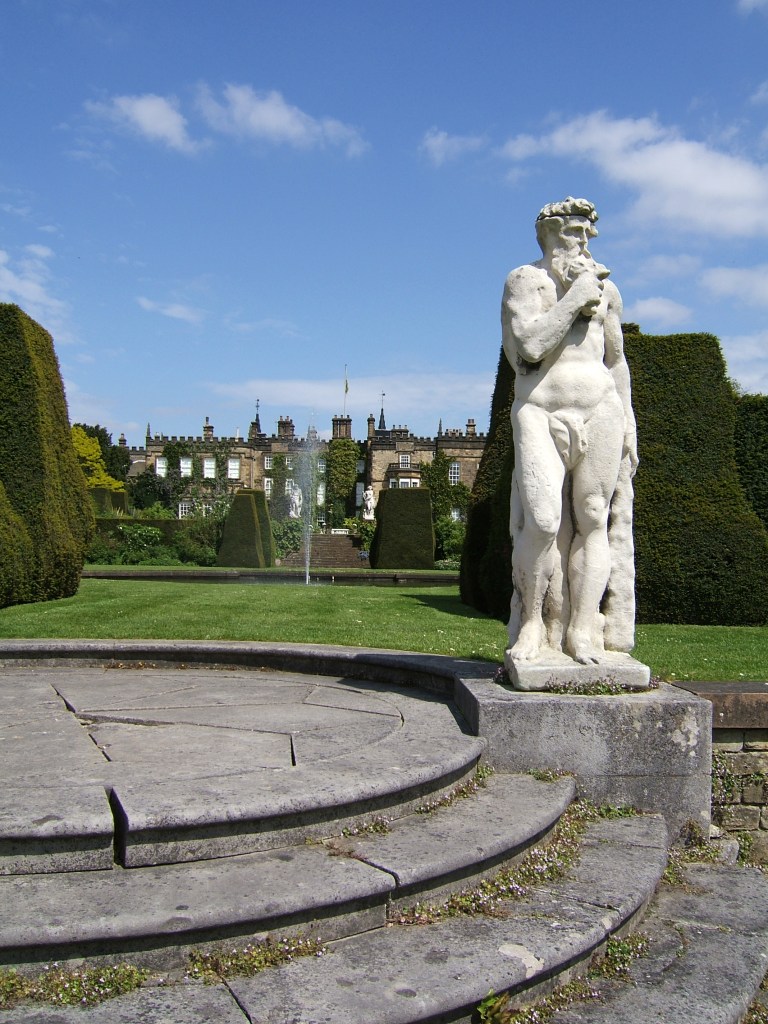
The reality of travel for the wealthy in the 1660s is illustrated by Sir George Sitwell’s description of his ancestor’s annual visits to London from Renishaw Hall, at Eckington near Sheffield. This was usually at the end of April, when the roads were again passable:
‘His plans were laid a month or six weeks in advance, and a week or ten days before starting a box or trunk of clothes was sent on by carrier. He left Renishaw at seven o’clock in the morning, attired in a riding suit, top boots, a horseman’s cloak and a ‘mounteroe’ or Spanish travelling cap, of velvet. Pistols were borne in the holsters, for Sherwood was a noted haunt of highwaymen’.
He was accompanied by a footman, dressed in livery, carrying more clothes. It was a four day journey; the first night spent at Nottingham, the second at Harborough, and the third at Dunstable, with an average stage of about thirty miles.
‘In London, Mr Sitwell frequented the Greyhound Inn in Holborn …. and there he paid about eight shillings and fourpence a week for chamber rent and washing, and eighteen shillings and eightpence for hay and corn for his horses. Food and minor expenses came to about £1 6s. 8d. a week.
His stay in London usually lasted about a fortnight, and allowed him to meet family and friends as well as attending to business at his lawyer’s. He was also able to keep in touch with the political world via his cousin, Roger Allestry, an MP. But the fact that this trip required spending eight days on the road well illustrates the reality of seventeenth century life.
Sir George Sitwell, ‘Country Life in the Seventeenth Century’, in ‘Memorials of old Derbyshire’, 1907, Ed. C. Cox
William Hogarth: Strolling actresses dressing in a barn
Many people imagine that in the past travelling was uncommon, since most folk stayed put all their lives, with the occasional visit to the nearest market town. But in fact, despite the difficulties, substantial numbers were on the move, mainly from necessity. With a much smaller population, widely scattered across the country, few towns were large enough to support a range of services. Justice, for example, might be dispensed by the local magistrate , but for more serious offences the quarter sessions were held every three months, with the assize judges travelling from town to town.
Similarly, outside London few places were large enough to have their own theatres. So at least from Tudor times, and probably earlier, ‘strolling players’ would be on the road, probably with a couple of carts for their props, bringing their dramatic repertoire to an audience quite deprived of entertainment.
The more respectable troupes would be invited to perform at the houses of the gentry, but the majority could have rigged up a temporary stage at an inn yard or even the churchyard. Hogarth’s engraving, above, satirically suggests the low social standing of the players, forced to prepare their performance in a barn, where they would presumably be spending the night. At least the children seem to be enjoying the atmosphere!
As with many kinds of itinerant workers who have left no written records, it is hard to know what kinds of plays they performed. Apparently well-known stories such as Robin Hood were popular. Some of the performers could have been acrobats or jugglers, foreshadowing the travelling circus, which first appeared in England in the 1760s.
However, the authorities were always nervous of the theatre, fearing it would inflame popular rebellion, and although London theatres were often closed (firstly by the Puritans in 1642), strolling players were more difficult to control. But an Act of Parliament of 1737 (just visible on the bed in the foreground) sought to suppress them, and the performers in the engraving may be making their last bow.
Hermits are generally imagined to be solitary recluses, who adopted an isolated life to focus on spiritual matters. Yet little is known about the lives of individual hermits, which are first mentioned in Britain about 700 CE. Most surviving ‘hermitages’ are natural or man-made caves, and a remarkable feature of our region is the four hermitages on the route of the Portway; two in Nottingham and two in Derbyshire. This distribution suggests that the hermits who lived there helped travellers on the road, either with practical information or possibly with their religious issues. Hermitages were sometimes linked to a monastery or abbey, and in our case one was connected with Lenton Abbey west of Nottingham, while Dale Hermitage was a forerunner to Dale Abbey, built close by.
Nineteenth-century painting of ‘druidical remains’, Nottinghamby W. Bradbury
Sneinton Hermitage, a mile east of the centre of Nottingham, is cut into the sandstone rock on which much of the town was built. It is now protected by steel railings, and was apparently larger before the site was developed by railway construction. Travellers disembarking from boats on the River Trent would have approached the town this way.
The second hermitage, illustrated in the painting but wrongly described as ‘druidical remains’, is now on private ground behind a modern block of flats on Castle Boulevard. Hermitage Walk, a street in the Park above, used to give access to the caves, which, judging by the painting, were given a parkland setting at some point. The most unusual feature of this group of caves is a rock-cut chapel known as St Mary de la Roche, which may have been the work of friars and could have been a pilgrimage centre before the site was acquired by the monks of Lenton Abbey in the thirteenth century.
Dale Hermitage
The third hermitage, and the most accessible, is in an idyllic woodland setting near Dale in southeast Derbyshire. At this point the Portway descends a steep slope, and a hermit could have given travellers practical guidance. The photo shows a series of holes cut in the rock face above the door, which presumably allowed a wooden extension to be built in front of the cliff face. According to legend, a Derby baker was told in a dream to come and live in Depedale, and he was the predecessor to the monks who established the Abbey, now almost entirely demolished, in about 1200 CE.
Cratcliffe crucifix
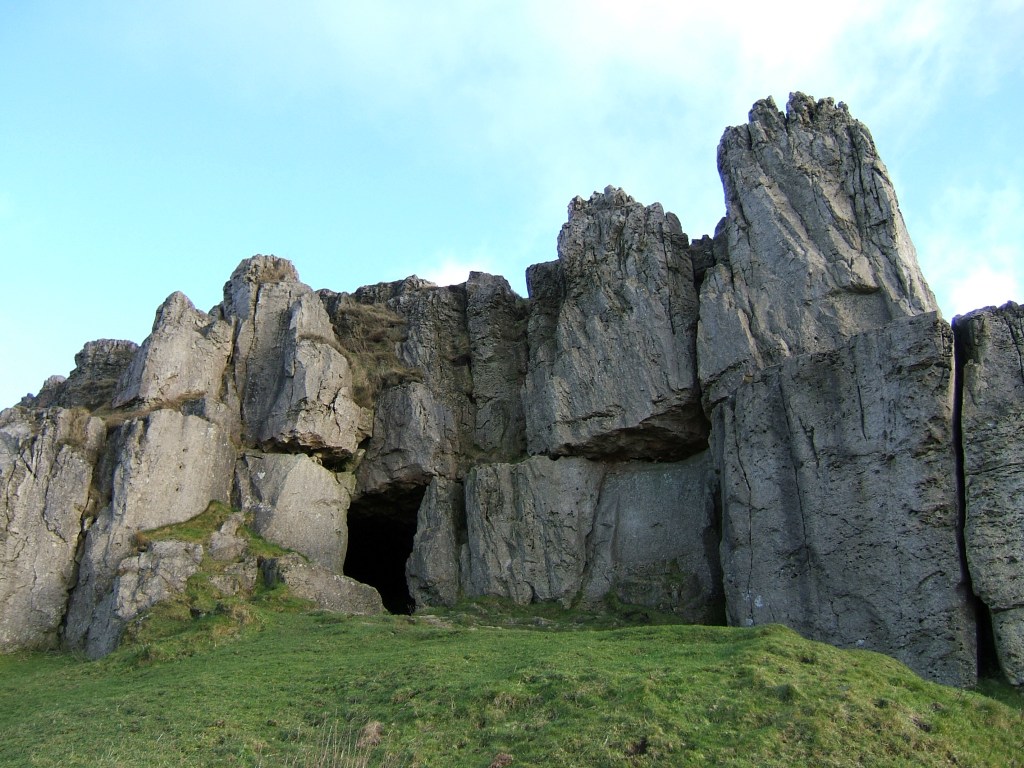
Cratcliffe Hermitage can be found by forking off the main path up to Robin Hood’s Stride on Harthill Moor. It’s a bit of a scramble to reach it, but the position is spectacular, looking back over the Portway towards Winster. The rock opening is flanked by two old yew trees, presumably planted in the nineteenth century, and railings protect the remarkable carved crucifix on the wall inside. Unusually, there is a record in the accounts of Haddon Hall (only two miles away) of the hermit selling rabbits to their kitchen in 1550, so apparently he had survived the Dissolution of a few years earlier.
Taken together, these four sites provide a possibly unique insight into the reality of medieval travel. Among the various types of wayfarers would have been pilgrims, heading for shrines in Dale or Lenton Abbeys, who may have supported the hermits in return for their prayers for a successful journey. Other travellers would have been glad of information about the next stage of the journey, and possibly suggestions about where to find food and shelter for the night.