

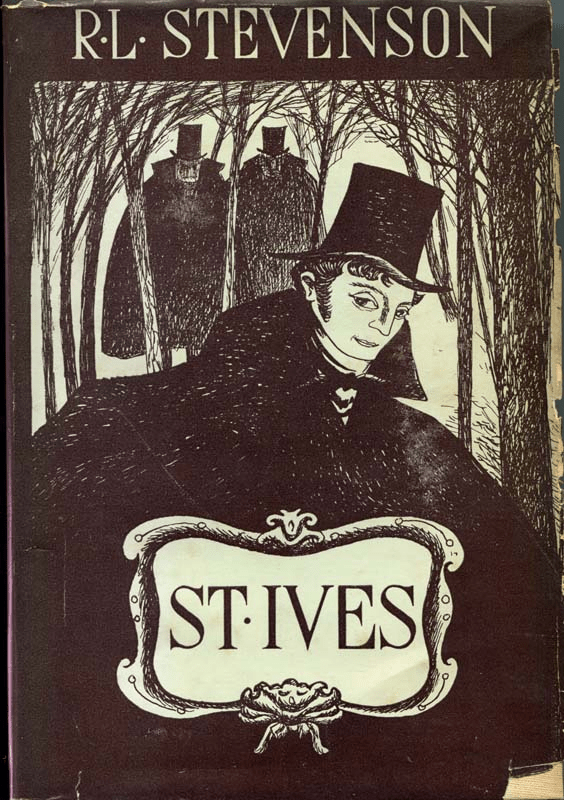
The last, unfinished novel by Robert Louis Stevenson, St Ives, is the exciting story of an escaped French prisoner of war in the Napoleonic period. After breaking out of prison in Edinburgh he heads south to England, first in company with a couple of drovers and then, over the border, on the Great North Road. On the way he gives us a rare picture of travel in the early nineteenth century:
The main roads of England are incomparable for excellence, of a beautiful smoothness, very ingeniously laid down, and so well kept that in most weathers you could take your dinner … off them. On them, to the note of the bugle, the mail did its sixty miles a day; innumerable chaises whisked after the bobbing postboys …
The drovers who help the hero flee Scotland are portrayed as taciturn, rough and hardy characters, but totally honest and self-reliant. They follow their droving trails through the hills, well away from the main roads, which is the ideal route for an escaped prisoner. Once in England St Ives stays at roadside inns, where visitors were expected to join the general conversation around the dining table, on subjects like:
… the country, the state of the roads, the business interest of those who sat down with me, and the course of public events …
and:
I came to the model of a good old-fashioned English inn, and was attended on by the picture of a pretty chambermaid. We had a good many pretty passages as she waited table or warmed my bed for me with a devil of a brass warming pan … and as she was no less pert than she was pretty, she may be said to have given rather better than she took.
In this, and most of his other stories such as Treasure Island or Kidnapped, Stevenson is using a classic model – the traveler’s tale, which was already three hundred years old. Beginning in Spain with novels such as Cervantes’ Don Quixote, a little later Bunyan’s Pilgrim’s Progress, then in the eighteenth century many novels in Britain and France like Candide or Tom Jones, this was an incredibly popular genre. Sometimes called ‘picaresque’, from the Spanish word ‘picaro’, a disreputable, wandering character, these novels all consist of a series of adventures linked together by a journey, adventures in which the hero meets a variety of people.

Given the scarcity of other material, these stories are one of the best sources for historians of travel. Not only do they give an insight into the mechanics of travel in the past, as for example in The Pickwick Papers, where we can ride past a turnpike gate, but they also illustrate contemporary attitudes towards, for instance, inn keepers or chambermaids, as in the example above, in which Stevenson may be lightly satirising such conventions. Today it has become fashionable to talk about ‘my journey’ as a pretentious synonym for ‘my life’, but clearly this conflation is far from being a novelty!

