

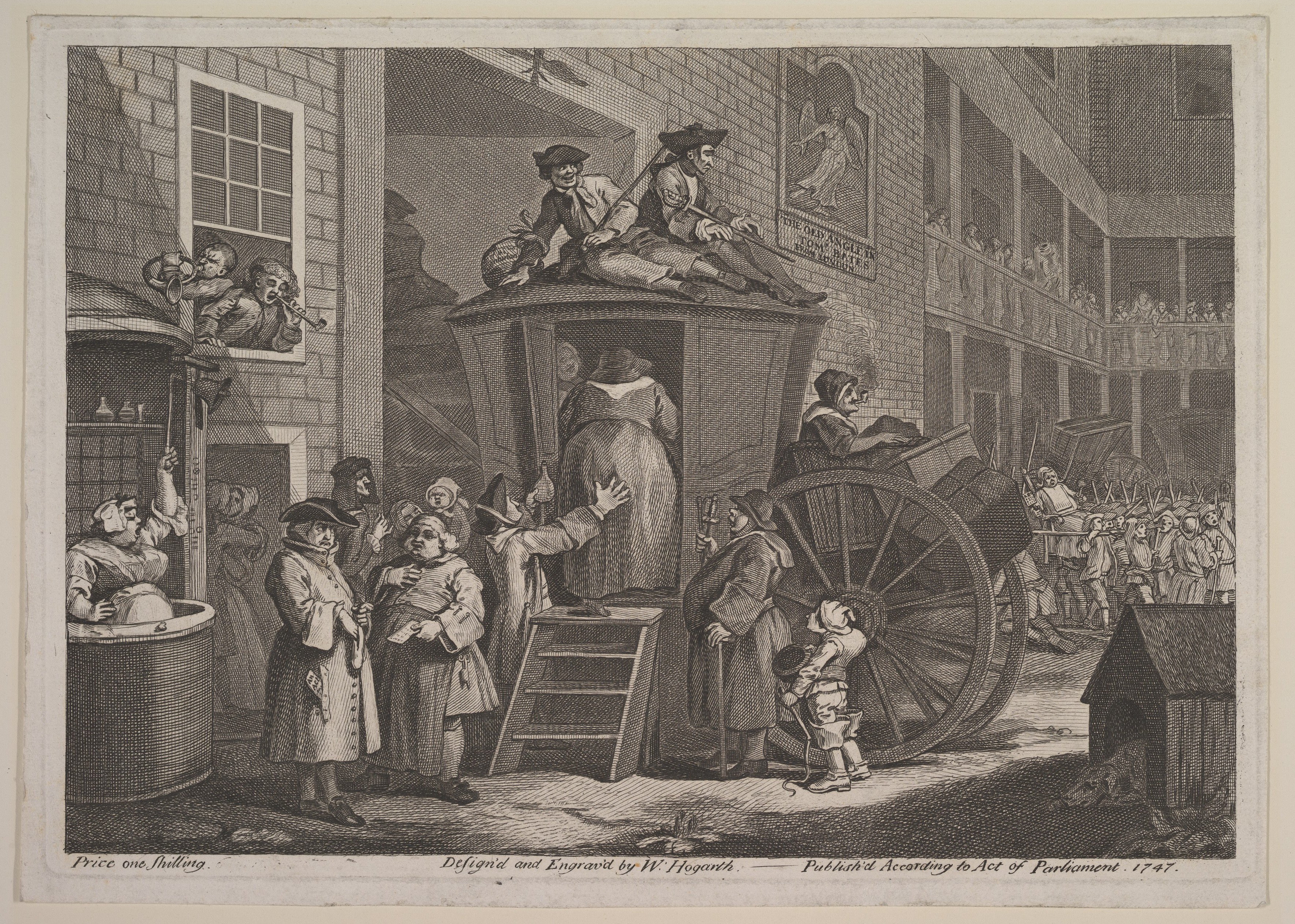
The romantic image of the stagecoach, as seen on hundreds of Christmas cards, portrays the coach’s arrival at a snowy inn, horns being blown to warn the landlord to make ready for the hungry passengers. But the real experience must have been less glamorous: unheated and crowded. Travel by stagecoach became quicker and somewhat more comfortable during the later eighteenth century, thanks to better turnpike roads and steel springs. However, it was always expensive and never popular, many men and some women preferring to ride their own (or hired) horses. Hogarth’s print satirises the discomforts of being squeezed into a small compartment for a long day’s journey, while those travelling ‘outside’ (at cheaper rates) were always in danger of falling off. But by the early nineteenth century the trip from Derby to London could be done in one long day, saving the expense of hotels enroute.

Stagecoaches were so-called as they had to travel in stages, changing horses every 10-12 miles. Pulling such a heavy load (at least half a dozen passengers, the coachman and the coach) horses needed to be rested after that distance. Consequently coaching inns were built in most towns served by stagecoach routes, but also at strategic points along the roads. They can often be identified by an arch to allow the coach to enter the yard behind, as at the Red Lion in Wirksworth. The Peacock at Oakerthorpe (now called Pestos at the Peacock) was sited at the junction of two important turnpikes: Nottingham – Newhaven and Derby – Chesterfield. The name ‘Peacock’ suggests a connection with the Duke of Rutland, whose family symbol this is. Another coaching inn financed by a great Derbyshire landowner was the Newhaven Hotel, built by the Duke of Devonshire at the junction of the Nottingham turnpike with the Derby – Buxton route.

The growth of travel by stagecoach led to the development of a huge ‘horse economy’, requiring not only coachmen but ostlers, farriers, chambermaids, cooks and other indoor staff. The larger inns would have stabled at least 100 horses. This all went into decline after 1840, as the railways spread over the country and provided much cheaper and more comfortable travel, although in the more remote parts of Derbyshire stage coaches continued in use to the 1880s.


 The Old Roads of Derbyshire