Lord Byng pays a visit

The only known portrait

John Byng (1743-1813) was born into a family of soldiers and sailors, the younger son of the 3rd Viscount Torrington. He bought his commission in the Grenadier Guards when he left Westminster School, and retired as Colonel of the Regiment in 1780. Having no landed estate to look after, he decided to spend his early retirement travelling, and between 1780 and 1791 he rode thousands of miles around England, keeping an extensive record of his travels in a series of diaries. He had married, at the age of 24, Bridget Forrest, the daughter of an admiral, who went on to have 14 children with him, all but one of whom (unusually) survived infancy. Presumably Bridget was accustomed to having a semi-absent husband from his military years?

Willersley Castle, Cromford

There is clearly a sarcastic element of class consciousness in Byng’s comments on Richard Arkwright’s Willersley Castle when he visited Derbyshire in 1779:

‘Went to where Sr R.A. is building for himself a grand house in the same castellated stile (sic) as one sees at Clapham, and really he has made a happy choice of ground, for by sticking it up on an unsafe bank, he contrives to overlook, not see, the beauties of the river, and the surrounding scenery. It is the house of an overseer surveying the works, not of a gentleman …’.

Byng’s tone must be connected with his position as the younger son: he had inherited no castles, and in the aristocratic world of this period anyone who had actually worked for their fortune was worth a sneer.

Cromford Mills as were. Note the distant tower on Crich Stand, the predecessor of the war memorial

Needless to say, John Byng was equally unimpressed by the nearby mill: ‘Every rural sound is sunk in the clamour of cotton works, and the simple peasant is changed into the impudent artisan’. The fact that the ‘simple peasant’ had chosen to work in the mill, as a welcome alternative to lead mining or worse, may not have crossed his mind. But Byng’s reaction was typical of the many tourists who were beginning to scour the Peak District for the romance of wild scenery and Gothic views. His diaries, however, do give the flavour of travel 250 years ago: his servant often rode ahead to reserve rooms at an inn, and would carry a set of sheets so that his master didn’t have to sleep on the damp or dirty bedding often provided by the house!

Watery ways

The Derwent Valleybackbone of the county

When the rains come the streams fill, and we become suddenly aware of the network of waterways that surround us. Normally just half visible, these then threaten to flood the roads and menace our houses. The most fundamental feature of the landscape, brooks and rivers have been flowing in their current courses for over ten thousand years since the last ice age, and have had a dominant influence on our history, as water sources, barriers and boundaries, and also as liquid energy.

The meanings of river names are remarkably impenetrable: unlike most village names many seem to be pre-Saxon, and some even hint at a pre-Celtic language. Kenneth Cameron[i] had a hard time explaining Amber, Dove, Wye, Noe, Lathkill, Derwent and Ecclesbourne (this one of the few ‘bournes’ in the county). Of course there are several River Derwents in England, and it appears to mean something like ‘oak river’. But when does a brook become upgraded to river? And when does the tiny sic (pronounced ‘sitch’) gain the status of a brook?

Due to their permanence, rivers have historically been used as convenient boundary markers, as with the Dove as the Staffordshire border or the Erewash marking part of the Nottinghamshire boundary. Within the county, streams may also mark parish or hundred (wapentake) limits. In lowland counties rivers were often navigable, yet in Derbyshire most were barriers rather than aids to travel. In wet winters larger rivers were often impassable, except where rare and expensive bridges had been built, such as at Cromford or Whatstandwell. Early routes avoided river crossings where possible and kept to ridgeways, above the thickest woods on the river banks.  Seasonal flooding was so bad in the lower Dove valley when Daniel Defoe visited in the 1720’s that he abandoned trying to reach Ashbourne from Derby.

The River Amber floods South Wingfield church – again

It is believed that in pagan times water spirits (or gods or whatever) were worshipped; water being seen as the source of life. There is substantial archaeological evidence of votive offerings (such as money or jewellery) being found at sites of wells or springs. So this may explain a Derbyshire mystery: why were some medieval churches built so close to frequently flooding rivers? All Saints at South Wingfield is regularly swamped by the Amber, and is well away from the main village, and the same goes for Duffield’s St. Alkmund’s, built right on the banks of the Derwent, as is, further upstream, St. Helen’s at Darley Churchtown. Were these built on ancient sacred sites, or were these locations convenient for baptisms – or both?

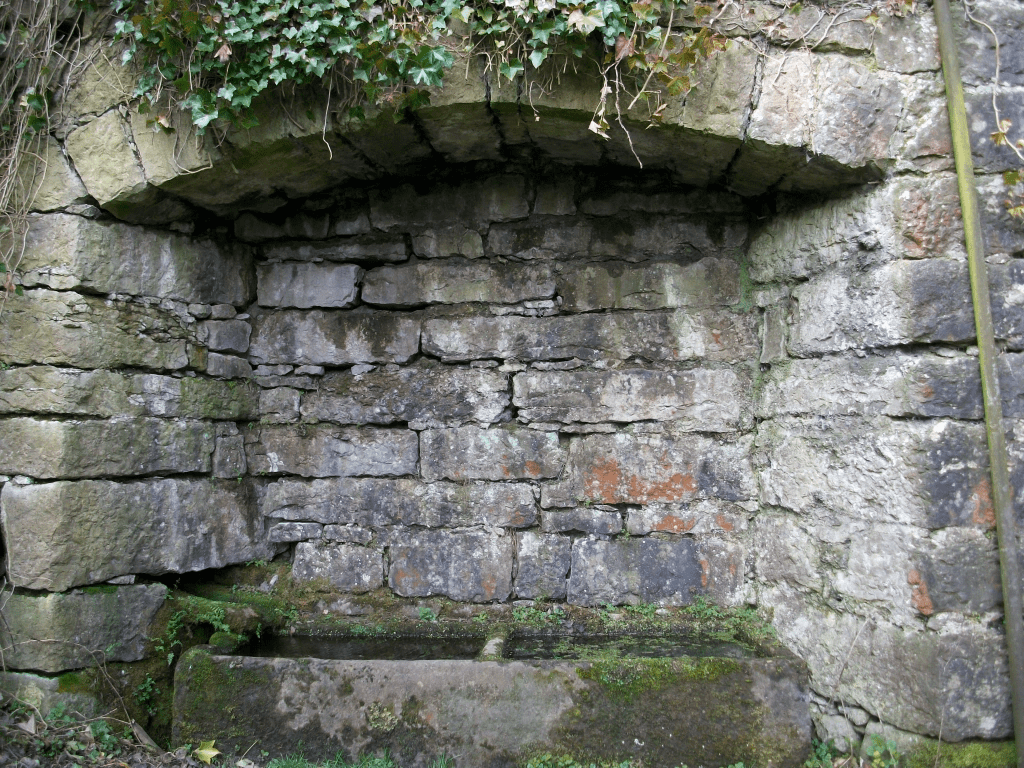
Well and spring below St John the Baptist’s church at Matlock Bath

Watermills were common before the Normans arrived, but it is noticeable that many in Derbyshire were located on minor rivers rather than on the Derwent. Presumably the large rise and fall of the Derwent made it more difficult to harness the river’s power. Some of the sites, for example on the Lea Brook at Smedley’s in Lea, seem today to have too little flow to power a mill wheel, but most had millponds to provide reserves of water during dry spells. When Arkwright built his first mill at Cromford he used the water from the Bonsall Brook rather than the nearby river. Later mills (e.g. at Milford and Darley Abbey) which did use the river required massive engineering works to create their weirs and leats.


[i] Cameron, K. (1959) The Place Names of Derbyshire Vol. 1

Farey’s footsteps

John Farey Esq.

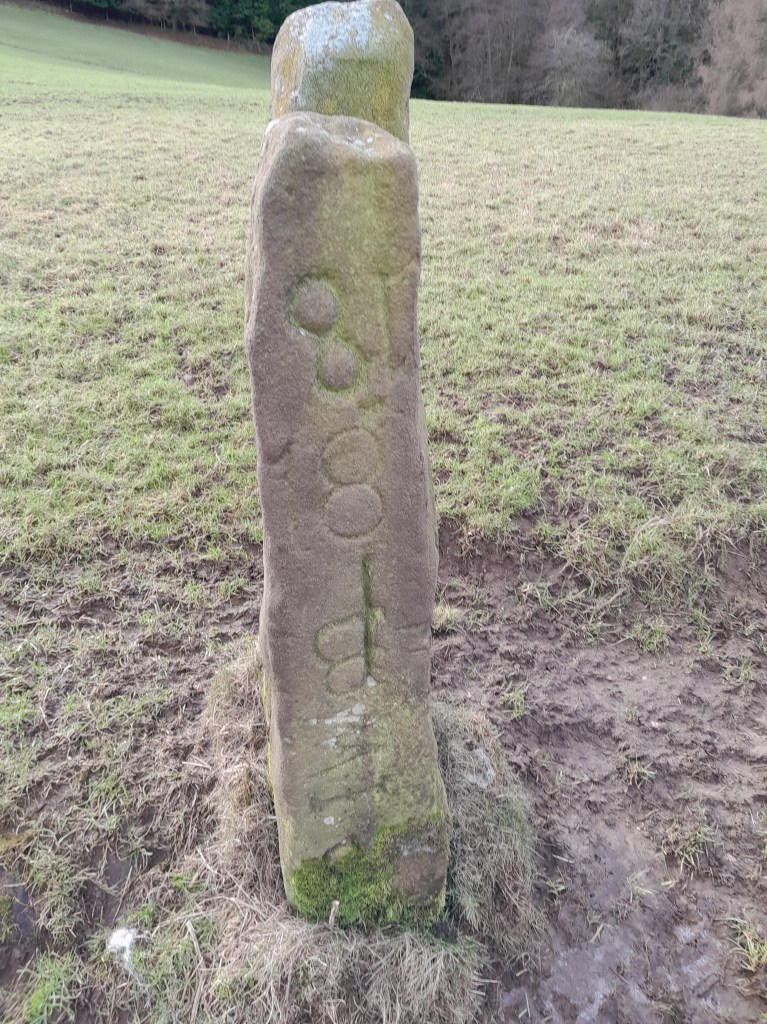
John Farey (1766-1826) was a geologist and mathematician who wrote an extensive report on agriculture in Derbyshire, early in the nineteenth century. To research the subject he clearly had to travel widely, and this experience led him to produce a shorter report on the roads of Derbyshire in 1807. Finding his way around was clearly a concern, as he writes scathingly about the state of the milestones (‘too much neglected’) on account of the lack of maintenance: instead they are ‘shamefully defaced’ by ‘idle and disorderly persons’. Similarly the ‘way-posts or finger boards’ (i.e. signposts) ‘are entirely defaced’ with ‘scarcely a single inscription legible’. Despite this anti-social behaviour, Farey also notes the use of Latin on some ‘wayboards’, notably Via Gellia in Bonsall Dale and ‘Equus Via Longford’ near Shirley.

The Rutland Arms, Bakewell

He does, however, approve of the ‘many excellent Inns’ on the county’s turnpikes, and mentions the Rutland Arms at Bakewell, the Eagle and Child at Buxton, the King’s Arms at Derby and the New Inn at Kedleston, among others. As a geologist he notices that Peak Limestone is hard and so good for road building, but that Magnesian Limestone is easily crushed into a ‘gritty mire’. This was probably the first time that a such scientific approach to road construction had been made.

Farey also approvingly describes a feature of roads in the horse era that few historians have noted. He sees that ‘throughout the County’ cottagers’ children, women and old men are seen ‘perambulating certain lengths of the public Roads’, which they patrol regularly ‘carefully picking up every piece of horse-dung that falls’, and then carry their collections in baskets on their heads for sale to local farmers. Apparently shepherds on the few remaining commons did the same. Farey does not provide details of the going rate for a basket of horse dung, but the practice is an indicator of the depths of poverty in the pre-industrial world. He goes on to complain of the practice of turning cattle and horses out into the lanes to feed on the verges, saying that his horse had been upset by these semi-feral creatures. However, despite his criticisms, Farey rates this county’s roads positively: ‘… after paying a good deal of attention to this subject in most parts of England, I think few of the counties excel Derbyshire as to its roads …’ .

A cold coming

Happy Christmas everybody

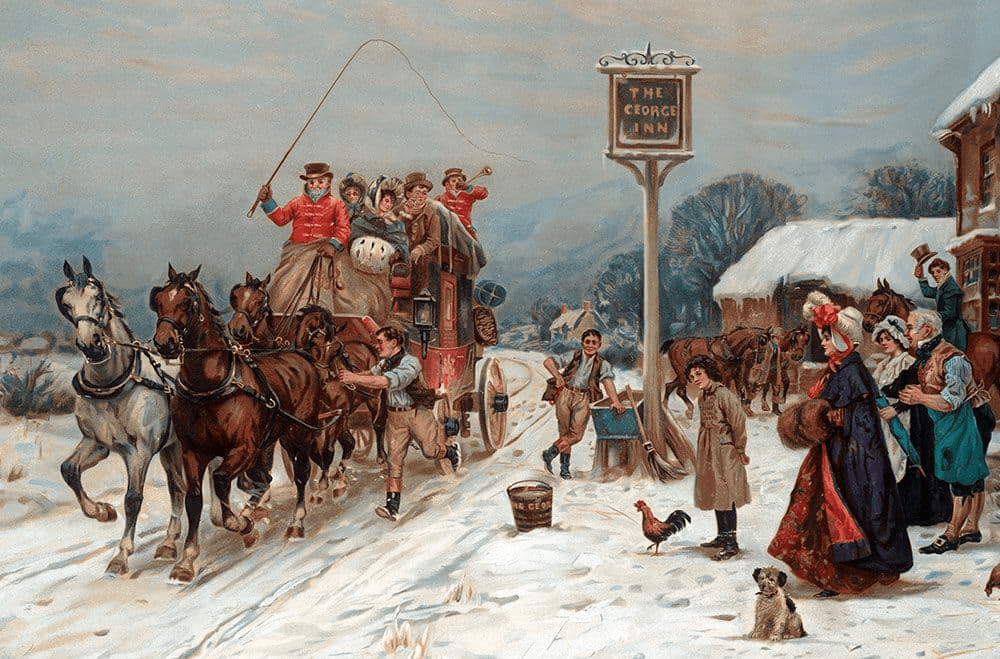
The image of a laden stagecoach arriving at a snowy inn has decorated millions of Christmas cards, along with robins and holly. The card above contains all the elements: the rural setting, icy roads, mine host on his doorstep to welcome the travellers, with the postern blowing his horn to announce (unnecessarily) their arrival, while the lady in the blue cloak is waiting to board. This kind of scene may have become popular because people wanted to travel at Christmas to visit their families, though in practice few would have gone by an expensive coach.

In practice most Christmas coach journeys must have been anything but romantic. Even without snowdrifts, the inside seats would have been both cramped and stuffy, while the cheaper seats on top would be bitterly cold and quite dangerous, as frozen fingers tried to hold on as the coach bounced over the ruts. In ‘Snowed Up’, above, the men have climbed down from the roof while the women passengers stay on board, no doubt hoping they won’t have to push. The scarlet coachman seems about to whip the horses, which are busy eating snow.

181 years ago …

The Christmas card was invented in 1843 by Henry Cole (director of the V&A) and drawn by John Horsley, who has signed this example with a tiny self portrait (bottom right). It portrays the Cole family enjoying a seasonal meal, flanked by scenes of charity: feeding and clothing the poor. These form an interesting link with modern cards, which are often sold for charities. A financial comparison with today’s cards is also fascinating: Cole sold his cards for a shilling and they would have cost a penny to post, but translated into modern values the cards would be £5.37 each, while the postage would be just 44p. And not a robin, snowman or stagecoach in sight!

The mystery of Fin Cop

Aerial view of the site of Fin Cop: Curve of ramparts visible top left

Fin Cop lies on the route of the Portway, about two kilometres north of Ashford in the Water. It is perched on a headland high above the sharp curve in the River Wye in Monsal Dale, and consists of a ditch and incomplete ramparts enclosing an area of about ten acres. Pennyunk Lane, which is believed to be a Celtic name, passes nearby, and is a section of the Portway whose route been somewhat modified by field enclosures. The question is – what was the purpose of the site?

Monsal Dale viaduct with Fin Cop in distance

The OS map marks the site as ‘settlement’, although it is often labelled ‘hillfort’. In fact it may have had several functions, as revealed by the extensive excavations which were carried out in 2009 and 2010 by the local history group supported by Archaeological Research Services. These reveal activity on the site going back to the Mesolithic – the time of hunter gatherers, when local chert was worked into tools. During the Bronze Age there were a number of barrow burials on site, and some kind of enclosure, possibly for corralling livestock. However, the idea of a permanent settlement seems unlikely, at nearly a thousand feet and far above a water source – much more probable that this was a ‘caravanserai’ on the Portway, being about ten miles from the next at Mam Tor, enclosing enough pasture for travellers’ animals to graze on.

Remains of a woman in her 20s, found at Fin Cop in 2010

There seems to have been a change, possibly climatic, in the Peak District in the Iron Age, indicated by a reduced population. This theory is supported by the dramatic finds made by the excavation of 2010, which show that about 400 BCE the ramparts were hurriedly raised to a height of about three metres and a ditch dug alongside. In the excavated sections the skeletons of nine women and children were found, whose bodies appear to have been hurriedly thrown into the ditch before the walls were broken down. Given that only a fraction of the site was excavated, this suggests a massacre of possibly over a hundred people, and warfare on a serious scale. We will never know the full story of this fascinating place, but these recent finds give us a taste of one chapter in its long history.

Source: https://www.archaeologicalresearchservices.com/projects/site/index.html

Waterloo sunset?

The hero of the hour

In an age of instant news, when an election result in the USA is available instantly on our phones, it’s hard to imagine a time when news of events even a hundred miles away could take weeks to reach Derbyshire. Before railways and national newspapers began to shrink distances a frequent source of information was the stagecoach, carrying the latest news from London. So on the 8th of July 1815, the people of Derby were finally sure that Napoleon had been decisively defeated at Waterloo when the Traveller Coach, one of the regular services from the capital, arrived in town. Celebrations were clearly called for, as the coach was decorated with laurels and lilies, and was pulling a French tricolor in the dust behind – a flag that was shortly burned by the crowd. So 20 days after the French defeat on June 18th the news began to percolate through the county.

Another Derbyshire coach, the Peveril of the Peak, starting from Islington

The battle was protracted and bloody, with some estimates putting the number of casualties at about 50,000, with equal numbers of dead and wounded on each side. Yet for civilians in Britain it decisively concluded over 20 years of warfare, and Wellington was widely honored for his victory, despite the fact that British forces were a minority of the Allied armies, and it was only the timely arrival of German troops that tipped the balance – even Wellington admitted that it was ‘the nearest run thing you ever saw in your life’.

The Wellington Cross, Baslow Edge and a visitor

Many monuments commemorate the battle, such as the cross above, although this was not erected until 1866, years after Wellington’s death. But not everyone welcomed the defeat of Napoleon. For many radicals and romantics, such as Byron, the French emperor was the heir to the revolutionary spirit of 1792, and British troops had died to replace a hated Bourbon on the throne of France. These sympathisers included the sixth Duke of Devonshire, who displayed a large marble bust of the emperor at Chatsworth, and as part of a liberal, Whig family had no time for the arch-Tory Arthur Wellesley, first Duke of Wellington.

Chelsea pensioners reading the Waterloo Despatch’. Wellington commissioned this picture from Wilkie for the enormous sum of £12,000.

Mr Brown’s girls

Ford Madox Brown – The Hayfield (1855)

By 1878 the painter Ford Madox Brown, at the age of 57, was suffering from severe gout, that classic Victorian ailment. His wife and model Emma had become alcoholic, probably as a result of the cuckoo in their nest, the 37-year-old poet Mathilde Blind, the object of his unresolved passion. It was Mathilde who proposed a family holiday in the fashionable resort of Matlock Bath that summer, along with his daughter Lucy and Lucy’s husband Frank. They would presumably have come by the Midland railway from their London home, and then by station fly to the house they had rented, ‘Belmont’, high above the river on Waterloo Road. The August weather allowed the younger members of the party to enjoy long walks along the valley, but Madox Brown was unable to join them, being literally bedridden with gout for most of the holiday. Perhaps that’s why he produced no Derbyshire paintings to rival those he painted in the London area, such as The Hayfield (above). As an associate of the Pre-Raphaelites he was faithful to their principle of working outdoors for authentic lighting effects, as can be seen in his iconic painting The Last of England.

Belmont survives, a Grade II listed building which was constructed in 1847, one of the earliest houses on Waterloo Road. By 2021 it was in a dilapidated condition, and was auctioned that year for £203,000. Today it is freshly renovated and repainted, tucked away off the road, with views over towards High Tor.

Brown in painterly pose

This self-portrait was made about the same time as Brown’s visit to Matlock. His lengthy beard and severe expression give him a patriarchal air, but friends such as Rossetti claimed that he was genial and sociable. He certainly had a difficult life: his parents were English but led a wandering life in the Low Countries for economy; his mother and sister both died before he was 20 and his father shortly after. He married a cousin, Elisabeth Bromley, who died of TB six years later, and then married his model, Emma, who posed as the emigrating wife in The Last of England. Her drinking increased as he became infatuated with two much younger and strikingly attractive women, Maria Spartali and Mathilde Blind, both part of London’s intellectual immigrant community, Marie from Greece and Mathilde from the German-speaking states. Yet neither of these relationships appear to have been consumated, while their consequence was to make all parties miserable – welcome to Bohemia!

The Clarion call

The invention of the safety bicycle in the late nineteenth century created the possibility of leisure travel for working-class people. Derbyshire and the Peak District, close to the industrial cities of Sheffield, Nottingham and Manchester, were prime destinations for Sunday rides. These early cyclists clearly felt the need to organise themselves into clubs for mutual support, and so adopted the name and outlook of the Clarion newspaper, a socialist weekly founded by Robert Blatchford in 1891 in Manchester. They not only took the name, but they also saw themselves as travelling propagandists, rather in the later Soviet style, spreading the good word to remote villages. Local Clarion Cycling clubs held a meeting in 1895 at the Izaak Walton Hotel in Dovedale to form the National Clarion Cycling Club.

BlatchfordThe man with the moustache

Robert Blatchford (1851-1943) had a remarkable life, despite being largely self-educated, including a period in the army and a successful career as a journalist. His best-seller, Merrie England (1894), was supposed to have won far more votes for the new Labour party than Das Kapital . However, his support for the Boer War led to a sharp drop in his popularity in left-wing circles. Perhaps his real achievement was to create the Clarion movement as an umbrella which inspired numerous groups, not only for cyclists but also for ramblers, drama, field studies, scouts and drawing. The Clarion Cycling Club is still active today, despite suffering a recent split over the word ‘Socialism’ on its masthead.

Sheffield Clarion Ramblers at the Barrel Inn, Bretton, 1930

Early cycling and walking groups had a strong ethical dimension. They were not out in the fresh air just for their health, but also for their moral betterment. The slogan of the Sheffield group was ‘A rambler made is a man improved’, though as can be seen in the photo above plenty of women were also keen on improvement. There was a distinct overlap between ramblers and non-conformist chapels: both offered a spiritual as well as a social opportunity. Sheffield Clarion Ramblers had their first meeting in Edale in 1900, led by the remarkable GHB Ward (still going strong in 1930 as seen above, with his arms around chap in the front). The group campaigned continuously for the right to roam, and reached a peak membership in the late 1940s with about 200. Perhaps their achievement is summed up in Ward’s adage: ‘A man who was never lost never went very far’.

Uphill work in the Dale

Village idyll: Farm and church seen from the wood above Dale Abbey village

The importance of public rights of way – both footpaths and bridleways – in England is shown by the tremendous effort expended on settling disputes when these routes are challenged. A recent example is at Dale, near Ockbrook in the east of Derbyshire, where the Portway runs past the remains of Dale Abbey and the Hermit’s Cave. The ancient track leaves Hermit’s Wood, goes past the church and into the village, and this point has been the focus of the disagreement.

The bridleway in dispute at Verger’s Farm (A-C on map)

The owners of Verger’s Farm attempted to obstruct use of the route through their farmyard, claiming that an alternative route (E to X on map) should be used, although this involved a stiff climb. This led to an official inquiry opening in 2019, led by an inspector from Defra (Department for Environment, Food and Rural Affairs), who was unable to carry out a site visit until 2021 due to the COVID pandemic. 23 people gave evidence in support of the long-standing existence of the bridleway through the yard, including members of the British Horse Society, a powerful lobby. Against these were 14 objectors, including the family of the farm. A mass of documentary evidence was also presented, including old photos and guidebooks to the district. The inspector, in her final decision in 2023, confirmed the validity of the original route of the bridleway on the strength of the historical evidence, leaving aside the personal statements.

Dale Abby church, semi-detached to the farmhouse next door

This case illustrates the extraordinary passions that a right of way dispute can generate. The bridleway in question is only a few hundred metres long, but caused an argument involving dozens of people, the parish council, the county council (DCC) and Defra, which continued for over four years. Now that the way is officially waymarked, we should recognise their efforts by visiting the village; either walking from the Carpenters’ Arms in Dale village or taking the more ambitious route along field paths from the Royal Oak in Ockbrook.

Canal competition

Leawood pump house in steam

For thousands of years goods had to be carried by roads, and a horse and cart could move about a ton of stone or coal. But with industrial growth in the eighteenth century increasing demand for raw materials canals became a feasible mode of transport, a horse-drawn narrowboat could carry 30 tons. From about 1760 the canal network grew quickly, and by 1788 a route was planned from Cromford to Langley Mill, where it would link up with the Erewash Canal and so gain access to the Trent basin. Local entrepreneurs such as Gell at Hopton and lead smelters at Lea and Crich were keen to promote this facility for their minerals, while also benefiting from cheaper coal deliveries.

The aqueduct at Bullbridge

Building the canal with nothing more advanced than shovels and wheelbarrows seems remarkable today, especially as aqueducts were needed to cross the Derwent by the Leawood pump house and over the Amber (above – the railway came later!). In addition, Butterley tunnel, about 3,000 yards long, proved difficult to cut and maintain. The entire route from Cromford to the Butterley tunnel was on a level, so no locks were needed. This saved water, which was always an issue given the original supply was the Bonsall Brook, shared with Arkwright’s mill. The pump house was a later addition, lifting water from the Derwent. The estimate for the canal’s construction was about £42,000, but inevitably the actual cost was nearly twice this when it finally opened in 1794.

The staff of Wheatcroft’s office at Cromford Wharf

The sign in the photo gives a good idea of the goods carried by the canal: not just coal and coke but also salt, pipes and straw. However, by the time this was taken the canal was in decline: from the 1850s the railway was providing a cheaper and faster service. At its peak in the early 1800s the canal carried 300,000 tons per year, and paid shareholders a whopping 20%. But in 1852, as profits declined, the canal was sold to its railway rival – which was already operating the High Peak line from Cromford to Manchester. The tunnel suffered several rock falls, which finally closed the through route in 1900, though local traffic between Hartsay and Cromford continued until 1944. It seems curious that such a substantial, splendid piece of engineering should have such a short life, effectively becoming redundant after only 50 years!