


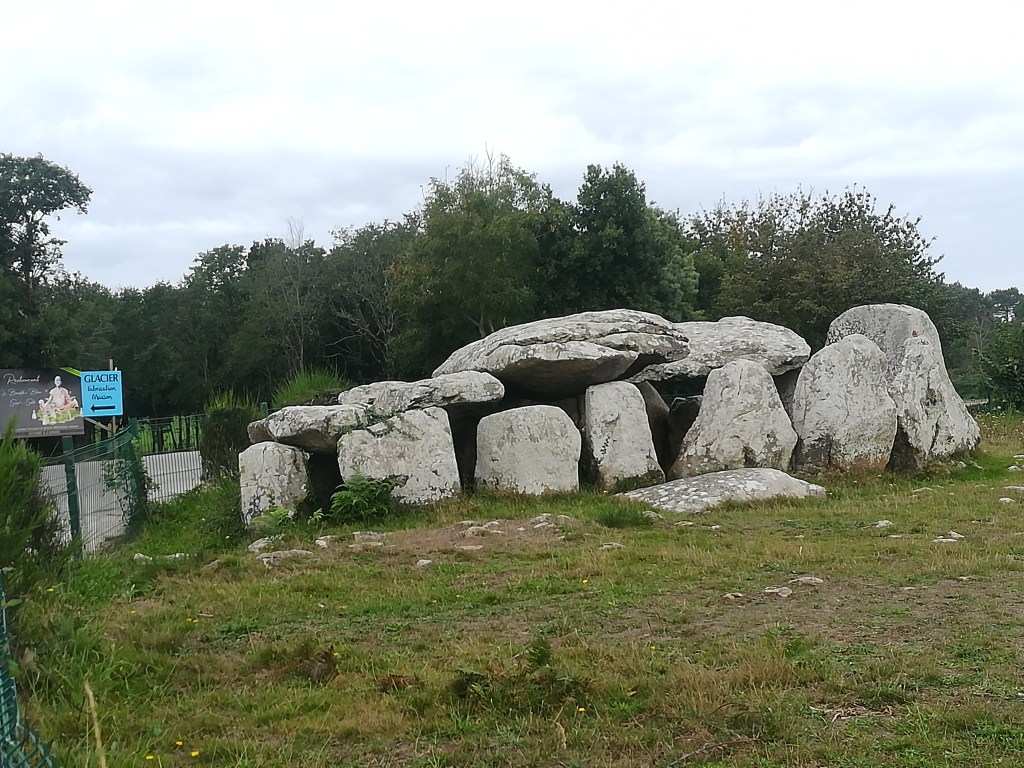
Cromlechs are ancient megalithic structures, thought to pre-date stone circles, so possibly over 6,000 years old. Welsh examples consist of a flat cap stone supported by several upright stones, as in the photo above. They may have been burial sites, but they certainly were not ‘Druidical altars’, as was imagined by early antiquarians. As far as I know there are now none in Derbyshire, but there is some evidence that at least one existed until the early nineteenth century.
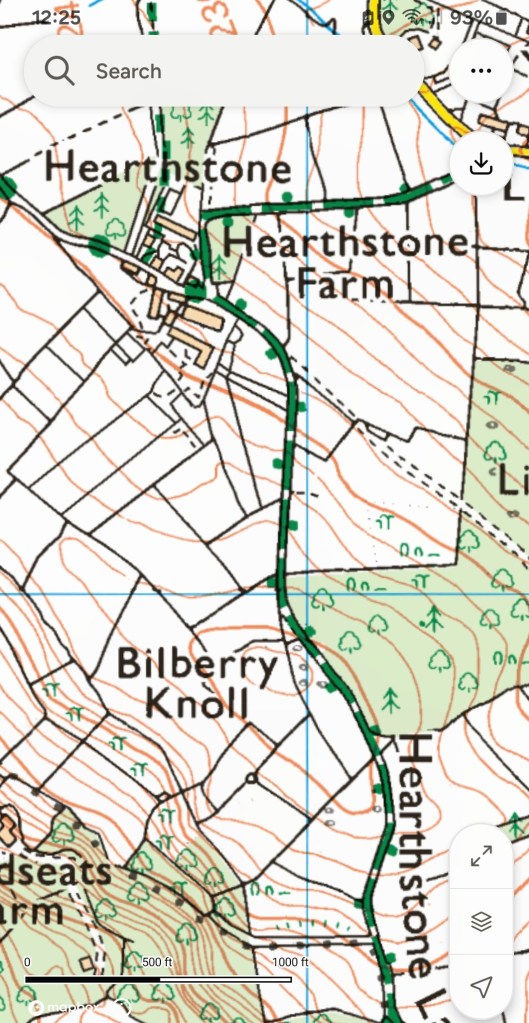
Hearthstone Lane is an ancient route that runs south from Riber to Cromford and beyond. Writing in the Derbyshire Archaeological Journal for 1887, Benjamin Bryan looked at the evidence for a cromlech in this area. There were a surprising number of guide books to the county in the late eighteenth and early nineteenth centuries, and Bray’s Tour of Derbyshire of 1783 mentions a structure on Riber hill consisting of one capstone resting on uprights. A similar monument is mentioned in Pilkington’s View of Derbyshire of 1789, and then Beauties of England and Wales (1803) names this as the Hirst Stones, and describes a hole sunk into the top slab. Frustratingly, none of these writers provides an illustration or an exact position.

The Matlock Companion of 1835 describes the cromlech as recently broken up, and claims that it had been destroyed by the farmer looking for material for stone walls. In 1866 the editor of the DAJ questioned two old ‘cottagers’ of Riber about the stones, and was told that they both used to play on the monument as children. So there seems little doubt that there had been a cromlech on Riber hill until the early nineteenth century, and it seems likely that the name Hearthstone Lane is a corruption of Hirststone. Several roads in the area are named after prominent stones e.g. Holestone Lane and Cuckoostone Lane. The obvious site of the cromlech is at the top of Bilberry Knoll, the highest point on the lane, providing impressive views in every direction.
This story is a reminder of the chance nature of survival of ancient structures, and how recently and easily they could have been lost. Yet Hearthstone Lane remains as a rewarding historical walk, easily accessible from Cromford station: one of the finest green lanes in the district.
 The Old Roads of Derbyshire
Curious, concise and convincing 😉
Nice illustrations too.
LikeLike
Absolutely fascinating! Thankyou for writing this. And what a great loss from our local array of prehistoric monuments.
The name is really interesting too. Do you know the derivation of Hirst/Hurst in the name?
As it appears in modern places like Hurst Farm in Matlock, but also in the history of multiple places associated with Hob Hurst, our little hobgoblin/sprite who pops up in our folklore a few times. Like ‘Thirst House cave’ near Chelmorton, where the little ‘hob’, Hob Hurst, was said to live, playing his fiddle and protecting a magic door to another place. One idea is that ‘the Hurst house’ became ‘th’urst house’, then ‘thirst house’.
Or ‘Hob Hurst’s House’ the rectangular barrow on Beeley Moor, or the cave on Fin Cop with the same name again.
My working theory for these places connects them to ‘Thyrs’, the Anglo Saxon word for giant/spirit/demon. Thurs to Hurst is not too far… and that word is linked to Hob Hurst’s name by some people too.
I think it’s interesting that many of these places were thought to be significant to ancient people. Aside from the Barrow, Thirst house cave had Romano-British offerings buried around the entrance.
So I think the word, and sometimes the folklore character, got repeatedly linked to these prehistoric sites in Derbyshire.
It seems like the Hirst Stones is another place that fits this pattern.
But I wondered if you had any different ideas about why this, and other places, have the recurring word ‘Hurst/Hirst’ in them?
LikeLiked by 1 person
‘Hurst’ is a common suffix for place names in Derbyshire and I think it refers to a wooded slope. But that doesn’t help in this case because the landscape must have changed hugely since Saxon times, as this seems a Saxon name for something much older.
LikeLike
Very interesting. It’s hard to say for sure when the landscape has probably changed a lot, but that makes sense for some areas (like Lea Hurst or conceivably Hurst Farm on that hillside. But not for other places, like Hob Hurst’s House the barrow or for some of the associated caves. I still think that maybe Hob o’ th’ Hurst is mixed up in this somewhere…
LikeLike
Sorry, my username seems to have gone funny above (perfectlyd…)
I’m a regular reader/have commented before. Not that it really matters!.
LikeLike