Beating the bounds

Boundary stone near Fritchley

This stone, partly broken, can be found lurking in the hedge of the minor road that links Fritchley with Wingfield. Although partly broken, one side still reads ‘Winfiel(d)’ and the other ‘Crich’. Easily mistaken for a milestone, this is actually a boundary stone marking the limits of these two parishes, marked BS on Ordnance Survey maps. The boundary here can still be followed on public footpaths, southwards to a footbridge over the River Amber and Sawmills, northwards (briefly) to Park Head. The OS maps mark the boundaries with black dots, though they can be difficult to see.

A custom revived

The parish system of local government is thought to have been established in Saxon times, although individual parishes were originally much larger. In the past, parishes were the only kind of local authority that affected most people’s lives, being responsible, for example, for road maintenance. Therefore the limits of the parish were important, and in a largely pre-literate society this knowledge had to be handed down orally, hence the annual perambulation known as ‘Beating the Bounds’. This involved the priest, various landowners and some unfortunate young lads, whose fate was to be beaten at critical points so they would remember them. Who knows whether this beating was symbolic or real?

Another stone in North Derbyshire

Rivers and streams were often used as boundaries, since they were unlikely to move very much, but as they were not always available other marks, such as large trees, might be used, and clearly boundary stones were sometimes also needed. Where the line of a road (or footpath) is a boundary it suggests that the road is very ancient and important, such as sections of the old Roman road (The Street) running north from Pikehall, which was in use for at least 1,500 years. Today the custom of bounds beating is obviously redundant, but in places it has been revived as an enjoyable excuse for a group walk, as in the Macclesfield example above. More locally, a WEA group from Crich re-enacted the ceremony in 1984, and produced a very helpful written account of their route around the 14 miles of the parish boundary. See: https://www.crichparish.co.uk/PDF/beatingbounds.pdf
Going round in circles?

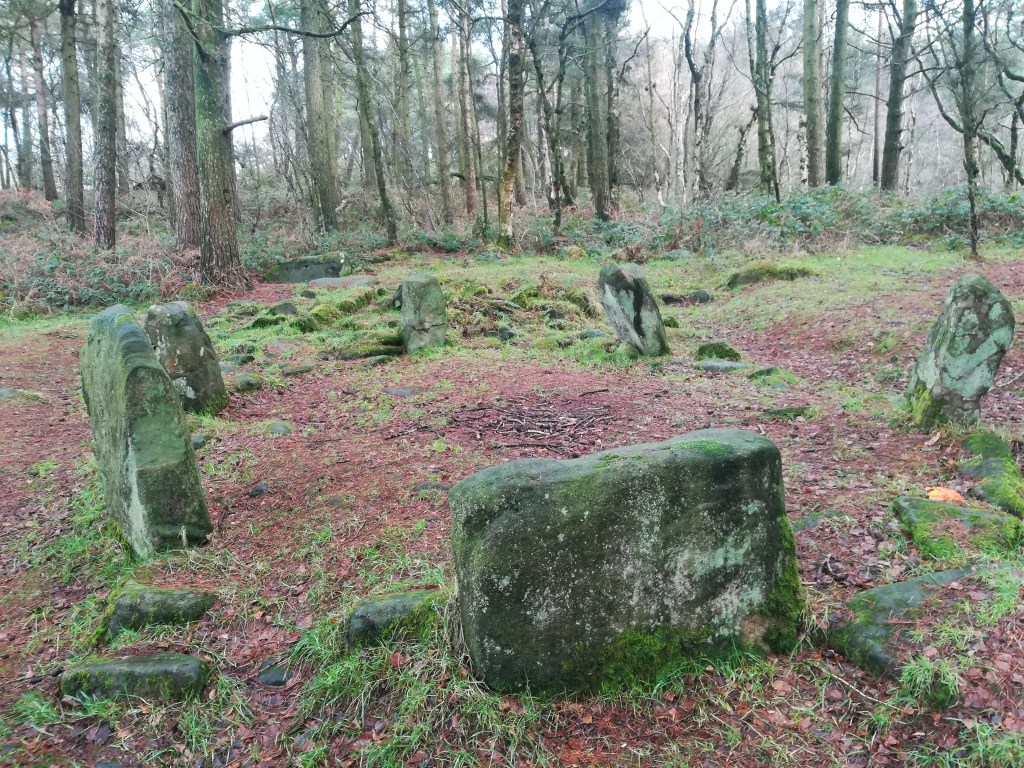
Doll Tor, near Birchover

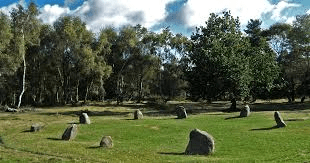
There are over a thousand stone circles in Britain and France, and Derbyshire has its share, ranging in size from Arbor Low (up to 50 metres in diameter) to much smaller versions, such as Doll Tor (above). This latter is part of a cluster of circles, with the Nine Ladies on Stanton Moor close by, and Nine Stones Close on Harthill Moor not far off. There may have been more circles in the past, since we have evidence that some have been pillaged for their stone (Nine Stones actually only has four stones), and others destroyed as pagan symbols by God-fearing landowners. Most of the surviving circles are on moorland or high pastures, which raises the question whether the reason for their survival was their location on land of little value. Others might argue that the circles were built on high places for astronomical purposes, to observe sunrises for instance. In fact, although the circles have been studied, measured, excavated and theorised about for over two hundred years, we still seem no closer to knowing their purpose

Nine Stones (in theory) Close on Harthill Moor

There does seem to be agreement that most circles belong to the Bronze Age, roughly 3,000 years ago, though obviously dating such basic structures is not easy. But over this time span many may have been altered, so there’s no guarantee we’re looking at the original layout. Some of the stones at Doll Tor, for example, have been re-set, and Bateman records seven stones on Harthill Moor in the nineteenth century (others claim that these stones have been raised to standing position, it being the only circle in the county with standing stones).

Nine Ladies Circle on Stanton Moor

Some circles seem deeply unimpressive: The well-known Nine Ladies, for instance, hardly compares with the majesty of Stonehenge. Yet, large or small, there is still no clarity on why these monuments were built. Vague talk of ceremonial sites or astronomical observation is pure speculation and seems as dubious as Victorian ideas of ‘druidical temples’. Perhaps there is a simpler explanation. Before the Romans arrived the British lived in round, wooden houses – effectively the only shape of building they made. A stone circle can be seen as a symbol – a permanent representation – of their house, which proclaimed ownership of the land to all travellers and passers-by. The circle would be a permanent claim to their property, in days before the Land Registry. Both Arbor Low and Nine Stones are on prehistoric routes (the Street and the Portway), but other circles would have been visible from the tracks across the uplands.

Druids doing their thing

The books of the road

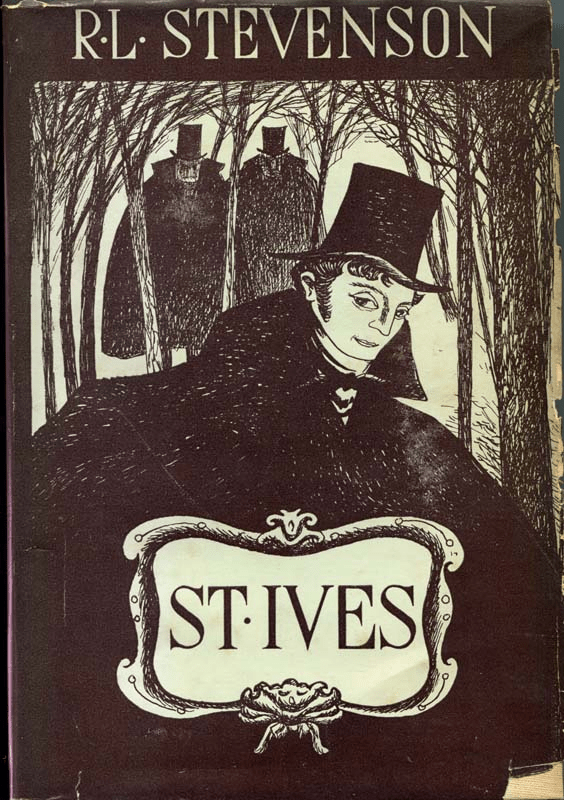
The last, unfinished novel by Robert Louis Stevenson, St Ives, is the exciting story of an escaped French prisoner of war in the Napoleonic period. After breaking out of prison in Edinburgh he heads south to England, first in company with a couple of drovers and then, over the border, on the Great North Road. On the way he gives us a rare picture of travel in the early nineteenth century:

The main roads of England are incomparable for excellence, of a beautiful smoothness, very ingeniously laid down, and so well kept that in most weathers you could take your dinner … off them. On them, to the note of the bugle, the mail did its sixty miles a day; innumerable chaises whisked after the bobbing postboys …

The drovers who help the hero flee Scotland are portrayed as taciturn, rough and hardy characters, but totally honest and self-reliant. They follow their droving trails through the hills, well away from the main roads, which is the ideal route for an escaped prisoner. Once in England St Ives stays at roadside inns, where visitors were expected to join the general conversation around the dining table, on subjects like:

… the country, the state of the roads, the business interest of those who sat down with me, and the course of public events …

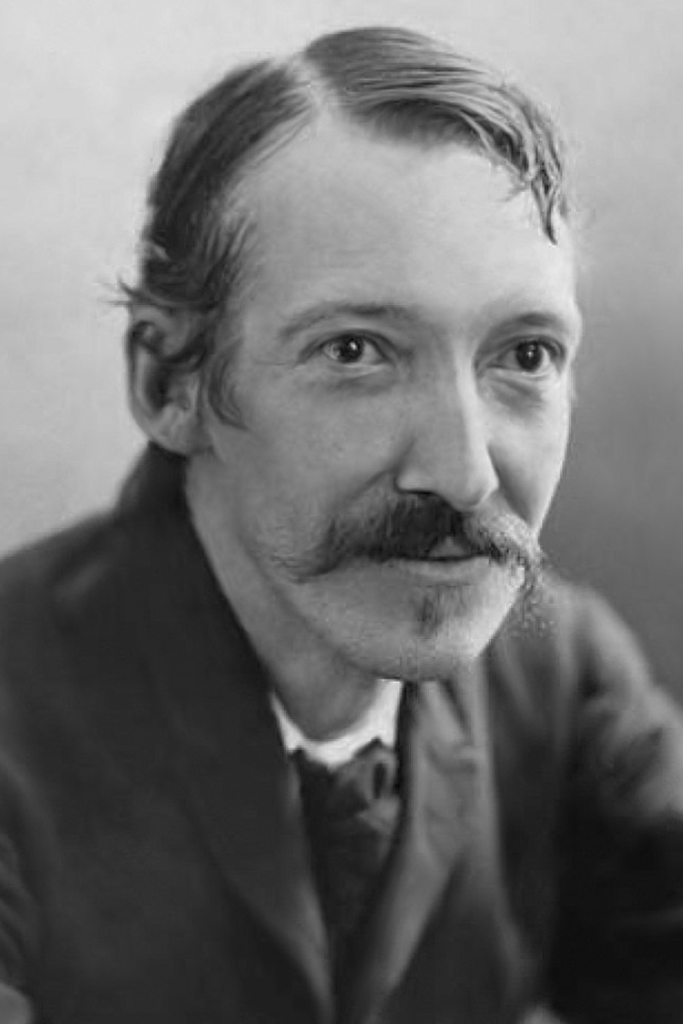
R L Stevenson

and:

I came to the model of a good old-fashioned English inn, and was attended on by the picture of a pretty chambermaid. We had a good many pretty passages as she waited table or warmed my bed for me with a devil of a brass warming pan … and as she was no less pert than she was pretty, she may be said to have given rather better than she took.

In this, and most of his other stories such as Treasure Island or Kidnapped, Stevenson is using a classic model – the traveler’s tale, which was already three hundred years old. Beginning in Spain with novels such as Cervantes’ Don Quixote, a little later Bunyan’s Pilgrim’s Progress, then in the eighteenth century many novels in Britain and France like Candide or Tom Jones, this was an incredibly popular genre. Sometimes called ‘picaresque’, from the Spanish word ‘picaro’, a disreputable, wandering character, these novels all consist of a series of adventures linked together by a journey, adventures in which the hero meets a variety of people.

Still in print after 350 years

Given the scarcity of other material, these stories are one of the best sources for historians of travel. Not only do they give an insight into the mechanics of travel in the past, as for example in The Pickwick Papers, where we can ride past a turnpike gate, but they also illustrate contemporary attitudes towards, for instance, inn keepers or chambermaids, as in the example above, in which Stevenson may be lightly satirising such conventions. Today it has become fashionable to talk about ‘my journey’ as a pretentious synonym for ‘my life’, but clearly this conflation is far from being a novelty!