Uphill work in the Dale

Village idyll: Farm and church seen from the wood above Dale Abbey village

The importance of public rights of way – both footpaths and bridleways – in England is shown by the tremendous effort expended on settling disputes when these routes are challenged. A recent example is at Dale, near Ockbrook in the east of Derbyshire, where the Portway runs past the remains of Dale Abbey and the Hermit’s Cave. The ancient track leaves Hermit’s Wood, goes past the church and into the village, and this point has been the focus of the disagreement.
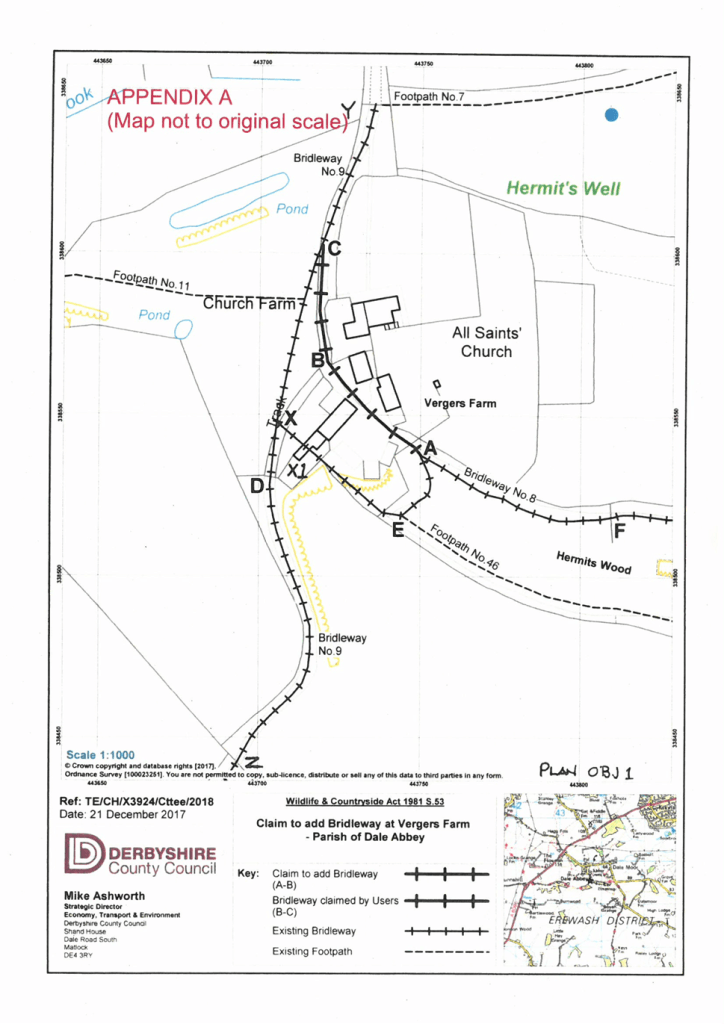
The bridleway in dispute at Verger’s Farm (A-C on map)

The owners of Verger’s Farm attempted to obstruct use of the route through their farmyard, claiming that an alternative route (E to X on map) should be used, although this involved a stiff climb. This led to an official inquiry opening in 2019, led by an inspector from Defra (Department for Environment, Food and Rural Affairs), who was unable to carry out a site visit until 2021 due to the COVID pandemic. 23 people gave evidence in support of the long-standing existence of the bridleway through the yard, including members of the British Horse Society, a powerful lobby. Against these were 14 objectors, including the family of the farm. A mass of documentary evidence was also presented, including old photos and guidebooks to the district. The inspector, in her final decision in 2023, confirmed the validity of the original route of the bridleway on the strength of the historical evidence, leaving aside the personal statements.

Dale Abby church, semi-detached to the farmhouse next door

This case illustrates the extraordinary passions that a right of way dispute can generate. The bridleway in question is only a few hundred metres long, but caused an argument involving dozens of people, the parish council, the county council (DCC) and Defra, which continued for over four years. Now that the way is officially waymarked, we should recognise their efforts by visiting the village; either walking from the Carpenters’ Arms in Dale village or taking the more ambitious route along field paths from the Royal Oak in Ockbrook.
Canal competition

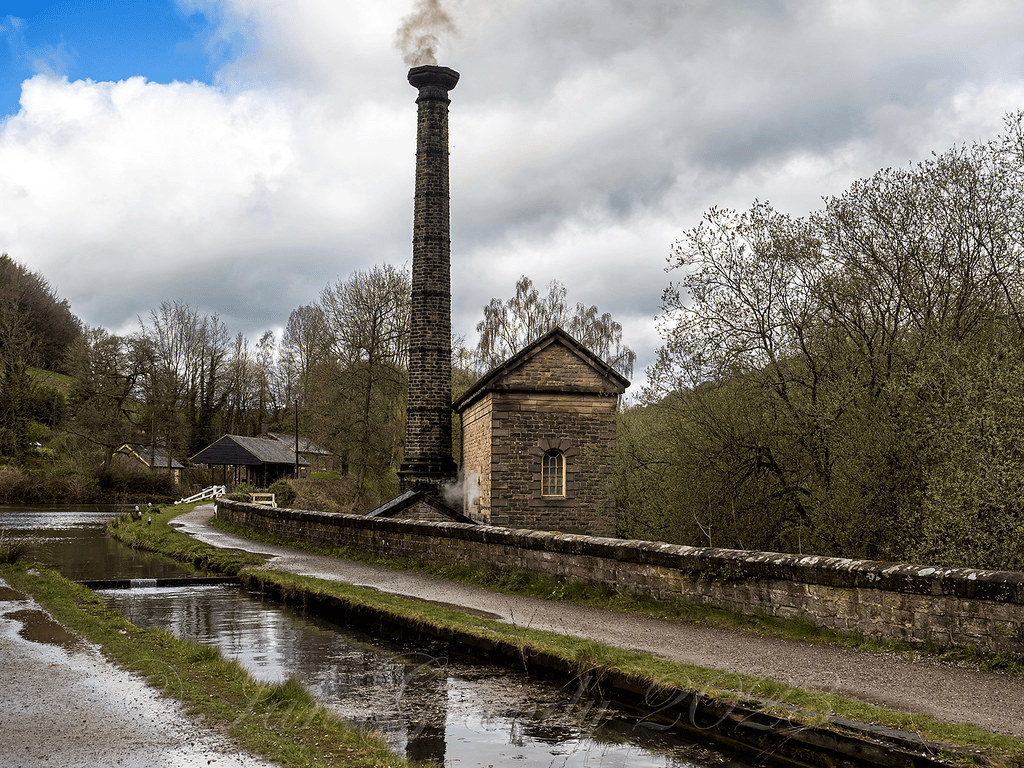
Leawood pump house in steam

For thousands of years goods had to be carried by roads, and a horse and cart could move about a ton of stone or coal. But with industrial growth in the eighteenth century increasing demand for raw materials canals became a feasible mode of transport, a horse-drawn narrowboat could carry 30 tons. From about 1760 the canal network grew quickly, and by 1788 a route was planned from Cromford to Langley Mill, where it would link up with the Erewash Canal and so gain access to the Trent basin. Local entrepreneurs such as Gell at Hopton and lead smelters at Lea and Crich were keen to promote this facility for their minerals, while also benefiting from cheaper coal deliveries.

The aqueduct at Bullbridge

Building the canal with nothing more advanced than shovels and wheelbarrows seems remarkable today, especially as aqueducts were needed to cross the Derwent by the Leawood pump house and over the Amber (above – the railway came later!). In addition, Butterley tunnel, about 3,000 yards long, proved difficult to cut and maintain. The entire route from Cromford to the Butterley tunnel was on a level, so no locks were needed. This saved water, which was always an issue given the original supply was the Bonsall Brook, shared with Arkwright’s mill. The pump house was a later addition, lifting water from the Derwent. The estimate for the canal’s construction was about £42,000, but inevitably the actual cost was nearly twice this when it finally opened in 1794.

The staff of Wheatcroft’s office at Cromford Wharf

The sign in the photo gives a good idea of the goods carried by the canal: not just coal and coke but also salt, pipes and straw. However, by the time this was taken the canal was in decline: from the 1850s the railway was providing a cheaper and faster service. At its peak in the early 1800s the canal carried 300,000 tons per year, and paid shareholders a whopping 20%. But in 1852, as profits declined, the canal was sold to its railway rival – which was already operating the High Peak line from Cromford to Manchester. The tunnel suffered several rock falls, which finally closed the through route in 1900, though local traffic between Hartsay and Cromford continued until 1944. It seems curious that such a substantial, splendid piece of engineering should have such a short life, effectively becoming redundant after only 50 years!

Comfort at the crossroads

Relief showing a Roman imperial messenger arriving at a mansio in a chariot

Roman military dominance depended on its well-known road system, which not only allowed troops to move quickly, but also allowed messengers to ride rapidly with news or orders. To accommodate such travellers a kind of guest house, called ‘mansio’ in Latin, was built at regular intervals on the main roads, offering fresh horses as well as food and lodging.

Just over the Staffordshire boundary, south of Lichfield, are the extensive ruins of a Roman settlement built at the junction of Watling Street (near the line of the A5) and Ryknield Street, which continues to Little Chester and beyond. Both were important Roman roads, and this was first the site of a fort, then a mansio was built, and subsequently a small town grew up around it, known to the Romans as Letocetum.

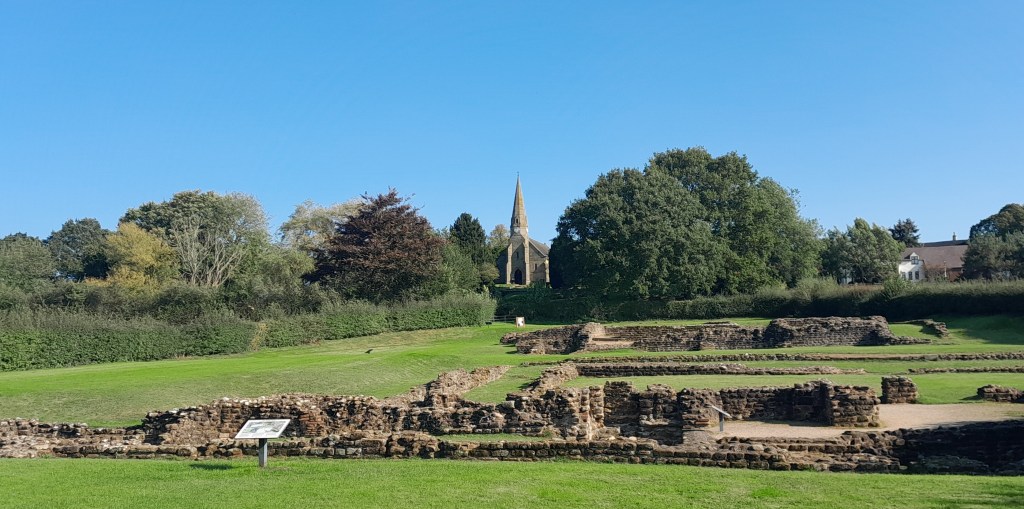
Excavated ruins at Wall

The remains of the settlement can be visited in the village of Wall, on a gently sloping site only a few hundred metres from the noisy M6 toll road. In the foreground of the picture above are the ruins of a bath house, so that tired wayfarers could have a warm soak after a day in the saddle. It seems strange to imagine public baths in such a remote spot, and it would be interesting to know who was allowed to use them.

Foundations of the mansio

Despite the care with which this site is preserved by English Heritage it is hard to imagine it in its heyday. But an inscription from Aesernia in Italy of the dialogue between an innkeeper and a departing guest gives more flavour, and can be translated as: ‘Innkeeper, let’s settle our account. One measure of wine and bread, one coin; some stew, two coins. Agreed. The girl, eight coins. That, too, is agreed. Fodder for the mule, two coins. That animal can take me to my destination…’.