

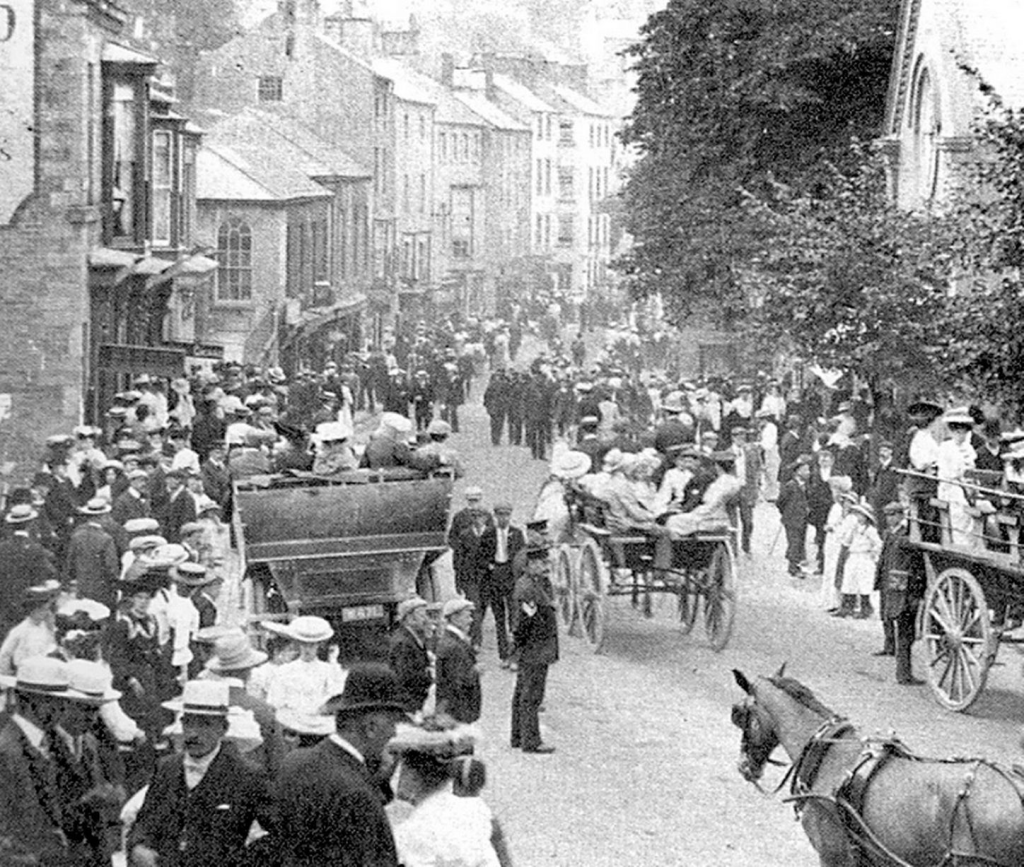
A jolly holiday crowd at Matlock Bath
Today it is easy to forget the importance of the horse before the twentieth century. Leaving cavalry and racing aside, they were critical in agriculture and travel, reaching a peak in the nineteenth century when there were an estimated three million horses in Britain. Selective breeding during the medieval period led to horses replacing oxen in plough teams, while others were bred for speed and endurance. Travellers, unless poor, generally went on horseback, certainly before reliable coach travel was available in the 1830s. For many professions, such as doctors and lawyers, travel by horse was simply the most convenient mode, combining flexibility with reasonable speed, for long and short journeys. For example, James Clegg of Chapel- en-le Frith, a dissenting minister, rode nearly 1,000 miles in the first half of 1730, according to his diary.

Clegg’s chapel at Chinley near Chapel-en-le Frith
The ability to ride was necessary for these kinds of jobs, and gentlemen in particular were expected to ride with a certain style, especially when out hunting, or otherwise displaying their social status. When and how boys (and it was generally males before the modern period) learned to ride is a good question, and although there have always been riding schools, we can presume that most were taught by their fathers, or servants such as grooms. The population was mainly rural until the mid-nineteenth century, when riding ability would have been as common as knowing how to cycle is today.

Matlock Bath as was
DH Lawrence provides an example of this in his novel The Rainbow. Set in the 1870s, he depicts the young farmer Tom Brangwen riding from Cossall to Matlock Bath:
“One Whitsuntide he went a jaunt, with two other young fellows, on horseback to Matlock, and thence to Bakewell. Matlock was at that time just becoming a famous beauty spot, visited from Manchester and from the Staffordshire towns. In the hotel where the young men took lunch, there were two girls , and the parties struck up a friendship”.
In the story Tom gets off with one of the girls, tells his companions not to wait for him, and leaves his horse with an ostler while he takes the young lady for a walk in the woods. This is a reminder of the variety of jobs that were involved with the horsey world, such as ostlers, grooms, saddle makers and many more. The 1871 census for the parish of Matlock lists 12 wheelwrights, 15 blacksmiths, 17 cab drivers, 6 coachmen, 8 grooms, and 4 saddlers, not to mention a horse breaker, a coach maker and an ostler.
 The Old Roads of Derbyshire
Once again, a superb post that ticks all the boxes: historically interesting, well-researched, nicely illustrated and a thoughtful comparison with life today 👍
LikeLike