Lord Byng pays a visit

The only known portrait

John Byng (1743-1813) was born into a family of soldiers and sailors, the younger son of the 3rd Viscount Torrington. He bought his commission in the Grenadier Guards when he left Westminster School, and retired as Colonel of the Regiment in 1780. Having no landed estate to look after, he decided to spend his early retirement travelling, and between 1780 and 1791 he rode thousands of miles around England, keeping an extensive record of his travels in a series of diaries. He had married, at the age of 24, Bridget Forrest, the daughter of an admiral, who went on to have 14 children with him, all but one of whom (unusually) survived infancy. Presumably Bridget was accustomed to having a semi-absent husband from his military years?

Willersley Castle, Cromford

There is clearly a sarcastic element of class consciousness in Byng’s comments on Richard Arkwright’s Willersley Castle when he visited Derbyshire in 1779:

‘Went to where Sr R.A. is building for himself a grand house in the same castellated stile (sic) as one sees at Clapham, and really he has made a happy choice of ground, for by sticking it up on an unsafe bank, he contrives to overlook, not see, the beauties of the river, and the surrounding scenery. It is the house of an overseer surveying the works, not of a gentleman …’.

Byng’s tone must be connected with his position as the younger son: he had inherited no castles, and in the aristocratic world of this period anyone who had actually worked for their fortune was worth a sneer.

Cromford Mills as were. Note the distant tower on Crich Stand, the predecessor of the war memorial

Needless to say, John Byng was equally unimpressed by the nearby mill: ‘Every rural sound is sunk in the clamour of cotton works, and the simple peasant is changed into the impudent artisan’. The fact that the ‘simple peasant’ had chosen to work in the mill, as a welcome alternative to lead mining or worse, may not have crossed his mind. But Byng’s reaction was typical of the many tourists who were beginning to scour the Peak District for the romance of wild scenery and Gothic views. His diaries, however, do give the flavour of travel 250 years ago: his servant often rode ahead to reserve rooms at an inn, and would carry a set of sheets so that his master didn’t have to sleep on the damp or dirty bedding often provided by the house!

A lovely day out in the Bath

Today Matlock Bath rarely seems short of visitors; even in winter there will be customers for ice cream, and car parks fill up by mid-day. But in the past, especially before the railway arrived in 1849, and when road access was challenging, the village had to work harder to attract travellers. Early fame depended on the waters, of course, but wallowing in a lukewarm bath had limited appeal, yet the spectacular landscape of High Tor to one side and Masson Hill opposite was the subject of many paintings, helping spread its reputation. Local entrepreneurs began adding to the natural beauty, starting with Lovers’ Walks, on the east side of the Derwent, and originally only accessed by ferry or from Willersley. The Walks are first mentioned in 1742, making them possibly the earliest public ‘park’ in the country. Paths were created by the river and up the hillside, with seats, shelters and ornaments provided to enhance the views.

View of Matlock Bath from the Heights of Abraham c. 1840s

Presumably eighteenth-century visitors were more energetic than modern holidaymakers, since before the cable cars were installed reaching the Heights involved a steep-ish walk. Opened in 1787, the rather quirky name derives from the supposed similarity to the Heights of Abraham in Quebec, where General Wolfe died in 1759. These gardens offered views over the valley, improved by building the viewing platform of the Victoria Tower in 1844. Clearly, hillside walks were a limited attraction, so the old lead workings in Masson were opened up to visitors, now named Masson Cavern and Rutland Cavern, both continuing to offer some spectacular sights.

The Switchback Railway, Derwent Gardens c. 1910

About 1887 a craze for ‘switchback’ railways, a basic kind of gravity operated roller coaster, swept the country. The Buxton family bought and ran Matlock’s version, which had been built on the site of Derwent Gardens, and it continued operating until about 1930. Judging from the photos it would have never passed Health and Safety inspections, but was apparently extremely popular!

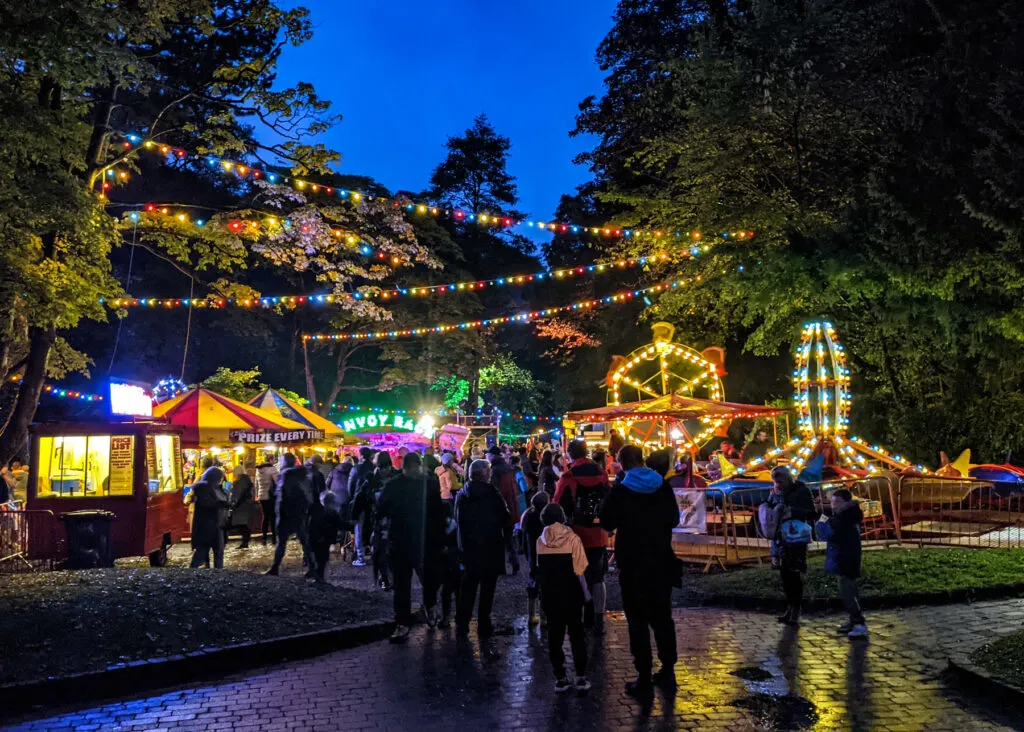
Matlock Bath Illuminations, or Venetian Nights, dates back to 1897, when it was an attempt to prolong the holiday season into the autumn by offering a spectacular display of illuminated boats, accompanied by fireworks. These have continued up to the present, with breaks for wars, floods and, of course, Covid-19. Especially in the 1920s and 30s there was strong competition for the prize for the best boat, and some of the remarkable winners can be seen on the Andrews pages at:

https://www.andrewsgen.com/matlock/pix/matlockbath_illuminations_boats.htm