

Many people imagine that in the past travelling was uncommon, since most folk stayed put all their lives, with the occasional visit to the nearest market town. But in fact, despite the difficulties, substantial numbers were on the move, mainly from necessity. With a much smaller population, widely scattered across the country, few towns were large enough to support a range of services. Justice, for example, might be dispensed by the local magistrate , but for more serious offences the quarter sessions were held every three months, with the assize judges travelling from town to town.
Similarly, outside London few places were large enough to have their own theatres. So at least from Tudor times, and probably earlier, ‘strolling players’ would be on the road, probably with a couple of carts for their props, bringing their dramatic repertoire to an audience quite deprived of entertainment.
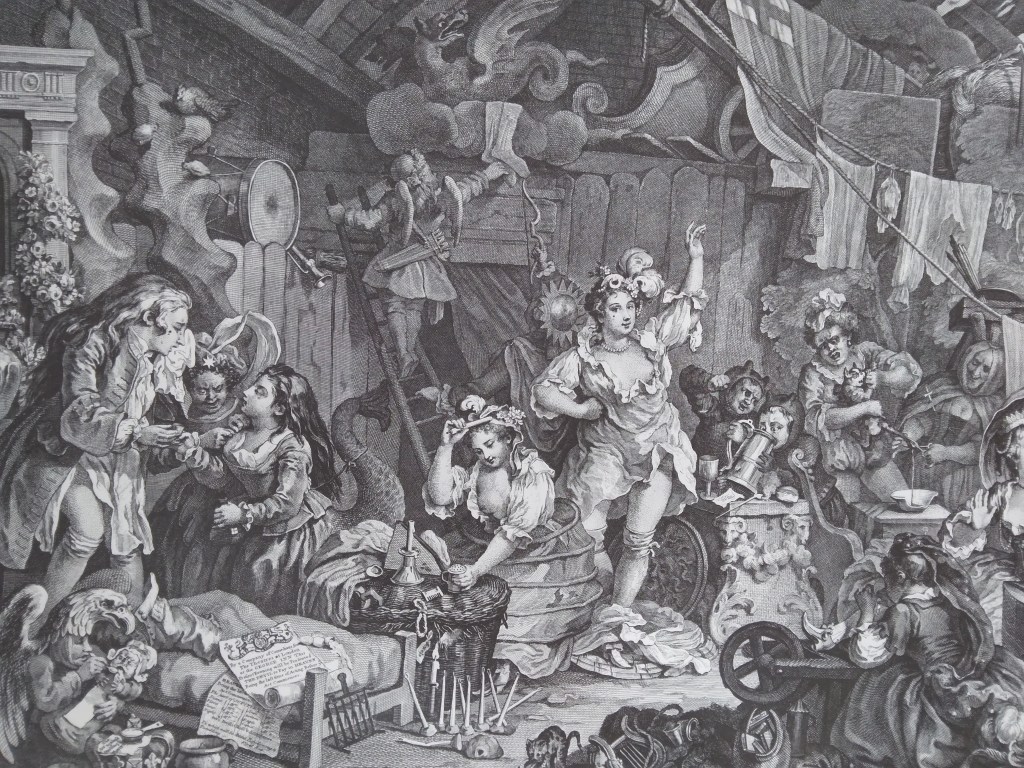
The more respectable troupes would be invited to perform at the houses of the gentry, but the majority could have rigged up a temporary stage at an inn yard or even the churchyard. Hogarth’s engraving, above, satirically suggests the low social standing of the players, forced to prepare their performance in a barn, where they would presumably be spending the night. At least the children seem to be enjoying the atmosphere!
As with many kinds of itinerant workers who have left no written records, it is hard to know what kinds of plays they performed. Apparently well-known stories such as Robin Hood were popular. Some of the performers could have been acrobats or jugglers, foreshadowing the travelling circus, which first appeared in England in the 1760s.
However, the authorities were always nervous of the theatre, fearing it would inflame popular rebellion, and although London theatres were often closed (firstly by the Puritans in 1642), strolling players were more difficult to control. But an Act of Parliament of 1737 (just visible on the bed in the foreground) sought to suppress them, and the performers in the engraving may be making their last bow.
 The Old Roads of Derbyshire