A cold coming

Happy Christmas everybody

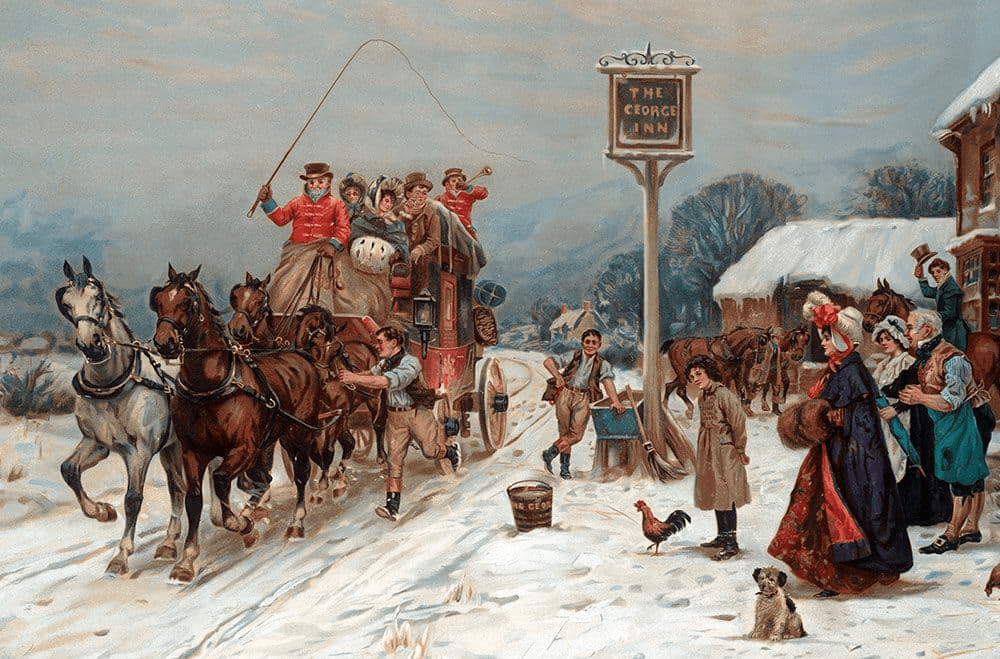
The image of a laden stagecoach arriving at a snowy inn has decorated millions of Christmas cards, along with robins and holly. The card above contains all the elements: the rural setting, icy roads, mine host on his doorstep to welcome the travellers, with the postern blowing his horn to announce (unnecessarily) their arrival, while the lady in the blue cloak is waiting to board. This kind of scene may have become popular because people wanted to travel at Christmas to visit their families, though in practice few would have gone by an expensive coach.

In practice most Christmas coach journeys must have been anything but romantic. Even without snowdrifts, the inside seats would have been both cramped and stuffy, while the cheaper seats on top would be bitterly cold and quite dangerous, as frozen fingers tried to hold on as the coach bounced over the ruts. In ‘Snowed Up’, above, the men have climbed down from the roof while the women passengers stay on board, no doubt hoping they won’t have to push. The scarlet coachman seems about to whip the horses, which are busy eating snow.

181 years ago …

The Christmas card was invented in 1843 by Henry Cole (director of the V&A) and drawn by John Horsley, who has signed this example with a tiny self portrait (bottom right). It portrays the Cole family enjoying a seasonal meal, flanked by scenes of charity: feeding and clothing the poor. These form an interesting link with modern cards, which are often sold for charities. A financial comparison with today’s cards is also fascinating: Cole sold his cards for a shilling and they would have cost a penny to post, but translated into modern values the cards would be £5.37 each, while the postage would be just 44p. And not a robin, snowman or stagecoach in sight!

Waterloo sunset?

The hero of the hour

In an age of instant news, when an election result in the USA is available instantly on our phones, it’s hard to imagine a time when news of events even a hundred miles away could take weeks to reach Derbyshire. Before railways and national newspapers began to shrink distances a frequent source of information was the stagecoach, carrying the latest news from London. So on the 8th of July 1815, the people of Derby were finally sure that Napoleon had been decisively defeated at Waterloo when the Traveller Coach, one of the regular services from the capital, arrived in town. Celebrations were clearly called for, as the coach was decorated with laurels and lilies, and was pulling a French tricolor in the dust behind – a flag that was shortly burned by the crowd. So 20 days after the French defeat on June 18th the news began to percolate through the county.

Another Derbyshire coach, the Peveril of the Peak, starting from Islington

The battle was protracted and bloody, with some estimates putting the number of casualties at about 50,000, with equal numbers of dead and wounded on each side. Yet for civilians in Britain it decisively concluded over 20 years of warfare, and Wellington was widely honored for his victory, despite the fact that British forces were a minority of the Allied armies, and it was only the timely arrival of German troops that tipped the balance – even Wellington admitted that it was ‘the nearest run thing you ever saw in your life’.

The Wellington Cross, Baslow Edge and a visitor

Many monuments commemorate the battle, such as the cross above, although this was not erected until 1866, years after Wellington’s death. But not everyone welcomed the defeat of Napoleon. For many radicals and romantics, such as Byron, the French emperor was the heir to the revolutionary spirit of 1792, and British troops had died to replace a hated Bourbon on the throne of France. These sympathisers included the sixth Duke of Devonshire, who displayed a large marble bust of the emperor at Chatsworth, and as part of a liberal, Whig family had no time for the arch-Tory Arthur Wellesley, first Duke of Wellington.

Chelsea pensioners reading the Waterloo Despatch’. Wellington commissioned this picture from Wilkie for the enormous sum of £12,000.