The woman behind the 95 Ethels

Ethel as a young woman

In 1917 the recently married Ethel Ward (1894-1986) became a 23-year-old widow on the death in combat of her husband, Henry Gallimore. She came from a wealthy Sheffield family; her mother was connected to the Bassetts of licorice fame, while her father was successful in the steel industry . The family suggested that Ethel should try to overcome her grief by walking on the nearby moors; a remedy that seems surprisingly modern a century later. This led to Ethel becoming aware of the need to preserve the natural landscape on the western fringes of the city, and in 1924 she helped to establish the Sheffield Association for the Protection of Rural Scenery, which later became part of the Council for the Preservation of Rural England (CPRE).
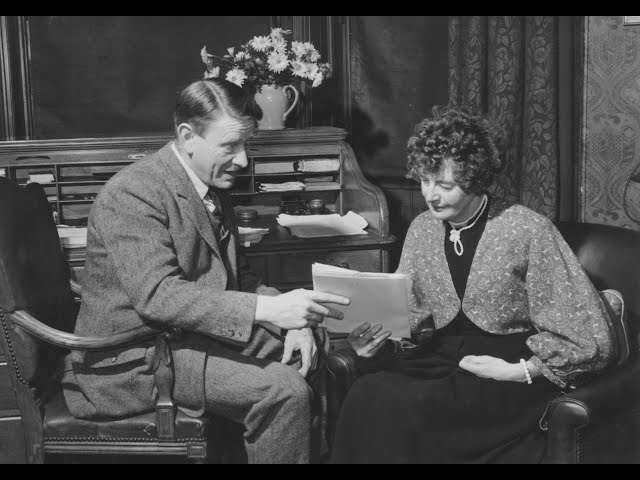
Gerald and Ethel in later life

In 1927 the 750-acre Longshaw estate, owned by the Duke of Rutland, came up for sale, and Ethel campaigned to raise funds for its purchase and protection from development. She was successful, and in 1931 the estate was given to the National Trust, who still run it today. In this decade she also helped to acquire land which became part of Sheffield’s green belt, the first British city to have one. By 1936 Ethel felt that she needed an assistant; her advert was answered by a young Manchester architect, Gerald Haythornthwaite, and they were married within a year.

On the Longshaw estate

During and after the second world war Ethel was closely involved with the CPRE and contributed to the creation of the Peak District National Park in 1951, Britain’s first. Today she is sometimes described as a forgotten figure, yet this seems a little exaggerated given that two books have recently been published about her (see below), a wood is named after her, there is a blue plaque near the site of her family home and, most impressively, a collection of 95 Peak District ‘summits’ have been collectively called ‘The Ethels’, similar to (but lower than) Scotland’s Munros. She and Gerald are buried in Crooke’s Cemetery in Sheffield.

Sources:

  1. Ethel: The biography of countryside pioneer Ethel Haythornthwaite, Helen Mort, 2024
  2. Wildly Different, Sarah Lonsdale, 2025

The Clarion call

The invention of the safety bicycle in the late nineteenth century created the possibility of leisure travel for working-class people. Derbyshire and the Peak District, close to the industrial cities of Sheffield, Nottingham and Manchester, were prime destinations for Sunday rides. These early cyclists clearly felt the need to organise themselves into clubs for mutual support, and so adopted the name and outlook of the Clarion newspaper, a socialist weekly founded by Robert Blatchford in 1891 in Manchester. They not only took the name, but they also saw themselves as travelling propagandists, rather in the later Soviet style, spreading the good word to remote villages. Local Clarion Cycling clubs held a meeting in 1895 at the Izaak Walton Hotel in Dovedale to form the National Clarion Cycling Club.

BlatchfordThe man with the moustache

Robert Blatchford (1851-1943) had a remarkable life, despite being largely self-educated, including a period in the army and a successful career as a journalist. His best-seller, Merrie England (1894), was supposed to have won far more votes for the new Labour party than Das Kapital . However, his support for the Boer War led to a sharp drop in his popularity in left-wing circles. Perhaps his real achievement was to create the Clarion movement as an umbrella which inspired numerous groups, not only for cyclists but also for ramblers, drama, field studies, scouts and drawing. The Clarion Cycling Club is still active today, despite suffering a recent split over the word ‘Socialism’ on its masthead.

Sheffield Clarion Ramblers at the Barrel Inn, Bretton, 1930

Early cycling and walking groups had a strong ethical dimension. They were not out in the fresh air just for their health, but also for their moral betterment. The slogan of the Sheffield group was ‘A rambler made is a man improved’, though as can be seen in the photo above plenty of women were also keen on improvement. There was a distinct overlap between ramblers and non-conformist chapels: both offered a spiritual as well as a social opportunity. Sheffield Clarion Ramblers had their first meeting in Edale in 1900, led by the remarkable GHB Ward (still going strong in 1930 as seen above, with his arms around chap in the front). The group campaigned continuously for the right to roam, and reached a peak membership in the late 1940s with about 200. Perhaps their achievement is summed up in Ward’s adage: ‘A man who was never lost never went very far’.

Snakes and dukes

The Snake Inn: Still a challenge for cyclists

The Snake Pass on the A57 Sheffield to Manchester route was one of the highest turnpike roads in the country, and is still plagued by winter closures due to snow and landslips. Reaching a height of 1,680 feet, it offers the most direct route between the two cities and may have been in use for thousands of years, yet there is little agreement about its history. On the 1:25,000 OS map much of the route as shown as a Roman road, and is named ‘Doctor’s Gate’, but although there was a 16th century Vicar of Glossop called Doctor Talbot there is little hard evidence to date the road further back in time.

A winding story

The Derbyshire Portway can be clearly traced from the Trent to Mam Tor, and from there the best route north is eastwards along Edale, then to climb up into the Woodlands Valley which heads northwest to the Pass. Today the bridleway lies to the west of the main road at first, then switches to the east above Alport Bridge, since the going is easier on that side. However, apart from the place name ‘Alport’ there is little evidence for speculation about its history, not even for the ‘Roman’ road – Dodd and Dodd (Peakland Roads and Trackways) claim that some Roman paving can be found, but such stonework is almost impossible to date and at this altitude it seems unlikely to have survived on the surface. However, Doctor’s Gate may well have been a medieval packhorse route.

A slippery snake

In the early nineteenth century the Dukes of Norfolk and Devonshire – principal landowners in the area – decided to build a turnpike road over the Pass to encourage trade between South Yorkshire and Lancashire. Part of the route, from Glossop up to the top of the Pass, was a completely new route, and this partly accounts for the debts that the Trust, established in 1818, ran up. There is some confusion about the engineer responsible: the Glossop Heritage website claims it was John Macadam, while other sources (e.g. Dodd and Dodd) say Telford. The road opened in 1821, but the arrival of a railway in 1845 was powerful competition, and when the Trust was wound up in 1870 it had debts of many millions, in modern terms. Since then the Pass has posed continual problems for the highway authority, being regularly closed by snow and landslips: all of which must add to the difficulty of keeping the Snake Inn, near the top of the Pass, running.

What about that snake? Nothing to do with the winding road – it’s the emblem of the Cavendish family, joint financiers of the road, seen here at Chatsworth.