Comfort at the crossroads

Relief showing a Roman imperial messenger arriving at a mansio in a chariot

Roman military dominance depended on its well-known road system, which not only allowed troops to move quickly, but also allowed messengers to ride rapidly with news or orders. To accommodate such travellers a kind of guest house, called ‘mansio’ in Latin, was built at regular intervals on the main roads, offering fresh horses as well as food and lodging.

Just over the Staffordshire boundary, south of Lichfield, are the extensive ruins of a Roman settlement built at the junction of Watling Street (near the line of the A5) and Ryknield Street, which continues to Little Chester and beyond. Both were important Roman roads, and this was first the site of a fort, then a mansio was built, and subsequently a small town grew up around it, known to the Romans as Letocetum.
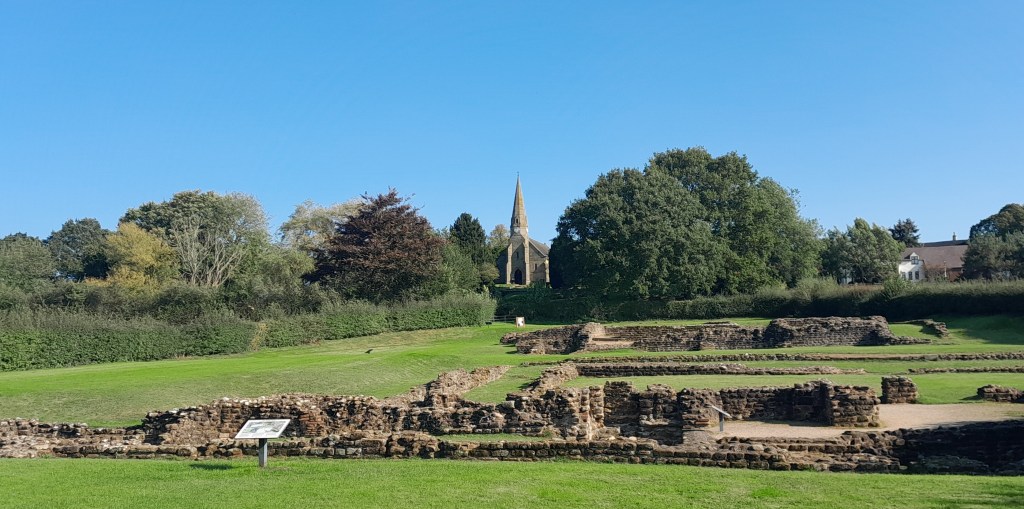
Excavated ruins at Wall

The remains of the settlement can be visited in the village of Wall, on a gently sloping site only a few hundred metres from the noisy M6 toll road. In the foreground of the picture above are the ruins of a bath house, so that tired wayfarers could have a warm soak after a day in the saddle. It seems strange to imagine public baths in such a remote spot, and it would be interesting to know who was allowed to use them.

Foundations of the mansio

Despite the care with which this site is preserved by English Heritage it is hard to imagine it in its heyday. But an inscription from Aesernia in Italy of the dialogue between an innkeeper and a departing guest gives more flavour, and can be translated as: ‘Innkeeper, let’s settle our account. One measure of wine and bread, one coin; some stew, two coins. Agreed. The girl, eight coins. That, too, is agreed. Fodder for the mule, two coins. That animal can take me to my destination…’.

Romantic Buxton?

Arnold Bennett’s masterpiece, The Old Wives’ Tale, published in 1908, is set in the mid-nineteenth century, and tells the contrasting stories of two sisters, Sophia and Constance. The latter spends her life running the family drapers’ shop in Stoke on Trent, while her sister has a more adventurous life in Paris. When Constance marries, Buxton is chosen for their honeymoon, a relatively short ride on the then North Staffordshire Railway:

“They had a way of saying: ‘Yes, we always go to Buxton. We went there for our honeymoon, you know.” They had become confirmed Buxtonites, with views concerning St Anne’s Terrace, the Broad Walk and Peel’s Cavern. They could not dream of deserting their Buxton. It was the sole possible resort. Was it not the highest town in England? Well, then!

The man himself

Bennett, who was a francophile and had lived in France since 1903, was clearly being satirical at the expense of these provincial folk:

“They always stayed at the same lodgings, and grew to be special favourites of the landlady, who whispered of them to all her other guests as having come to her house for their honeymoon, and as never missing a year, and as being most respectable, superior people in quite a large way of business. Each year they walked out of Buxton station behind their luggage on a truck, full of joy and pride because they knew all the landmarks, and the lie of all the streets, and which were the best shops.”

Park views

However, any holiday would be a luxury for working people in the 1870s, and ten days in Buxton would demonstrate that Mr and Mrs Povey were prosperous folk. The spa waters of the town have attracted visitors since Roman times (and probably earlier), though tourists in the eighteenth century frequently complained of the quality of accommodation. It was not until the Dukes of Devonshire made serious investments, such as building The Crescent, and the arrival of the railway in 1863, that large number of visitors began arriving. Today a rejuvenated town still attracts holidaymakers, although unfortunately the excellent Museum and Art Gallery has been closed indefinitely due to the discovery of dry rot.