The Clarion call

The invention of the safety bicycle in the late nineteenth century created the possibility of leisure travel for working-class people. Derbyshire and the Peak District, close to the industrial cities of Sheffield, Nottingham and Manchester, were prime destinations for Sunday rides. These early cyclists clearly felt the need to organise themselves into clubs for mutual support, and so adopted the name and outlook of the Clarion newspaper, a socialist weekly founded by Robert Blatchford in 1891 in Manchester. They not only took the name, but they also saw themselves as travelling propagandists, rather in the later Soviet style, spreading the good word to remote villages. Local Clarion Cycling clubs held a meeting in 1895 at the Izaak Walton Hotel in Dovedale to form the National Clarion Cycling Club.

BlatchfordThe man with the moustache

Robert Blatchford (1851-1943) had a remarkable life, despite being largely self-educated, including a period in the army and a successful career as a journalist. His best-seller, Merrie England (1894), was supposed to have won far more votes for the new Labour party than Das Kapital . However, his support for the Boer War led to a sharp drop in his popularity in left-wing circles. Perhaps his real achievement was to create the Clarion movement as an umbrella which inspired numerous groups, not only for cyclists but also for ramblers, drama, field studies, scouts and drawing. The Clarion Cycling Club is still active today, despite suffering a recent split over the word ‘Socialism’ on its masthead.

Sheffield Clarion Ramblers at the Barrel Inn, Bretton, 1930

Early cycling and walking groups had a strong ethical dimension. They were not out in the fresh air just for their health, but also for their moral betterment. The slogan of the Sheffield group was ‘A rambler made is a man improved’, though as can be seen in the photo above plenty of women were also keen on improvement. There was a distinct overlap between ramblers and non-conformist chapels: both offered a spiritual as well as a social opportunity. Sheffield Clarion Ramblers had their first meeting in Edale in 1900, led by the remarkable GHB Ward (still going strong in 1930 as seen above, with his arms around chap in the front). The group campaigned continuously for the right to roam, and reached a peak membership in the late 1940s with about 200. Perhaps their achievement is summed up in Ward’s adage: ‘A man who was never lost never went very far’.
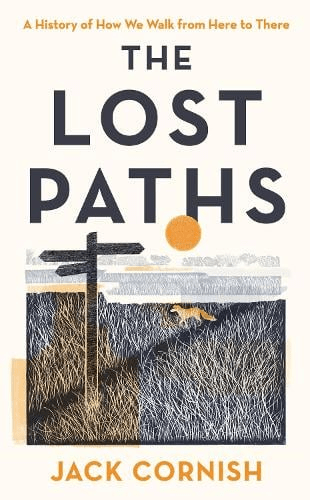
All you ever wanted to know about paths

Jack Cornish is Head of Paths at the Ramblers, which must be an excellent qualification to write on the subject. His recent book, The Lost Paths, sets out to be ‘A History of How We Walk from Here to There’. Ambitious in scope, the 19 chapters include such familiar subjects as pilgrim routes and turnpikes, but also cover topics like the growth of railways and the effects of the new post-war towns on traditional paths. Some of his material, such as the enclosures of the eighteenth and nineteenth centuries, may be familiar to any reader with an interest in history, but other topics, for instance the loss of rights of way due to military requirements during the Second World War, are unusual.

The author has assembled a fascinating range of detail, such as the vogue for ‘pedestrianism’ in the nineteenth century, when large bets were put on improbable feats of walking, such as London to York and back in six days. But his concerns are not only historical, since he discusses the need to make access to the countryside more diverse and welcoming for minority groups. If anything, the reader may feel that he has tried to include too much: it is interesting to know how many bricks were used to build London’s first railway (six million) but not really relevant to the stated theme – there’s a certain loss of focus.

Yet his palette is impressively broad in terms of geography, and Derbyshire readers may enjoy his description of a walk from Cromford to Rowsley via Bonsall Moor, which he undertakes as a recreation of the ‘mystery hikes’ which were apparently popular between the wars – hikers would board a train for an unknown destination:

‘The drama of the landscape hits me quickly. Minutes after stepping off my train, my path takes me along the bottom of a massive cliff face. Trees grow up high, directly out of breaks in the rocks, their leaves rusting and falling to the ground’.

Cornish’s own involvement in the walking he writes about is clear, and he effectively balances these personal reports with the more historical details. He is also good at recounting disputes with landowners over rights of way, and sets the inevitable Kinder trespass story in the wider context of the long-standing struggles for access all over this country.

I would certainly recommend The Lost Paths to all fellow walkers, though with a couple of caveats. The title doesn’t really do justice to the scope of the book, which is much broader than it suggests, and the illustrations – small black and white engravings – add little beyond decoration.