How old is Matlock?

St Giles, Matlock

Today it is easy to drive on the main roads through Matlock Bath or Matlock Bank without seeing Old Matlock, centred on St Giles Church and the handful of stone houses around it. But seen from Hall Leys park, the church is in a remarkable position, on top of a steep cliff, bounded by the Derwent on one side and the Bentley Brook on the other. Most of the church was rebuilt in the mid-nineteenth century, although the font is Norman. Yet it seems likely that this site has had some sacred significance since pre-Christian times, given the watery surroundings.

Pic Tor Lane

The road from here through Starkholmes and down to Cromford bridge is an old route, and the only road out of Matlock that was never turnpiked, and so remained toll-free. But another ancient way appears to run down Pic Tor Lane, past the old vicarage and under the railway bridge to the river. At this point there is geological evidence of a possible ford, and the route would have gone up Masson Hill along what is now St John’s Road and joined up with Salter’s Lane, which came via Leek and Hartington.

Pedestrian bridge under railway

The current Matlock bridge dates from the fourteenth century, but the position of the church supports the theory that the earlier crossing could have been here, further downstream. The significance of this route is further reinforced by the construction of the railway bridge and the pedestrian river bridge in the mid-nineteenth century, suggesting that this route was then seen as worth maintaining.

The Gatekeepers

Tollhouse near Holbrook

The arrival of turnpike roads in the mid-eighteenth century created a new type of job: tollgate keeper. Because the gates had to be manned day and night, accommodation had to be provided for the keepers, although presumably there was little traffic after dark. Many of these tollhouses, such as the one above on the Derby-Chesterfield turnpike, have survived, their original function indicated by their closeness to the road.

The task of collecting tolls was often auctioned off by the turnpike trusts on an annual basis, but the tollhouses and tollgates would belong to the trusts. Providing these added to the considerable cost of developing the turnpike roads, creating debts which, in many cases, would never be repaid.

The joys of gate keeping at night are vividly suggested by Dickens in his early novel ‘The Pickwick Papers’. Pickwick and Wardle are chasing Mr Jingle’s post chaise after midnight, when they reach a tollgate:

After a lapse of five minutes, consumed in incessant knocking and shouting, an old man in his shirt and trousers emerged from the turnpike-house and opened the gate. ‘How long is it since the post-chaise went through here?’ inquired Mr Wardle.

‘How long?’

‘Ah!’

‘Why, I don’t rightly know. It worn’t a long time ago, not it worn’t a short time ago – just between the two perhaps.’

Although toll gates are not marked on Burdett’s map, some are shown on Sanderson’s 1835 map marked as TB (toll bar). In some cases they gave the name to the settlement that grew up around the gate, notably Ambergate, where the tollhouse was near to the confluence of the River Amber with the Derwent. This may also apply to Bargate near Belper and Codnor Gate on the Cromford and Langley Mill turnpike.

Tollhouse on Steep Turnpike in Matlock

Surviving tollhouses can be a concrete reminder of the route of a turnpike road, which often followed a course which seems strange to us today. The example above at the foot of Steep Turnpike, in Matlock, should be no surprise, given the name of the road (note the walled-up doorway beside the road). But the cottage below, In Hopton, is a reminder that the Oakerthorpe to Ashbourne turnpike ran through the villages of Hopton and Carsington: the road beside Carsington Water is modern. Again, note the bricked-up doorway.

Probable tollhouse at junction with the Dene, Hopton

Using maps to research old roads

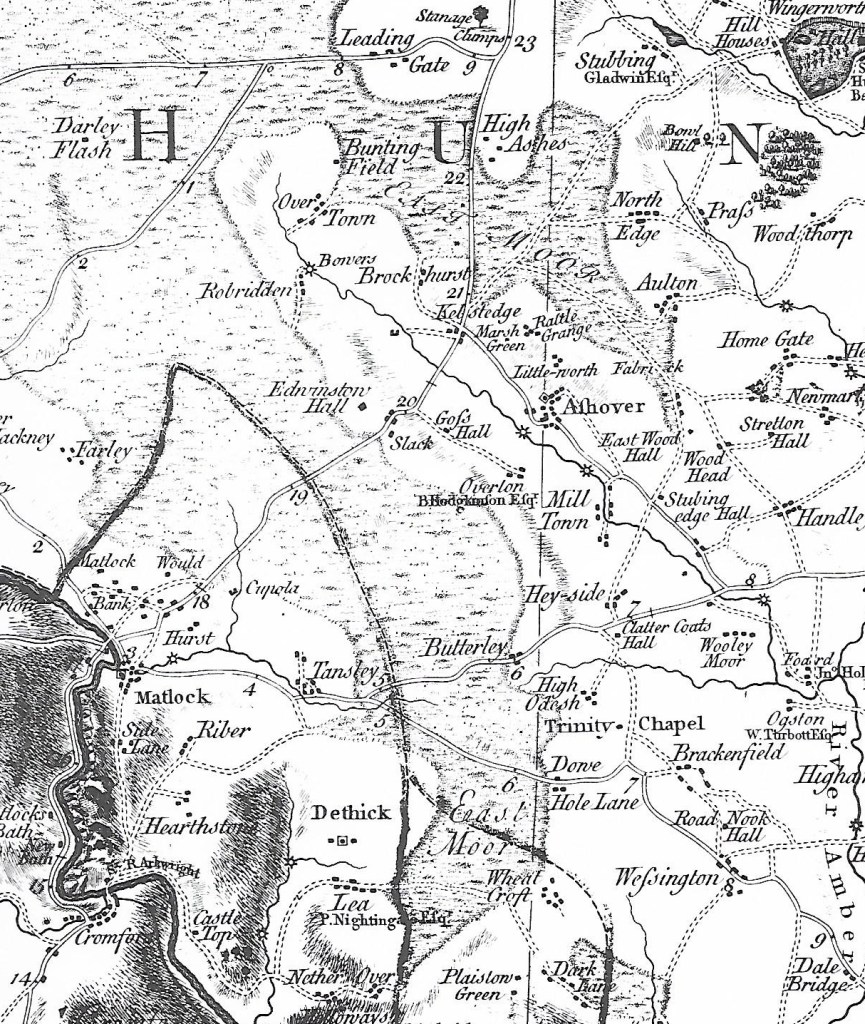
Maps are an obvious choice in researching the road network of the past, but they have several limitations. There are no accurate maps of Derbyshire’s roads before the mid-eighteenth century, when Peter Burdett published his inch-to-a-mile map of the county in 1767 (see section above). We can assume that the road network presented by Burdett was essentially the same system that had operated since medieval times, but many minor roads and paths were not included.

Burdett marks the new turnpike roads with solid lines, and shows the milestones, while broken lines are reserved for less important roads. The map reveals many changes over the past 250 years: East Moor covered a much larger area, for example, while the centre of Matlock was focused on St Giles, rather than Crown Square as today. Some of the place names are unreliable, so Whatstandwell is written Hotstanddell – perhaps the surveyor misheard a local accent!

Burdett’s map was revised in 1791 to include new industrial sites such as coal mines and the Cromford canal, but the next large-scale map was Sanderson’s map of 1835, ‘Twenty miles around Mansfield’, which covers the eastern part of Derbyshire and shows field boundaries and many road names.

This section of the map, covering a similar area around Crich, shows the growth of enclosures in the early nineteenth century over East Moor, as well as displaying the road network in more detail. At a scale of two and a quarter inches to the mile it was the largest scale map so far produced, and so is more valuable in some areas than the Ordnance Survey one inch to the mile map of Derbyshire, first produced in 1840.

Clearly all such early maps have their drawbacks and omissions, but for road historians they provide an invaluable reference source, full of clues to the landscape of the past.