The secrets of Shuckstone

The cross base, with dandelions, looking east

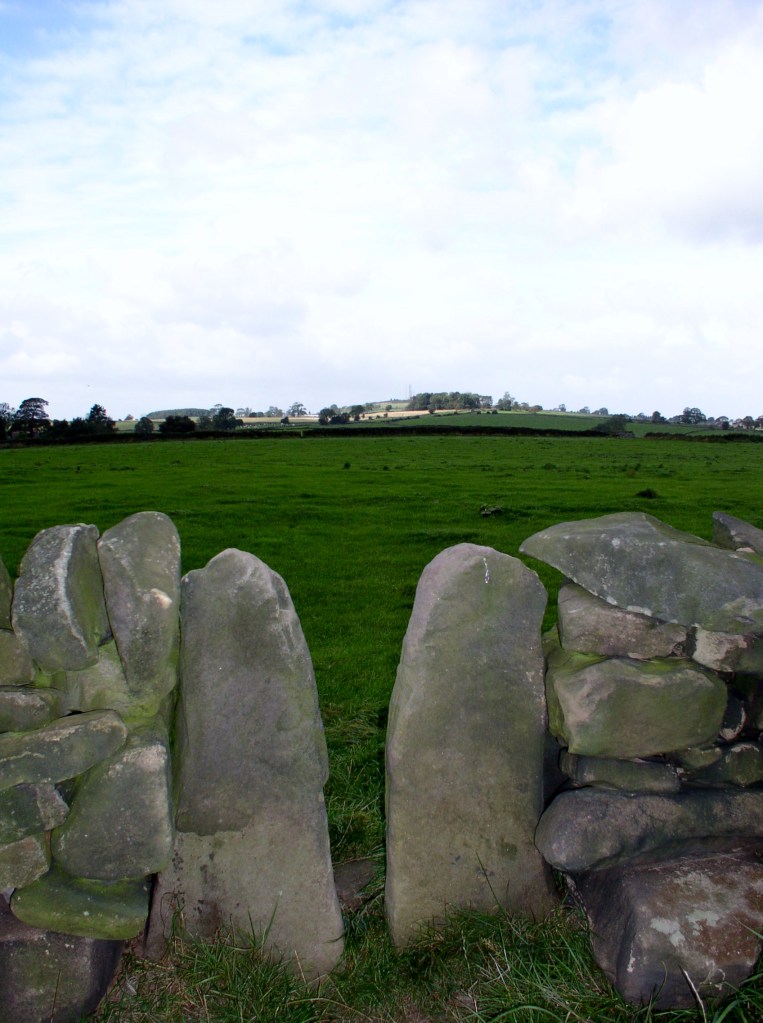
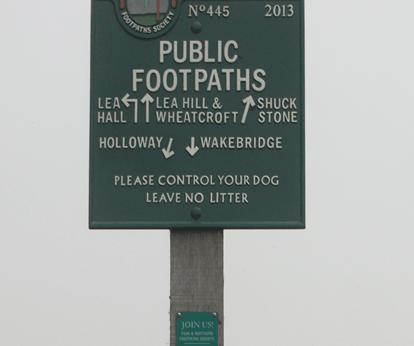
Starting from Whatstandwell Bridge, if you follow the track from the hamlet of Robin Hood up through the quarry and wood to Wakebridge, and then on past Wakebridge Farm up to the top of the hill, the route finally levels off and you come to Shuckstone Fields, behind Holly Grange Farm and above Lea. This large field contains the intersection of five footpaths, and Shuckstone Cross must have marked this point. Today only the base remains, and the markings on this are illegible, but according to local historian George Wrigglesworth the four sides were marked C (for Crich) A (possibly Ashover) M (Mansfield or Matlock) and W (Wirksworth). In the late eighteenth century a pot containing Roman coins was dug up here, presumably buried by someone wanting a clear marker for their savings. Not far away is a ‘Holy Well’ of three compartments, which could have offered refreshment for travellers.

The Holy Well

The term ‘cross’ can be misleading: the crosses found in country churchyards, as at Eyam, had a cross shape and were often preaching crosses, while a cross as at Shuckstone was simply a stone shaft held in a square base which acted as a waymark or signpost. This marker would have been clearly visible at this high point (nearly 900 feet), which was moorland until a couple of hundred years ago: the 1791 map shows that the area was the southern tip of East Moor, an expanse of rough pasture which stretched from here north towards Chatsworth and then Sheffield.

The Cross may have also been a boundary marker, since the same map (Burdett’s) also shows that the track up from the Derwent runs along the old wapentake boundary, with the wapentakes of Wirksworth to the west and Morleyston to the east. According to Kenneth Cameron, (The Place-names of Derbyshire Part 2) the name ‘Shuckstone’ is fairly recent, and older records, going back to the Domesday Book, refer to this spot as ‘Shuckthorn’ or similar, meaning the Devil’s thorn tree. This is certainly a location well worth visiting, but probably not on a dark night.
A choice of paths

The style of stiles

Since the nineteenth century stiles have been a familiar feature of the rural landscape, providing a bucolic focus for pictures of simple country folk or lovers’ trysts. Before the enclosure of moors and commons stiles weren’t needed, but with the arrival of hedges and dry stone walls access was needed for pedestrians. ‘Stile’ comes from the old German word ‘stigel’ which means to climb or go over.

Squeeze stile near Alport Height

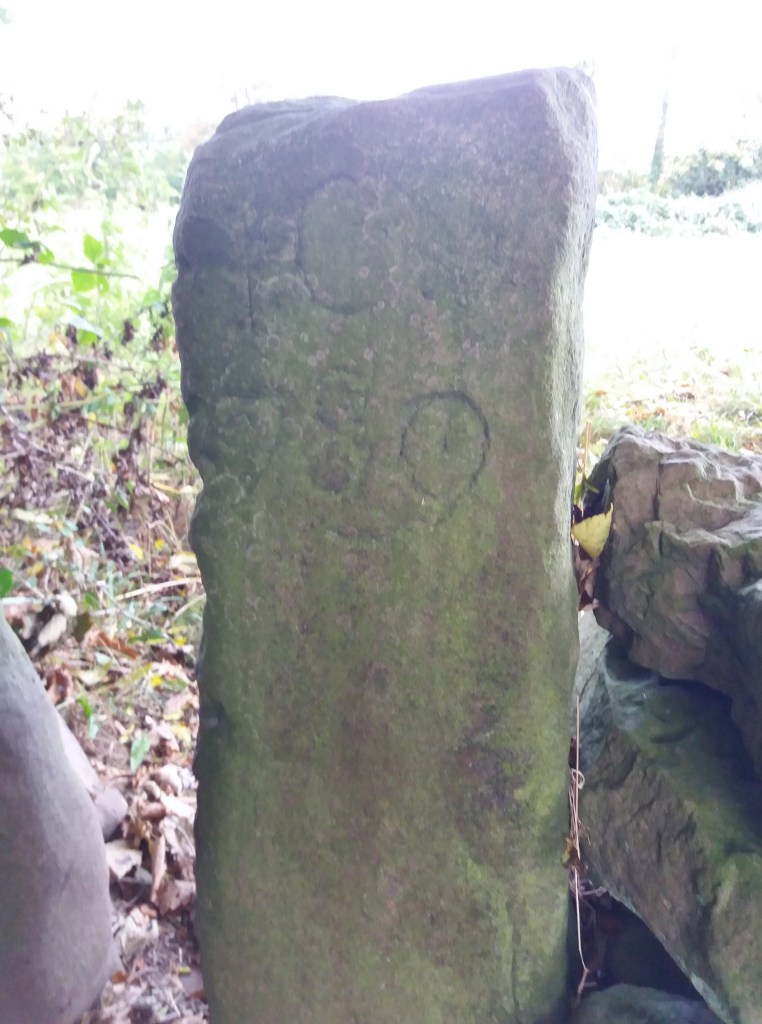
Squeeze stiles are a distinctive feature of the Derbyshire landscape. They are simple to pass through, but clearly are only effective if too narrow for sheep to slip between, and so can prove quite tricky for the overweight! They have the advantage of clearly marking the route of a path, so that when entering a field you can normally see the next stile ahead, and aim for that. Very occasionally the stile stones are dated, as in the example below at Lea, which suggests that this area was enclosed about 1780.

Other types of stile are with wooden steps, or stone steps let into a wall. Both can be more difficult for walkers if not well-maintained, and an upright wooden post should be provided for hand support. Dogs can also find stiles tricky, so the ideal model has a dog gate which can be raised when needed. But today there is a move to replace stiles with gates, more convenient for elderly walkers but also requiring more maintenance – and easily left open.

Stile and gate near Holbrook

Beyond their practical function, stiles can be seen as fossilised markers of footpaths, possibly 250 years old in many cases, but indicating routes that were in existence before the enclosures and which had to be preserved subsequently. In places the paths they serve could be medieval, and may once have been a long-distance road, now merely a Sunday ramble.

Dark Lanes and Holloways

Longwalls Lane above Blackbrook

How many ‘Dark Lanes’ can you find on the Ordnance Survey maps of Derbyshire? I know several, for example the one running from Wheatcroft towards Plaistow Green, but there are probably more. In practice these lanes are usually shady holloways, so that the meaning of the name is obvious. But what is the origin of holloways, which are found all over the county, though more commonly on sloping ground?

Over hundreds of years’ use, these tracks, which were most likely no more than packhorse routes, became eroded by the constant wear and tears of hooves and boots. Rain would erode the surface soil until bare rock was reached, as can be seen on Longwalls Lane above. There may well be a relation between the depth of the holloway and the age of the route, though that would be difficult to calculate. But what is clear is that a deep cut lane, lying a yard or more below the surrounding fields, must be several hundred years old.

Holloway near Lea

The picture above shows a good example of an ancient holloway, running between Lea and Upper Holloway. Unusually it can be partly dated from an adjacent stile stone (below) of 1780, meaning that the holloway was in use 240 years ago (and probably many more). A steep road in Holloway, leading up to the moor, is called The Hollow, and must have linked to the Lea route as well as giving the village its name.

Dated squeeze stile, Lea

Over time, some holloways became waterlogged, especially in winter, forcing road users to travel alongside. The old path bottom gradually became overgrown and clogged with saplings and brambles, so that the right of way moved parallel but above. Today it seems reasonable to estimate that any holloway is earlier than an enclosure road (most of which date to the early nineteenth century), and may well indicate the local medieval road network.