Hemlocked

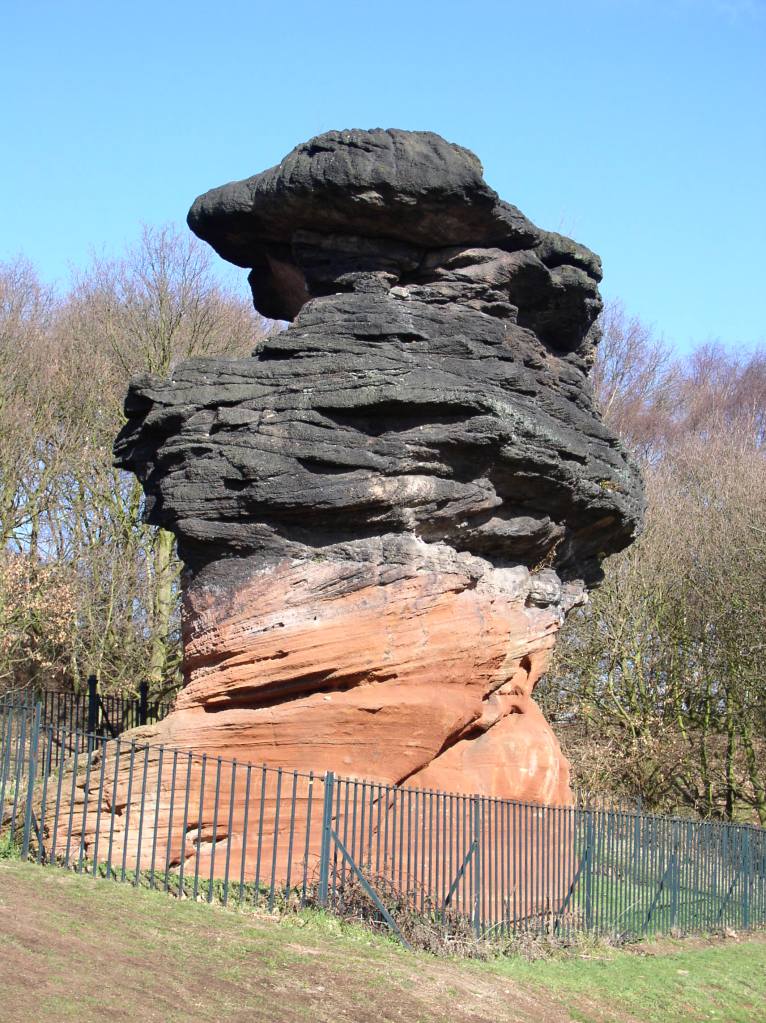
The Hemlock Stone

The Hemlock Stone on Stapleford Hill west of Nottingham is a sandstone pillar about five metres high, set in parkland. The name suggests that it may have acted as a boundary marker between Derbyshire and Nottinghamshire, and it is found near the Portway’s crossing of the Erewash (the county boundary). It seems to have had more significance in the past, with eighteenth-century references to its use for Beltane celebrations, and was famous enough for DH Lawrence to include it in Sons and Lovers as the destination for an Easter walk.

A barefoot Lawrence at the University of Nottingham

The walk from Eastwood to the Hemlock Stone had actually taken place in 1905, organised by Lawrence for his family and friends. Beginning in the town, the original route is now difficult to follow due to the construction of the A610 on the line of the old railway, but the walking party first crossed the semi-derelict Nottingham Canal, then the Erewash, and thirdly the Erewash Canal, soon coming to a footbridge over the Midland mainline railway, whose express trains linked Eastwood and Langley Mill to London. The party next joined the Heanor-Ilkeston road and followed this through Ilkeston, a town Lawrence knew from his teacher training. Their route then turned towards Stapleford: today mostly built up but following pleasant country lanes a hundred years ago. It is interesting that the Stone was seen as a significant destination, worth a fourteen-mile walk (at least), and was clearly a popular spot:

‘Everywhere in the field below, factory girls and lads were eating lunch or sporting about’.

Jessie Chambers, the model for Miriam Leivers

In the novel the importance of this walk is the emerging love between the hero, Paul Morel, and Miriam, the girl from Haggs Farm (a thinly-disguised Lawrence and Jessie Chambers). Both felt rather alienated from the rest of the party, who were inclined to climb the Stone and carve their names there. On the way home they both fell behind the others, Lawrence struggling to repair an umbrella, and their mutual sympathy developed into a complicated affair which dominates the first half of Sons and Lovers and has become a classic of teenage angst.
…and miles to go before I sleep

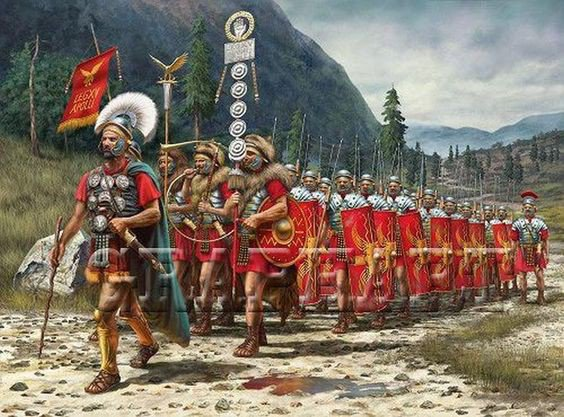
The Roman legions are supposed to have been capable of marching 20 miles per day. Even allowing for the Roman mile being slightly shorter than the modern mile, reducing the length to about 18 miles, this still seems very ambitious. It assumes they were walking on fairly well-surfaced roads rather than rough ground, but they must have been burdened by heavy equipment like shields. I imagine that this distance might have been possible in brief spurts, but for longer journeys something like 15 miles seems more realistic. However, the question of how far people could and did walk in a day is interesting, and can have surprising answers.

Looking down into Edale from Hollins Cross

There are many nineteenth-century examples of people walking remarkable distances to their work, especially in rural areas such as Derbyshire. It is easy to forget the complete lack of public transport in the days before bicycles became a practical solution. The 1851 Census records about 50 mill hands living at Castleton who worked at the cotton mill in Edale – their daily commute was about 3 miles each way but involved a climb of about 800 feet over Hollins Cross – in all weathers! Thomas Hardy’s novel Jude the Obscure describes Jude’s ten-mile walk to work as a stonemason; a figure which seems fantastic now but which must have been less remarkable when published in 1895. Even the walk to school could be arduous for children from outlying farms: Alison Uttley recalls her daily trudge from Castletop Farm near Cromford to Lea School, via Bow Wood – about a mile and a half each way. At the beginning of the twentieth century DH Lawrence, when a schoolboy in Nottingham, had to walk over two miles from his home in Eastwood to Kimberley station to catch a train into the town. As fictionalised in Sons and Lovers:

‘Mrs Morel was rather anxious about his health. But she herself had had to put up with so much that she expected her children to take the same odds’.

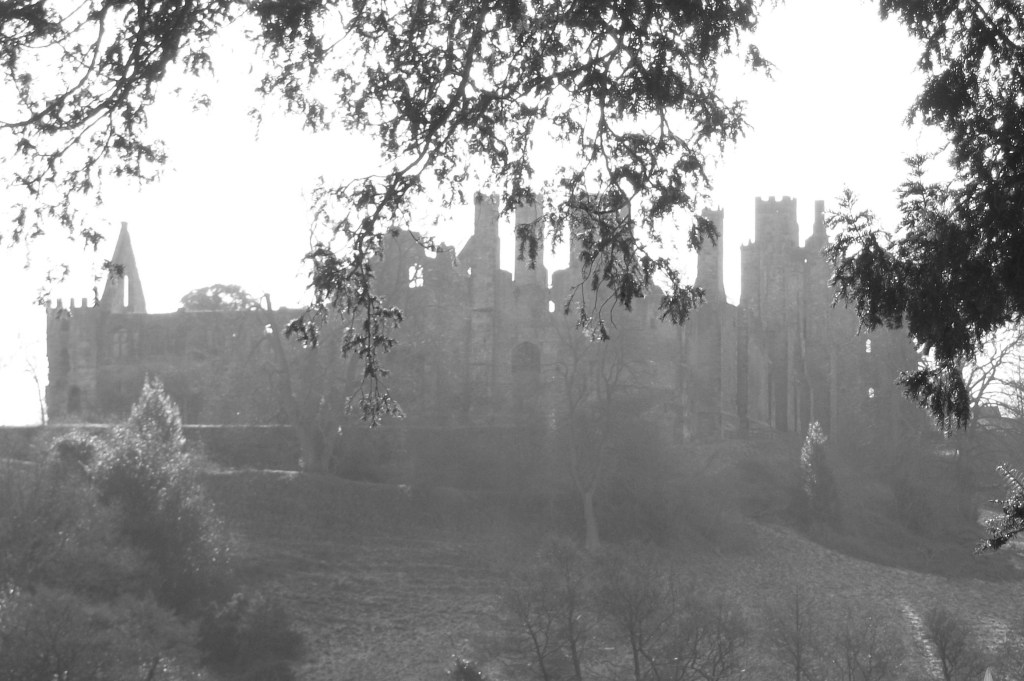
The romantic ruins of Wingfield

Lawrence also provides a good illustration of the popularity of hiking in the early twentieth century among the more radical working classes. For the first time, people had sufficient energy to go walking in their free time – something that would have been unthinkable for a labourer a hundred years earlier. In Sons and Lovers he describes a walk taken by a group of young folk, all from the Congregational Church in Eastwood, from Alfreton station via Crich to Ambergate station. Here he fictionalises an actual walk he led at Easter 1905, in which they visited Alfreton church, Wingfield Manor and Crich Stand (clearly not the present tower). On arrival at Whatstandwell:

They managed to procure a loaf and a currant loaf, which they hacked into pieces with shut-knives, and ate sitting on the wall near the bridge, watching the bright Derwent rushing by, and the brakes from Matlock pulling up at the inn’.

Given that all the walkers had to walk to and from the station at the start and end of the walk, the minimum distance they would have walked is about sixteen miles – a distance that would give many modern (and better-shod) hikers a real challenge!

Sources:

Robert Frost ‘Stopping by woods on a snowy evening’

Fletcher, A.J. (1971) ‘The Hope Valley in 1851’. Derbyshire Archaeological Journal 91:169-182

Lawrence, D.H. Sons and Lovers, Penguin, Harmondsworth, 1948

Love in the slow lane

The Long Engagement’ by Arthur Hughes (Birmingham Art Gallery)

Before the mid-twentieth century many homes were overcrowded, with a lack of privacy that would surprise younger people today. Furthermore, parents were often inclined to supervise their children’s indoor behaviour, so that most ‘courting’ took place out of doors, away from adult eyes. This applied equally to middle-class people: in the Hughes’ painting above a curate is meeting his fiancee in the woods, where ivy has grown over their initials carved into a tree, symbolising their lengthy enforced wait until he can afford to marry.

Path from Crich to Chadwick Nick

Most towns and villages would have had a ‘lovers’ lane’ where courting couples could find some privacy, as in the Crich footpath above, which still has boulders carved with sets of initials. Suitable venues would not be too far from habitation, nor the paths too rugged for girls dressed in their best! The situation is well-described by DH Lawrence, always an honest depictor of working-class life at the turn of the twentieth century, in ‘Sons and Lovers’, when Paul and Clara take the Clifton path by the River Trent:

He held her fast as he looked round. They were safe enough from all but the small, lonely cows over the river. He sunk his mouth on her throat, where he felt her heavy pulse beating under his lips. Everything was perfectly still. There was nothing in the afternoon but themselves.

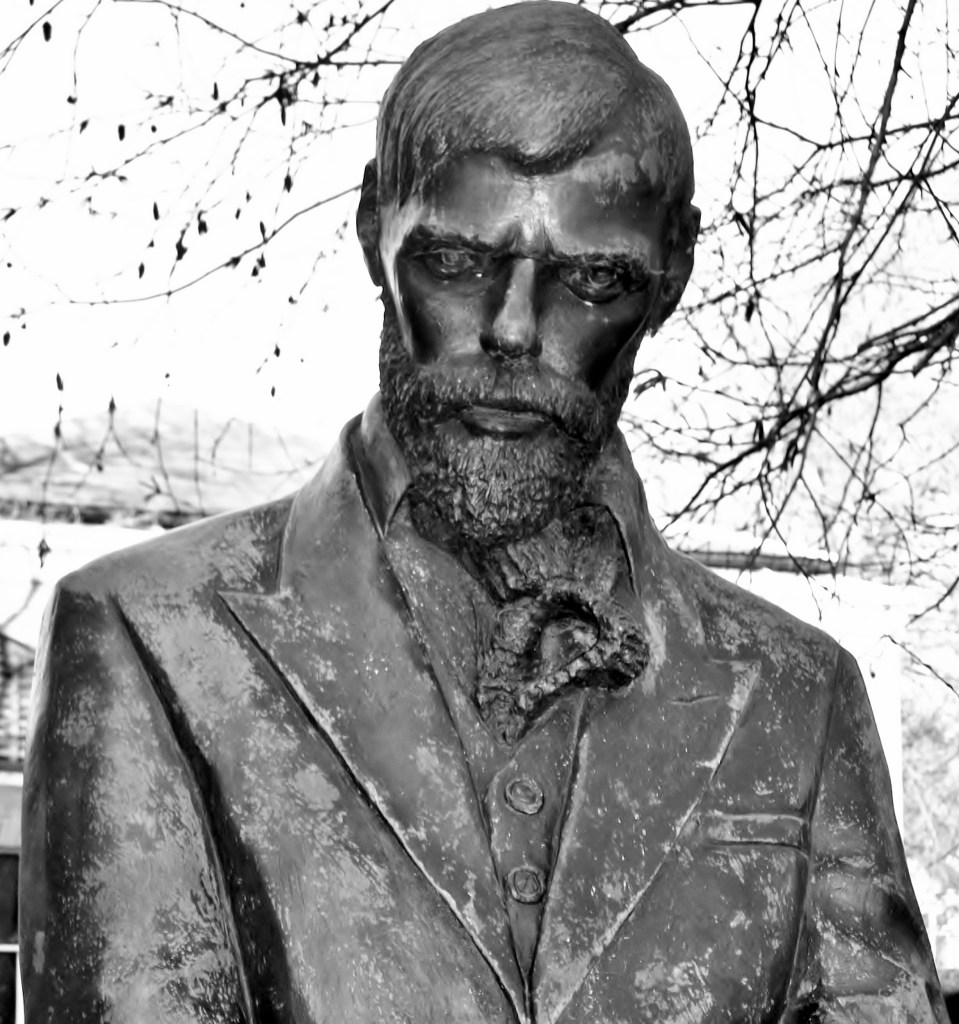
Statue of Lawrence at the University of Nottingham

Lawrence’s early stories and novels also give us a good idea of what were then acceptable distances for walking, either for work or pleasure. In 1905 public transport was limited and bicycles were only for wealthier people. On another occasion in ‘Sons and Lovers’ Paul and Clara are out in the hills after dark and she says that she needs to hurry back to the station to get the last train home to Nottingham. He says:

‘But you could easily walk it Clara, it’s only seven miles to the tram. I’ll come with you’.

It’s hard to imagine any contemporary lover thinking that an extra half hour with their darling was worth a two hour walk!