On the slow road to Wirksworth

The Road to Wirksworth/ George Turner

This painting is one of several with the same or similar titles and visual ingredients. The artist, George Turner, seems to have specialized in rustic views of his corner of Derbyshire, such as the example above, which must have been painted looking north at a junction on today’s B5023, Duffield to Wirksworth road. Dating from the start of the twentieth century, there is clearly little traffic, given the small flock of sheep dozing on the carriageway. The unsurfaced track looks quite stony, while the shepherd and his collie seem rather under-employed. Turner must have found this a successful formula for his work, since many other landscapes have similar content.

The other Turner

George Turner (1841-1910) was born in Cromford, and became a self-taught artist and art teacher. With his first wife Eliza he also farmed near Barrow-on-Trent, as depicted in some of his work. When she died in 1900 he moved back to the region of his childhood, first to Kirk Ireton and then to Idridgehay, which is on the Wirksworth Road. He then remarried Kate Smith, 30 years younger than him, who was also an artist. They lived there for the rest of his life, and he is buried in the churchyard. His son William, by his first wife, continued painting in the same vein. Turner’s work is in several local municipal galleries and currently can sell for several thousand pounds.

Lane at Gorseybank, Wirksworth/ George Turner

This view seems to be just outside Wirksworth, at Gorseybank, possibly on Prathall Lane. Some perennial themes are included, such as the shepherd with his mini-flock dozing away, but this time he has company: presumably his wife, and their child playing on the verge. Once again traffic must be minimal, and judging by the foliage it is early autumn. In the background can be seen the higher ground that encloses the town. Clearly Turner found it profitable to present the Derbyshire countryside as a static, timeless setting; even the sheep are motionless. The sky is quite blue, the branches wave about a bit, but nothing much else happens. A far cry from the nearby mills, quarries, mines, forges and railways which by this date had moved into the Ecclesbourne Valley!

The name of the lane

Road name near Holbrook

Although name signs like this are relatively modern, roads have been named for hundreds of years, and today road names are a useful resource for historians. We do not know what names the Romans actually gave their routes, but after their departure they were called ‘streets’ as in Ryknild Street, which ran from Derby to Chesterfield. Many place names e.g. ‘Stretton’ reflect this. Anglo-Saxons used the noun ‘way’ for their roads, and this survives in many expressions such as ‘highway’ and ‘byway’. The word ‘road’ was not common until the seventeenth century, and may be derived from the verb ‘rode’.

The most obvious type of name gives the destination of the road, hence Chesterfield Road or Brassington Lane. Another refers to some feature found on the road, either natural or man-made, such as Chapel Lane or Cuckoostone Lane. In the case of an ancient route like Hearthstone Lane, running from Cromford to Riber, there is no obvious Stone, raising the question ‘Where was it?’

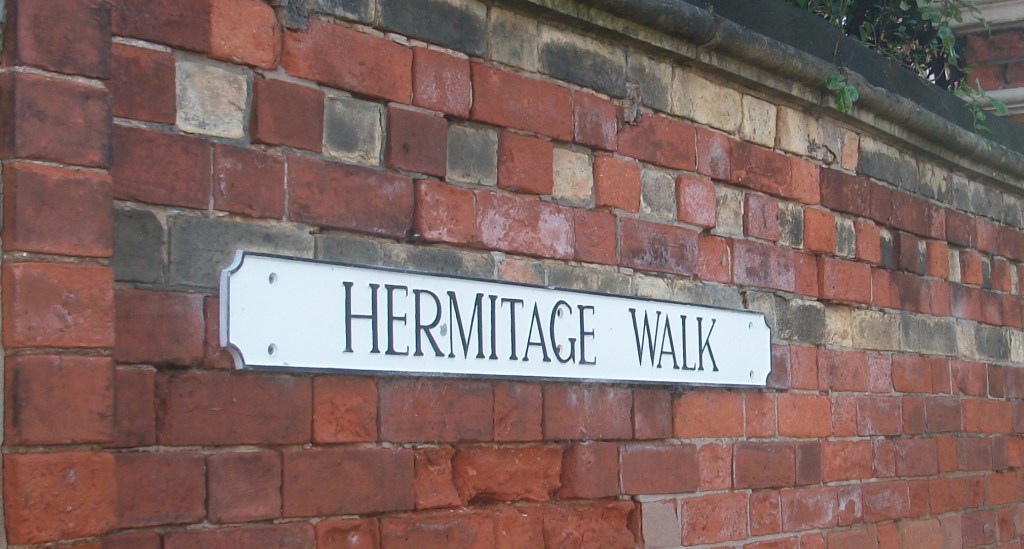
Hermitage Walk, Nottingham

This sign in The Park in Nottingham is a valuable clue that the ‘Walk’ led to an ancient group of caves (now inaccessible) that contained a rock-cut chapel. Other names refer to the state of the road: Long Lane, Marsh Lane, New Road. In this last case, the name suggests that there is an ‘old road’ that could be investigated.

Many road names refer to natural features using archaic vocabulary. ‘Shaw’ or ‘Carr’ names are common in Derbyshire, and mean a wood on a steep slope, as in Leashaw, Upper Holloway. ‘Sitch’ is Anglo-Saxon for a small stream. ‘Well’ endings as in Bakewell suggest a natural spring.

A few names refer to an individual, either familiarly in ‘Samuel’s Lane’ or more grandly with ‘Via Gellia’, named by Anthony Gell, the road developer, after himself in pseudo-Roman style.

Road sign on the Ridgeway near Heage

But there will always be names that elude discovery, or can only be the subject of wild guesswork. What’s the story behind Lickpenny Lane, for instance, or the Clatterway at Bonsall? Or did Wapentake Lane near Kirk Ireton really lead to the site of the ancient Wapentake?