Riding with Cobbett – 2

Statue of Cobbett at Farnham

In the early modern period, gentlemen – and the more daring ladies – preferred to travel on horseback. William Cobbett, touring England in 1822 for his masterpiece ‘Rural Rides’, explains this preference:

My object was … to see the country… and to do this you must either go on foot or on horseback. With a gig you cannot get about amongst bye-lanes and across fields, through bridle-ways and hunting-gates …

From his saddle Cobbett meets a rich variety of fellow travellers, who he reacts to with typical vigour:

On the road-side we saw two lazy-looking fellow, in long greatcoats and bundles in their hands, going into a cottage. ‘What do you deal in?’ said I to one of them, who had not yet entered the house. ‘In the medical way,’ said he. And, I find that vagabonds of this description are seen all over the country …

Near Uxbridge he mentions his amusement at seeing ‘in all various modes of conveyance, the cockneys going to Ealing Fair’, which sounds like a print by Hogarth come to life. Cobbett strongly sympathises with the situation of the rural labourers, as when he crosses the River Wey:

Here we found a parcel of labourers at parish work. Amongst them was an old play-mate of mine. The account they gave of their situation was very dismal. The harvest was over early … now they are employed by the parish … to break stones into very small pieces to make nice smooth roads lest the jolting, in going along them, should create bile in the stomach of the overfed tax-eaters.

Late nineteenth-century gypsy encampment

Cobbett is more positive when he meets a group of gypsies, whom he finds physically impressive:

At Cheriton I found a grand camp of gipsys, just upon to move to Alresford. I had met some of the scouts first, and afterwards the advanced guard, and here the main body was getting in motion. One of the scouts that I met was a young woman, who, I am sure, was six feet high …. The tall girl that I met at Titchbourn, who had a huckster basket on her arm, had most beautiful features. I pulled up my horse, and said, ‘Can you tell me my fortune, my dear?’

Still open for business – the Holly Bush at Headley today

One of Cobbett’s best qualities is the ability to laugh at himself. On one day’s ride he got thoroughly lost, as he refused to use the turnpike road, and spent hours being misled on bridle-ways by a guide, all in the pouring rain. He writes:

At the Holly Bush at Headley there was a room full of fellows in white smock frocks, drinking and smoking and talking, and I, who was then dry and warm, moralised within myself on their folly in spending their time in such a way. But when I got down from Hindhead to the public house at Road Lane, with my skin soaking and my teeth chattering, I thought just such another group, whom I saw through the window sitting round a good fire with pipes in their mouths, the wisest assembly I had ever set my eyes on.

A life on the road

Tramps" — illustration for "The Uncommercial Traveller" by Sol Eytinge, Jr.

Tramps on the roadside in Victorian times

In contrast with the rich and powerful, whose historical journeys were often recorded, we know very little about the thousands of people in the past who made a living from being on the move. Some may have been semi-criminals, but the great majority supported themselves by providing a service; moving goods to where they were wanted. Yet the stigma attached to itinerant workers persisted; they were often seen as a threat to the settled householder or shopkeeper. For some, such as the drovers, it could be a profitable business, while others had no choice but to beg from village to village, relying on the kindness of strangers.

Well into the twentieth century tramps were a familiar sight on our roads, with George Orwell providing an unusual glimpse of their lives in his Down and Out in Paris and London. Written in the 1930s, he describes the grim conditions in the ‘Spike’, where workhouse-style accommodation was provided by the local authorities. Today, of course, the volume of traffic on the roads makes old-style tramping impractical, so that the destitute sleep rough in cities, where there is more food, money and shelter.

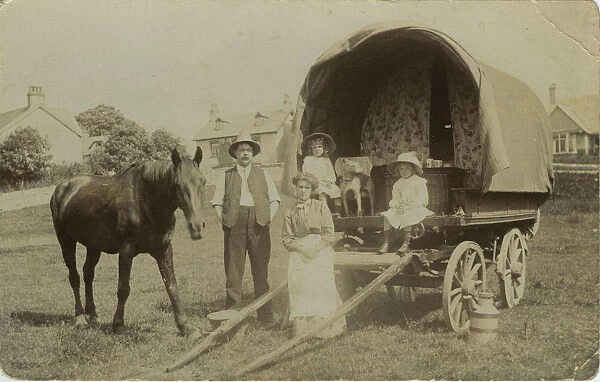
Gypsies and Caravan (Photos Prints Framed Posters Puzzles Cards Gifts  Canvas...) #20031226
A gypsy family in the 1930s

Gypsies, travellers or Roma are one marginal group that has attracted much interest and been heavily romanticised by writers such as George Borrow, while surviving into modern times. But others have been made redundant by the increase in personal mobility – we forget how isolated a Derbyshire village would have been up to the 1950s. Drovers were one of the most respected trades, responsible for the well-being of herds of valuable animals and their safe delivery to market. They would avoid turnpikes and use their own routes, with an overnight halt in an inn with grazing attached. Today it is difficult to trace droving roads, though place names such as Bullbridge may provide clues.

Probable west-east drove road near Minninglow

Pedlars (or travellers or hawkers) supplied the needs of isolated farms and cottages, in particular catering for women who could rarely visit a market town yet needed lightweight items such as sewing materials. They carried their goods in a pack, today commemorated in the name of the Hathersage pub, the Scotsman’s Pack. They must have been welcome visitors, but it is now hard to imagine how difficult their lives would have been, outdoors in all weathers and with the burden of the pack. Another significant group were the badgers or higglers, who bought goods such as eggs and butter from farmers and resold them at market. In theory they needed a licence to operate, so that for example in 1748 179 licences were issued at the Derbyshire Quarter Sessions, although many people may have operated unlicensed. As few, if any of these thousands of itinerant workers left a written record, tracing their lives is frustratingly difficult, but clearly their work was vital for the rural economy of the pre-motor age.