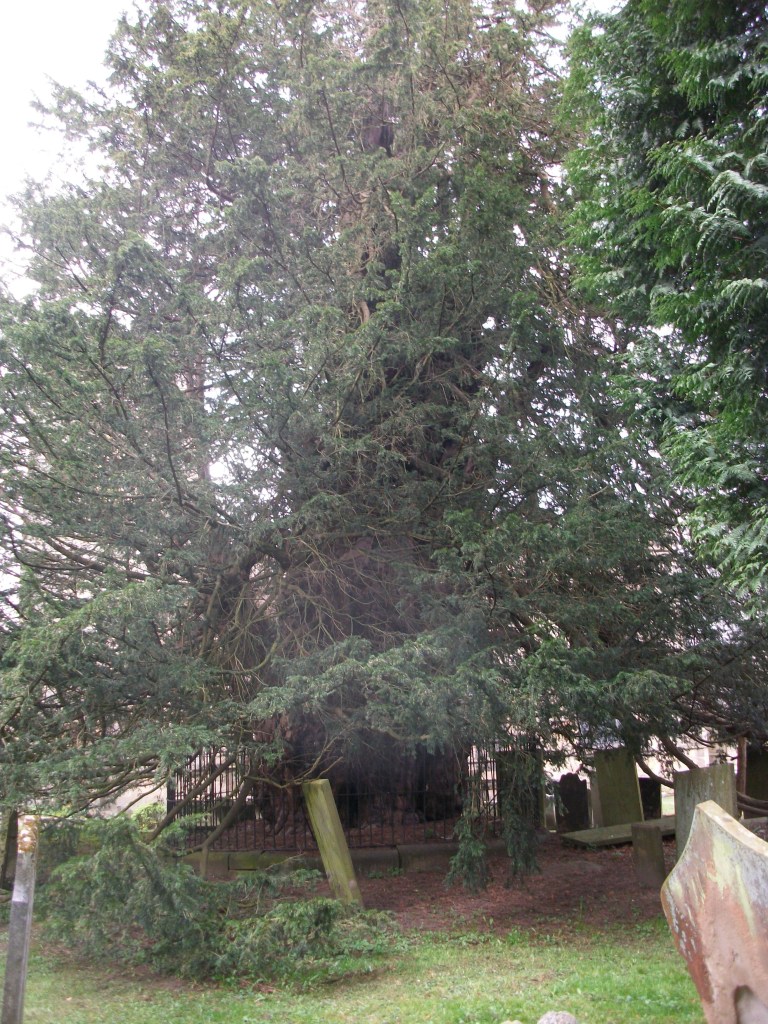
Traveller’s Tree

The yew tree in St Helen’s churchyard at Darley Churchtown is a well-known example of an ancient tree in a sacred setting. Growing near the west church porch, it is 33 feet in girth (which makes it hard to illustrate clearly), and is estimated to be 2,000 years old. Clearly it pre-dates the (twelfth-century) church, suggesting that this was a significant site even possibly in pre-Roman times. Certainly the nearby river crossing at Darley bridge has been part of an important west-east route for thousands of years.

There has been much speculation about churchyard yews, such as the idea that they were grown to provide wood for longbows, but their great age suggests a less prosaic function, as markers of significant sites for travellers.

The Darley yew is not the only ancient one in the county. The yew at St Edmund’s, Allestree may have given the name to the village, suggesting that the tree was already sizable when ‘Adelard’ had his settlement there. There are others at Beeley, Brailsford, Doveridge, Marston Montgomery and Muggington.

The Old Yew Tree, South Wingfield

Although native, the yew is not a common species in Derbyshire. However, it appears to be quite a common name for pubs and farms: with pubs at Dronfield, South Wingfield, Ednaston and (sadly now closed) Holloway. In some cases there is a yew growing on site – it would be interesting to know which came first, the tree or the pub? Pubs and inns were clearly important for travellers in the past, and before inn signs were displayed inn keepers hung an evergreen bush outside their door – usually holly or yew. This is the origin of the saying ‘A good wine needs no bush’. There are currently five Hollybush pubs in Derbyshire, at Grangemill, Makeney (which claims to be one of the oldest pubs in the county), Ripley, Breedon-on-the Hill and Church Broughton.

The Thorn Tree, Ripley

The most common pub tree name is the Royal Oak, which is the third most popular pub name in England. However, this is really a Royalist-type name, commemorating the escape of the future Charles II from Parliamentary troops by hiding up an oak. Other ‘tree pubs’, in descending order of popularity, are: Orange, Walnut, Pear, Oak and Cherry. It is notable that Matlock has a good variety of such pubs, all with rather unusual names: Thorn Tree, Laburnum, Sycamore and (until recently) Lime.

Sources

The Sacred Yew, Chetan and Brueton (1994)

The Place-Names of Derbyshire, Cameron (1959)

The Darley Mystery

St Helen’s, Darley Churchtown

Darley Churchtown is a small part of the large village of Darley Dale. Today it is easily by-passed as it lies off the A6, although it was on the line of the old Matlock-Bakewell turnpike. It has several curiosities, all centred on the church of St Helen’s. The most obvious is right outside the church porch: a huge yew tree, over thirty feet in circumference, and claimed to be anything up to 2,000 years old (see: The Sacred Yew, Chetan and Brueton). Even if this early date is taken with a pinch of salt, it may well have been growing before the Conquest, and would pre-date the existing church (which has a Norman font). It is certainly the largest of all the Derbyshire yews; other notable examples grow at Allestree and Doveridge.

Yew tree in St Helen’s churchyard

If you walk from the churchyard heading south, then take a field path to the right you find yourself walking along a reed-fringed dike, heading for the cricket ground at Darley Bridge. This winding path is still a parish boundary, which suggests it may be the old course of the Derwent, which has since shifted more to the west. This would mean that the church site was virtually an island, with the river running right beside it: even with the Derwent in its present course the church has often been flooded. Yet this is not the only church in this valley built on flood-prone sites: Duffield is another. Could this be an example of the belief that island sites were sacred places? An alternative possibility is that in the early church the river was used for baptism.

Another oddity can be found by walking from St Helen’s in the opposite direction, along the track north towards Rowsley. Just past the school is Abbey House, a substantial Victorian building. The Ordnance Survey map from 1896 marks ‘Remains of Abbey’ at this point, yet according to historians there never was an abbey at Darley Dale. Confusingly, the local abbeys were at Darley, just north of Derby, and at Dale near Ockbrook. So what was the origin of the idea of a Darley Dale abbey?  Curiously, the exact site of Derby’s Darley Abbey has never been identified, though it is presumed to have been on the site of Darley Park. That abbey was linked to St Helen’s Priory in the town, which has the same dedication as is found at Darley Churchtown. Perhaps the safest assumption would be to say that the religious site at Darley appears to be very ancient, quite possibly Saxon, that it could have been a semi-artificial island, and may well pre-date the abbey at Derby.