Uphill work in the Dale

Village idyll: Farm and church seen from the wood above Dale Abbey village

The importance of public rights of way – both footpaths and bridleways – in England is shown by the tremendous effort expended on settling disputes when these routes are challenged. A recent example is at Dale, near Ockbrook in the east of Derbyshire, where the Portway runs past the remains of Dale Abbey and the Hermit’s Cave. The ancient track leaves Hermit’s Wood, goes past the church and into the village, and this point has been the focus of the disagreement.
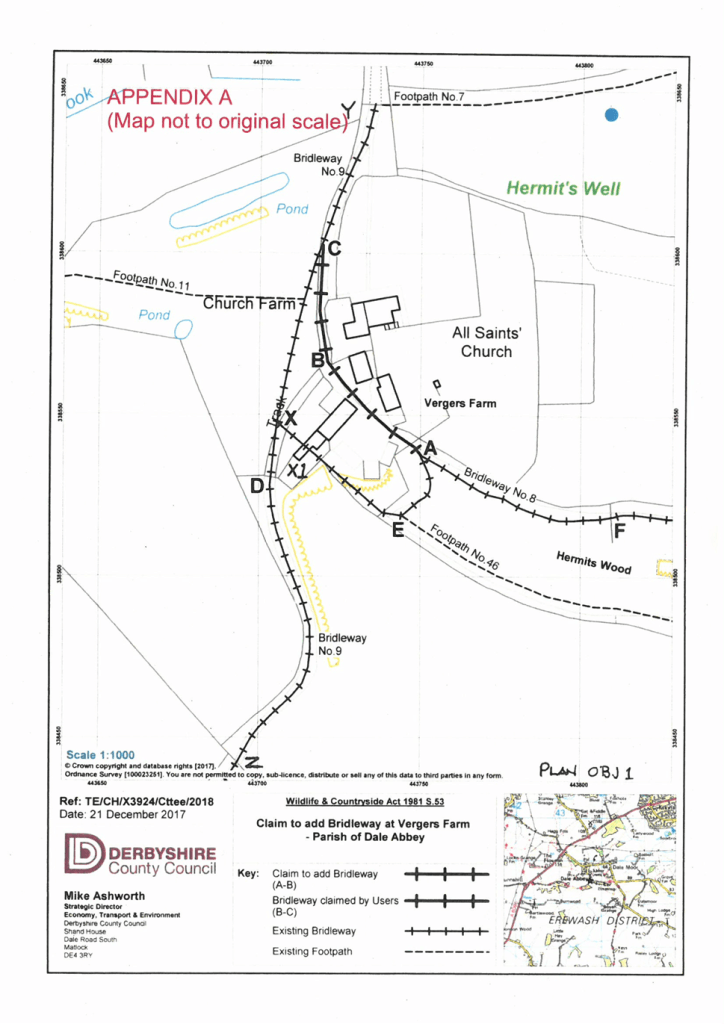
The bridleway in dispute at Verger’s Farm (A-C on map)

The owners of Verger’s Farm attempted to obstruct use of the route through their farmyard, claiming that an alternative route (E to X on map) should be used, although this involved a stiff climb. This led to an official inquiry opening in 2019, led by an inspector from Defra (Department for Environment, Food and Rural Affairs), who was unable to carry out a site visit until 2021 due to the COVID pandemic. 23 people gave evidence in support of the long-standing existence of the bridleway through the yard, including members of the British Horse Society, a powerful lobby. Against these were 14 objectors, including the family of the farm. A mass of documentary evidence was also presented, including old photos and guidebooks to the district. The inspector, in her final decision in 2023, confirmed the validity of the original route of the bridleway on the strength of the historical evidence, leaving aside the personal statements.

Dale Abby church, semi-detached to the farmhouse next door

This case illustrates the extraordinary passions that a right of way dispute can generate. The bridleway in question is only a few hundred metres long, but caused an argument involving dozens of people, the parish council, the county council (DCC) and Defra, which continued for over four years. Now that the way is officially waymarked, we should recognise their efforts by visiting the village; either walking from the Carpenters’ Arms in Dale village or taking the more ambitious route along field paths from the Royal Oak in Ockbrook.
On the road to Dale

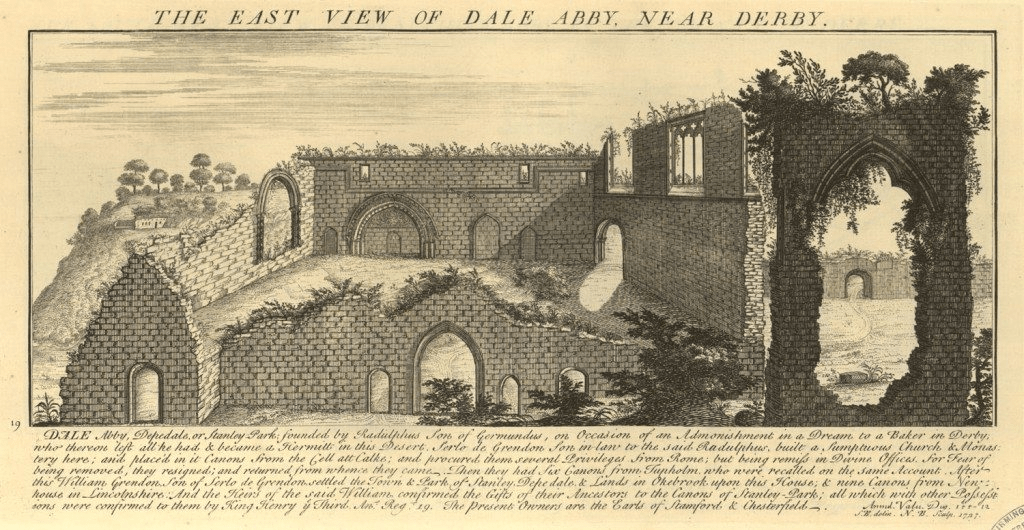
Compared with neighbouring Yorkshire, Derbyshire has hardly any visible remains of its abbeys. Even the location of Darley Abbey in Derby is uncertain, while Dale Abbey, between Ilkeston and Ockbrook, has just one solitary surviving arch (see below). The engraving above shows the state of the ruins in the eighteenth century, before the robbing of dressed stone had been completed. Yet at its height in the fifteenth century this abbey owned about 24,000 acres of land, throughout the county and beyond; endowments it had accumulated over the years. With only about 15 canons in residence, the job of administering these estates may have been given to lay people, but this task must have involved constant travelling. In addition, abbeys like Dale attracted pilgrims who came to pray before relics, in this case a phial of St Mary’s milk. For both reasons, Dale Abbey must have been sited on a good long-distance route.

The remains of the east window, Dale Abbey

The conventional view is that monasteries and abbeys were sited in remote, inaccessible places where the inmates could spiritually benefit from the tranquility of isolation. That may have been true at one time, but the running costs of both the abbey and its agricultural lands meant that two-way traffic steadily developed. In fact Dale was on the route of the Derbyshire Portway, linking it directly with Nottingham to the east, and to the northwest with Wirksworth and its estates at Griff Grange just beyond that town (‘grange’ suggests a monastic farm).

Dale church today

Dale Abbey was closed in 1538 (by William Cavendish) and its huge estates, consisting of churches and mills in addition to moors, woods and fields were sold off. By this time the influence of Protestantism was undermining the twin ideals of the monastic life and pilgrimage. The buildings were soon pillaged: some stained glass, for example, being taken to nearby Morley church. Today the village of Dale provides good walking, one of England’s few semi-detached churches (another survival from the Abbey) and a remarkable hermitage above in the woods, supposed to have been created by a Derby baker who sought a religious life there in the twelfth century.