


This early plan of the town of Derby, drawn about 1760, shows how small the town was 250 years ago. The central area is framed by the Derwent to the east and Markeaton Brook to the west, at that time still an open stream. The town is divided into five parishes: All Saints (now the cathedral), St Alkmund’s, St Peter’s, St Michael’s and St Werbergh’s. There is only one bridge (St Mary’s, still in use) giving access to the Nottingham road. The Silk Mill is shown, as are other signs of small-scale industry such as a ‘pot works’ and a ‘copper mill’. The urban core is surrounded by what look like orchards, but may be market gardens.

The second map, made at the same time, gives an equally vivid idea of the size of Derby then, when settlements like Chester Green or Darley were well outside the built-up area. The turnpike roads are clearly shown, with numbered miles. The London road runs through Osmaston, the Nottingham road goes past Spondon (or Spoondon), the Chesterfield road via Little Chester, and so on. By the second half of the eighteenth century regular coach services ran from the county town to all the major Midlands towns, and Derby was an important stage on the Manchester- London route, where passengers would spend the night.
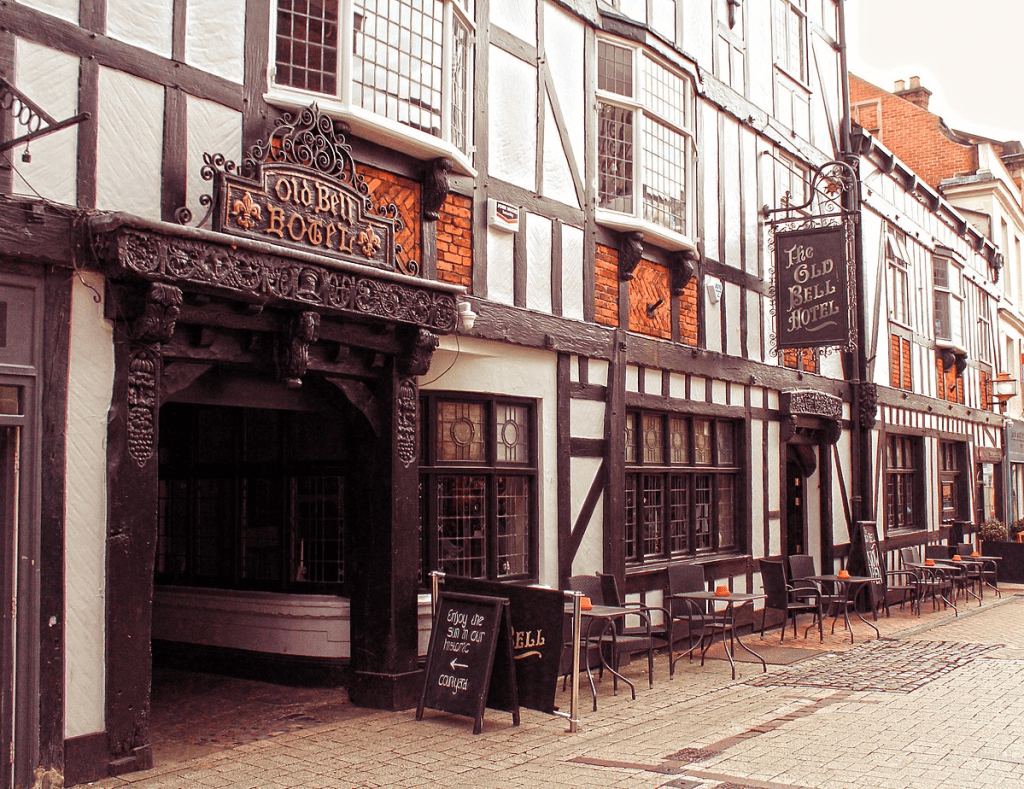
Road travel in the eighteenth century was transformed by both the use of steel springs on coaches after 1764, and the growth of the turnpike system. This is shown by the reduction in journey time on the Manchester to London route, from 62 hours (with two overnight stops) to 18 hours by the end of the century. ‘Flying Machines’ were advertised in the Derby Mercury in 1760 starting from Derby’s George Inn at a fare of £1-8 shillings. This is the equivalent of about £237 at modern values; a reminder that coach travel was not only uncomfortable but also very expensive. Among other Derby coaching inns were the Talbot and the Old Bell, the latter apparently the only survivor. Even on relatively smooth turnpikes, horses would soon tire, and would need changing regularly to maintain timing. By 1767 a coach left Derby three times a week at 9 pm and arrived in London by 7 pm the following day. Despite the (relative) speed, it’s easy to imagine the discomfort of this journey with only brief meal stops, and perhaps gain a new perspective on the comforts of travel on Midland Mainline!
Sources:
Burdett, P. (1791) Map of Derbyshire Derbyshire Archaeological Society
Twells, H. (1943) ‘Derby’s Flying Machines and earliest coaches’ DAJ 64: 64-82
 The Old Roads of Derbyshire