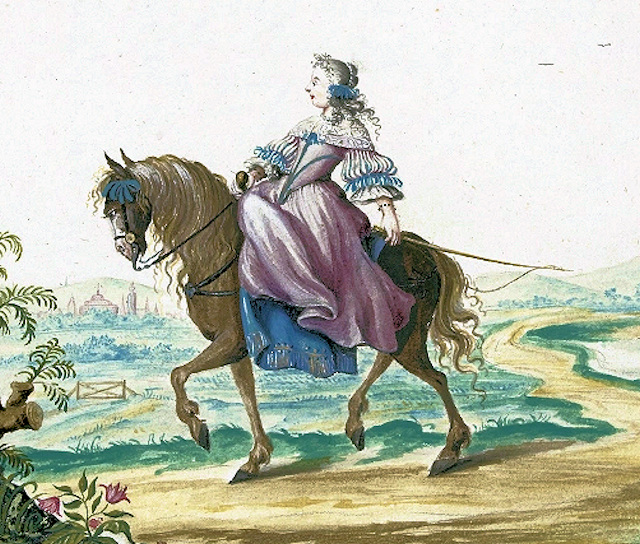
Woman riding side-saddle: No portrait of Celia appears to exist.
Celia Fiennes (1662-1741) was a well-connected lady who toured much of England on horseback around the end of the seventeenth century. Her journal provides a rare insight into the Peak District at this time, before turnpikes but when ‘tourism’ was just beginning. Although independent female travelers were rare at that time, her wealth allowed her to have two servants: an entourage that did not always protect her from the difficulties of travel. As the unmarried daughter of a Cromwell-supporting nobleman, Celia lived partly with a married sister in Hackney and seems to have traveled for both health and curiosity.

Woodcut of the old Buxton bathhouse
Like many more modern travelers Celia found much to complain of. At Buxton, where her party stayed at the Duke of Devonshire’s Buxton Hall, the beer was so bad that ‘very little can be dranke’. Worse were the bedrooms, which were overcrowded: ‘sometimes they are so crowded that three must lye in a bed’. Needless to say: ‘Few people stay above two or three nights it is so inconvenient’. It is easily forgotten that modern notions of privacy were quite foreign at this time. The main attractions were the bath and the water from St Anne’s Well. The former was about 40 feet long by 30 feet wide, and it was barely warm: ‘Just enough to open the pores of ones body’. Worryingly, the flow of water was weak, so that: ‘Its not capable of being cleansed after everybody has been in’. She must have questioned the health benefits of the process, but nevertheless plunged in.

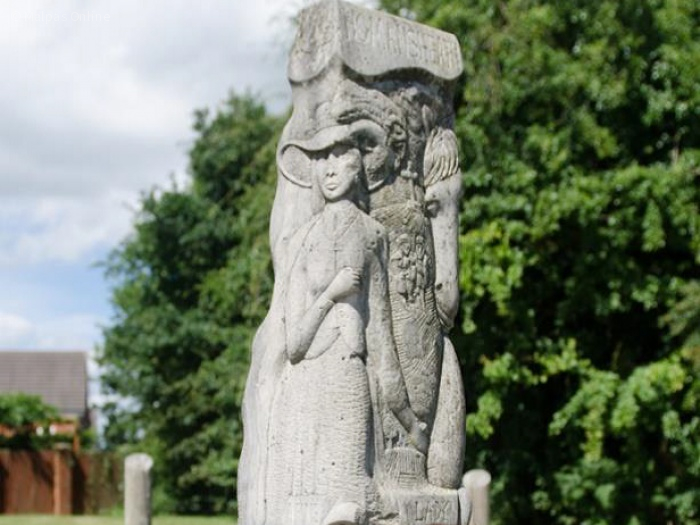
Memorial to Celia in the (suitably named) No Mans Heath, Cheshire
Celia Fiennes visited the so-called ‘Wonders of the Peak’ in the same way a modern tourist might tick off the local attractions in their guidebook. But equally interesting are her comments on travel generally, which she seems to have found extremely difficult in this area:
Indeed all Derbyshire is but a world of peaked hills, which from some of ye highest you discover ye rest like steeples or tops of hills as thick as can be, and tho’ they appear so close yet ye steepness down and up takes up yr time…
Even the guides couldn’t be relied on:
The country here about is so full of moore or quagmires and such precipices that one that is a stranger cannot travel without a guide, and some of them are put to a loss sometymes.
Her journals were not published in her lifetime, but eventually appeared in 1888 with the title Through England on a Side-saddle. The full text can be found at:
 The Old Roads of Derbyshire