Putting Brassington on the map

John Ogilby produced the first practical road map of England in 1675; a strip map which showed landmarks to guide the traveller, such as hills and rivers. The map above gives his route from Derby to Manchester, starting with Derby on the top right. In the next strip the section via Hognaston and Brassington can be seen, leading on to the old Roman road, then still in use, past Pikehall (Pikeham on map) and on to Buxton. The first stage of this itinerary became Derbyshire’s first turnpike road, the Shardlow to Brassington turnpike of 1720.

The Gate today: clearly older than the date on the porch

Today Brassington is a well-kept but rather isolated village, without a shop or cafe, but still having two pubs: The Miners Arms and The Gate. The former is a reminder of the glory days of the eighteenth century when some, at least, grew wealthy on lead mining, the latter must mark the end of the early turnpike; the last tollgate going north, since the Roman road lay on limestone, and was still passable after over 1,500 years! This is confirmed by Tollbar Cottage opposite. However, the Manchester route that Ogilby describes was too hilly for laden coaches, especially in bad weather, and by 1738 a newer, low-level turnpike via Ashbourne was in use, less direct but faster overall. There are other ‘Gate’ pubs in Derbyshire, all presumably marking a turnpike tollgate: for instance at Tansley, Swanwick and Belper.

St James Church, Brassington

St James Church must be the oldest building in the village: the tower and parts of the nave are impressively Romanesque. Although Brassington was originally part of Bradbourne parish, there was clearly a sizable congregation here in medieval times. Although it is dangerous to assume that church dedications have remained unchanged, St James is known as Santiago in Spanish, and he was the focus of the main West European pilgrimage routes in the middle ages. Could the dedication at Brassington suggest that the church wanted to be linked to the attraction of the saint’s burial in Galicia?

Sources:

Dodd A. & Dodd E., Peakland Roads and Tracks, 1980

Brassington Community Website: https://www.brassington.org.uk/

Surprising Bradbourne

All Saints churchyard with cross

Halfway between Brassington and Tissington is the small village of Bradbourne, with a population of just over a hundred. Yet the substantial church was once part of a priory, and was the centre of a network of local chapelries. The church tower, complete with elaborately carved doorway, is Romanesque. while in the churchyard is a rare Saxon cross from about 800, showing a crucifixion scene. Why would such a small settlement have such rich monuments?

Crosses of this date are quite rare in Derbyshire: Bakewell and Eyam have good examples. Clearly older than the church itself, they may have signalled the conversion of the area to Christianity, and formed a base for preaching before the church was built. It is possible that such crosses were more common, but many may have been destroyed during iconoclastic periods such as the Reformation. Wirksworth, only a few miles away, would probably be the local minster church.

Doorway to tower with a variety of carved creatures

There is little sign that Bradbourne was ever on a major route. According to the parish council website, the north eastern parish boundary was the course of the Roman road from Little Chester to Buxton, but no source is given for this claim. However, this is now good walking country; the Limestone Way runs about a mile to the north, and to the south Haven Hill (partly access land) offers a convenient circular walk.

The story of the stones

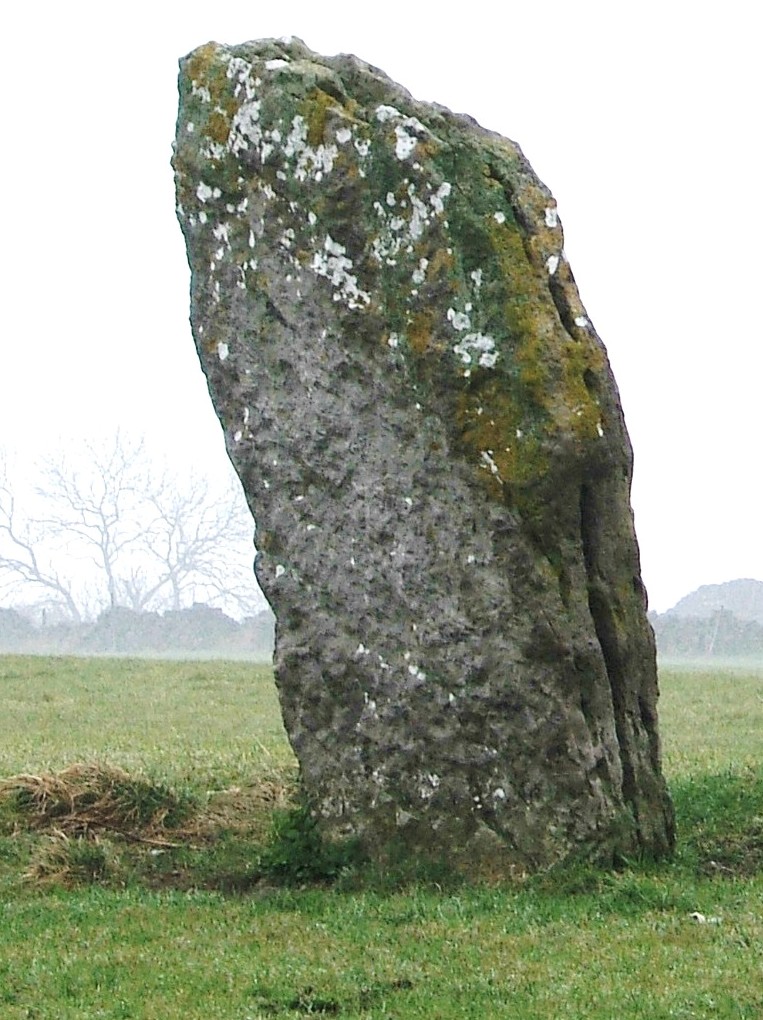
Stone near Wirksworth-Brassington road about one mile west of Wirksworth

It seems likely that single standing stones like the one above, which is over two metres high, have been used as route markers for possibly thousands of years. Stone is readily quarried in north Derbyshire, and once erected they are extremely durable, although some may have been broken up when the commons were enclosed. But in an open, moorland landscape they would have clearly stated ‘here is the route’ and would have been visible a mile away.

No-one knows how many such stones survive today, and not all are marked on the OS map, unlike the stone illustrated. They can be confused with gateposts, but these are generally shorter and have holes bored in them to attach hinges. Some have been worked so that they have been roughly squared, although they have no inscription, as with the stone below, which can be found at SK 299521, just off the public footpath but clearly visible from it. The location is in a direct line from the top of Alport Height to the alignment of Prathall Lane, leading into Gorseybank, southeast of Wirksworth, which might have been the route of the Portway in early medieval times.

Looking north to Middleton and Cromford moors

A third stone near Wirksworth can be seen opposite the Malt Shovel Inn, near the crossroads of the Alfreton-Ashbourne turnpike with the route down to Belper from Bolehill, although it must be much older than these. It is marked on an early nineteenth century map as ‘menhir’ and may well indicate a very early route of the Portway, avoiding the steep descent into the town by circling it on the east and north sides. As with the other stones, this is on private land, but is clearly visible from the road.

In common with many other prehistoric and historic sites, we can never know the full story behind these enigmatic stones, but this basic supposition – that we are looking at ancient route markers – is supported by the use of similar stone markers (but with lettering) for guide stoops in the early eighteenth century and then the introduction of regular milestones on the turnpike roads.

Stone near the Malt Shovel pub