Cross purposes?

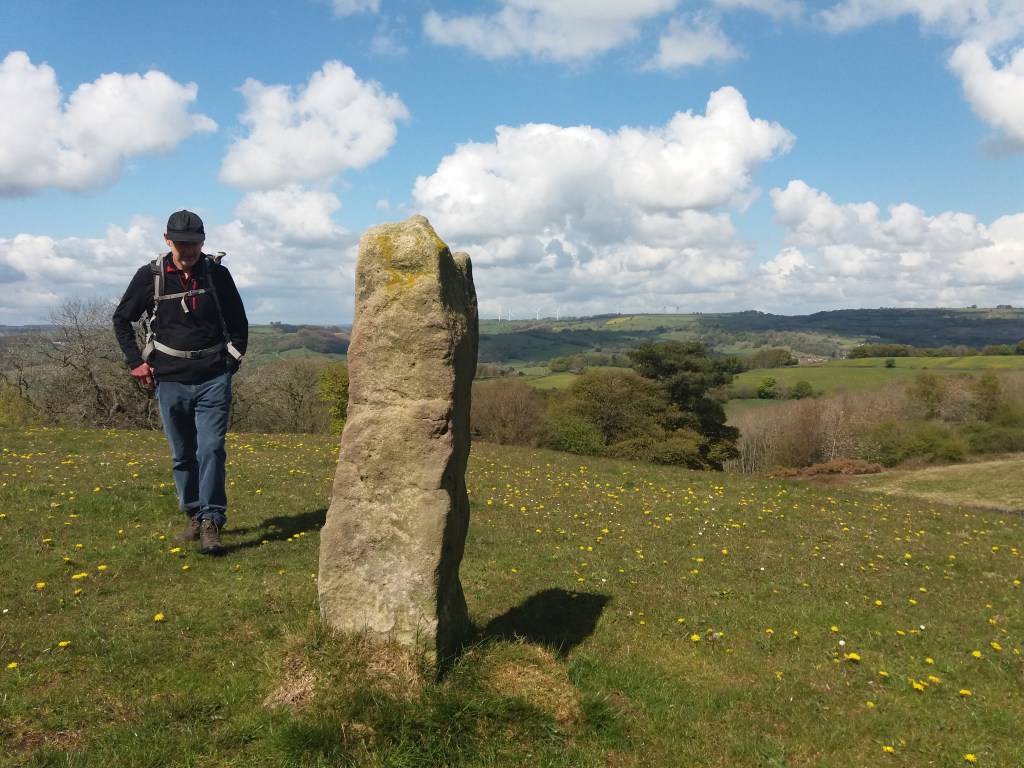
Stone south of Wirksworth at SK299521

Derbyshire has plenty of stone, as shown by its characteristic dry-stone walls, and walkers may find pillars of stone, like the example above, set in the landscape for no apparent reason. Impossible to date, and clearly not redundant gateposts, they can only be assumed to mark some long-lost route. In other places there does seem to be a link to an old track, as with the large stone below, less than a mile above Wirksworth on the Brassington road, on the line of the Portway.

Again, it’s impossible to date a megalith like this, but clearly a lot of trouble was taken to erect what must have been a route marker. Given that many stones like these have been re-used for building, and others deliberately destroyed as symbols of paganism, we can imagine a prehistoric landscape well populated with such pillars. Surviving stone circles reinforce the idea of stones having power and importance, and this may have continued into the early Christian period, from about 600 CE.

Cross in Bradbourne churchyard

Presumably the first Christian missionaries set up ‘crosses’ like this example in Bradbourne as symbols of the new beliefs; although badly worn a crucifixion scene can be found near the base. Similar crosses can be seen at Bakewell church (found on Beeley Moor) and Stapleford, on the Portway in Nottinghamshire. Although referred to as crosses they are actually simple carved pillars, which suggests an attempt to Christianize a pagan symbol.

Stapleford Cross, with scrollwork and saint.

Both of these monuments are thought to date from the ninth century, far older than the church they adjoin. The cross was only adopted as a Christian symbol in 692 CE, and one of the earliest examples of the ‘new’ pattern can be seen at Eyam churchyard (part of the shaft appears to be missing). It is always possible that these crosses were moved into the churchyards at some point, and they may originally have been route markers.
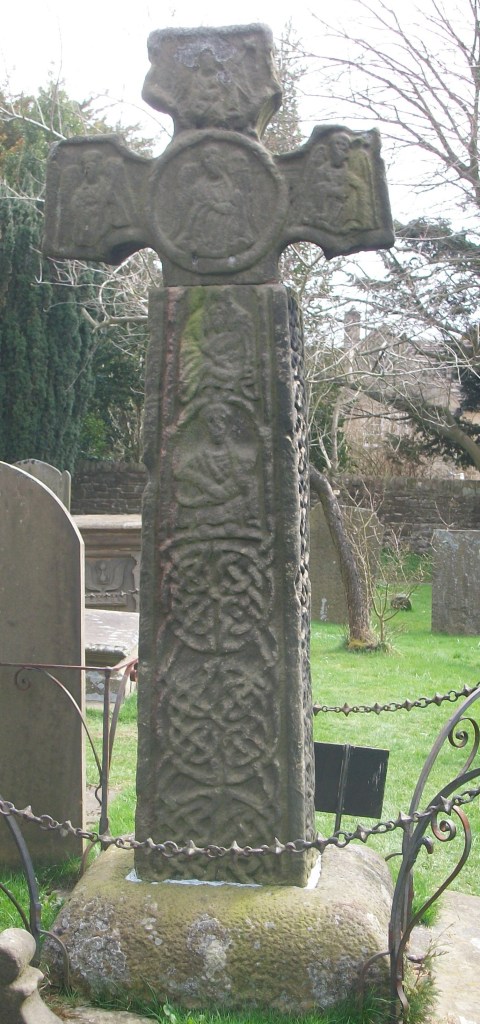
Celtic scrollwork at Eyam

In Medieval Britain crosses became more common and varied: wayside crosses, boundary crosses, market crosses and later, memorial crosses. In some cases they may have had the dual role of showing the way and indicating the next pilgrim shrine; this cross base at Cross Lane near Dethick seems to mark a route that extended south to Shuckstone Cross, only a mile away, and beyond. These (now lost) crosses would have protected travellers as well as guiding them to the holy places.
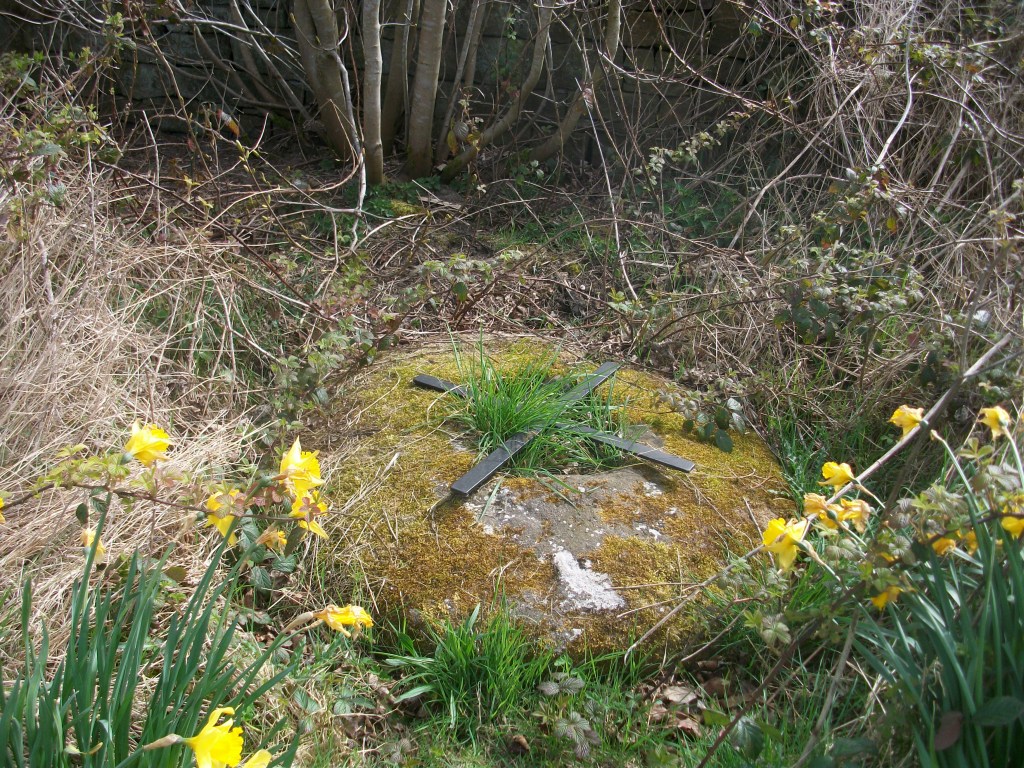
Cross base near Dethick with anti-theft device

See: Sharpe, N. ( 2002) Crosses of the Peak District, Landmark

Putting Brassington on the map

John Ogilby produced the first practical road map of England in 1675; a strip map which showed landmarks to guide the traveller, such as hills and rivers. The map above gives his route from Derby to Manchester, starting with Derby on the top right. In the next strip the section via Hognaston and Brassington can be seen, leading on to the old Roman road, then still in use, past Pikehall (Pikeham on map) and on to Buxton. The first stage of this itinerary became Derbyshire’s first turnpike road, the Shardlow to Brassington turnpike of 1720.

The Gate today: clearly older than the date on the porch

Today Brassington is a well-kept but rather isolated village, without a shop or cafe, but still having two pubs: The Miners Arms and The Gate. The former is a reminder of the glory days of the eighteenth century when some, at least, grew wealthy on lead mining, the latter must mark the end of the early turnpike; the last tollgate going north, since the Roman road lay on limestone, and was still passable after over 1,500 years! This is confirmed by Tollbar Cottage opposite. However, the Manchester route that Ogilby describes was too hilly for laden coaches, especially in bad weather, and by 1738 a newer, low-level turnpike via Ashbourne was in use, less direct but faster overall. There are other ‘Gate’ pubs in Derbyshire, all presumably marking a turnpike tollgate: for instance at Tansley, Swanwick and Belper.

St James Church, Brassington

St James Church must be the oldest building in the village: the tower and parts of the nave are impressively Romanesque. Although Brassington was originally part of Bradbourne parish, there was clearly a sizable congregation here in medieval times. Although it is dangerous to assume that church dedications have remained unchanged, St James is known as Santiago in Spanish, and he was the focus of the main West European pilgrimage routes in the middle ages. Could the dedication at Brassington suggest that the church wanted to be linked to the attraction of the saint’s burial in Galicia?

Sources:

Dodd A. & Dodd E., Peakland Roads and Tracks, 1980

Brassington Community Website: https://www.brassington.org.uk/

Surprising Bradbourne

All Saints churchyard with cross

Halfway between Brassington and Tissington is the small village of Bradbourne, with a population of just over a hundred. Yet the substantial church was once part of a priory, and was the centre of a network of local chapelries. The church tower, complete with elaborately carved doorway, is Romanesque. while in the churchyard is a rare Saxon cross from about 800, showing a crucifixion scene. Why would such a small settlement have such rich monuments?

Crosses of this date are quite rare in Derbyshire: Bakewell and Eyam have good examples. Clearly older than the church itself, they may have signalled the conversion of the area to Christianity, and formed a base for preaching before the church was built. It is possible that such crosses were more common, but many may have been destroyed during iconoclastic periods such as the Reformation. Wirksworth, only a few miles away, would probably be the local minster church.

Doorway to tower with a variety of carved creatures

There is little sign that Bradbourne was ever on a major route. According to the parish council website, the north eastern parish boundary was the course of the Roman road from Little Chester to Buxton, but no source is given for this claim. However, this is now good walking country; the Limestone Way runs about a mile to the north, and to the south Haven Hill (partly access land) offers a convenient circular walk.