Salt Paths and Saltways

The film of the book The Salt Path was released in the spring, adding to the fame of its author, who called herself Raynor Winn. This bestseller is the story of how she and her husband, called Moth, lost their Welsh home at the same time as he was diagnosed with a degenerative disease. Remarkably, the couple set off for a 600-mile walk on the South West Coastal Path, which led to massive book sales and a film deal. An inspiring, heart-warming story – until an Observer journalist starting probing some of her claims:

https://observer.co.uk/news/national/article/the-real-salt-path-how-the-couple-behind-a-bestseller-left-a-trail-of-debt-and-deceit

Whatever the truth of the claims and counter-claims in this affair, it is clear that many people were deceived, especially the editors at Penguin (‘unflinchingly honest’ – website) and the producers of the film. How could so many smart people fail to ask some pretty basic questions?

Salters Lane between Matlock and Bonsall

The book is presumably called The Salt Path because they followed a coastal route, the South West Coastal Path, created in the 1970s, which also offers some stunning scenery for the film. But much older Saltways cross Derbyshire, possibly dating from Roman times, which carried packhorse traffic from the salt pits of the Cheshire ‘wiches’ (such as Northwich) to towns like Chesterfield and Sheffield. Various routes can be followed using place names such as Saltergate, Saltersford and Saltsich; for instance the route from Leek via Hartington, Pikehall, Bonsall, Matlock and Ashover. These names are a reminder of the essential nature of salt in the medieval economy, not only for cooking but also for preserving meat and making ceramics.

The Peak District Pilgrimage Trail – Ilam to Eyam

The gullibility of those concerned with The Salt Path fiasco – including readers and viewers – can perhaps be explained by an atavistic faith in the power of pilgrimage, which the Coast Path certainly provided. There is a widespread belief in the benefit, spiritually and health-wise, of stepping out of ordinary life and setting off for a distant goal with few possessions. The most famous example is the Santiago Pilgrimage, now attempted by millions annually, while on a lesser scale the Peak Pilgrimage trail from Ilam to Eyam is a 39-mile (‘soul-healing’) route taking in a selection of historic churches.

Fixing a hole …

The Stonebreakers / Gustave Courbet 1858

Repairing holes in roads must have been one of the worst jobs in the pre-industrial world. Courbet was not the only artist attracted to the subject: his pair of stone breakers represent a class of unskilled labourers never previously regarded as a suitable subject for art, the viewer feels their dusty, sweaty toil . In contrast, John Brett’s The Stone Breaker (also 1858) portrays an almost idyllic scene; lovely weather, a handsome young lad on the job, and his dog amusing itself. The milestone in the corner (London 23) is a reminder that he is also filling in holes, and to do so required stone to be broken into small fragments to create an all-weather surface.

The Stone Breaker/ John Brett 1858

One of the earliest attempts to deal with the problem of road maintenance was made in 1555 when the Statute of Labour was passed, which gave responsibility for this to the parish. They were obliged to choose a Highway Surveyor, who had the unenviable task of getting all householders to work on the roads for four days a year (later increased to six). Farmers with horses and carts were also required to lend these to move stone. Clearly this system was unfair, since if the Great North Road ran through your parish there would be far more wear and tear than if, say, you lived in Bonsall. However, despite the drawbacks, roads were more or less kept open, and people and goods moved around. Even after the main routes were turnpiked from the mid-eighteenth century, unpaid labour was still required. This is shown locally in the diary of Rowsley farmer Mathew Gibbons, who records his father doing roadwork for six days in 1761-2.

That sinking feeling

Clearly this is not a problem that has gone away. A recent report states that potholes are the biggest worry for drivers today, which will surprise no-one who has tried driving or cycling on our Derbyshire roads in the last few years. Perhaps it’s time to go back to the parish system and get everyone out, once a month, for some DIY patching!

The lost fords of the Derwent – 1

Railway bridge on Ladygate leading to Old Matlock

River crossings have always been critical points on the road network, and originally these would have been fords, passable for riders in normal conditions, and possibly having stepping stones for those on foot. From medieval times onwards fords on the Derwent were mainly replaced by stone bridges, though their location is still remembered by the place names Bamford, Grindleford, Cromford, Homesford and Milford (from north to south). The original name for Matlock appears to have been Mestesforde (i.e. in the Domesday Book), and many historians have assumed that this ford was near the site of the current bridge. But the nucleus of old Matlock is actually at Starkholmes, not near Crown Island, and so it has been argued that the ford was near the point where Ladygate Lane now crosses the river on a footbridge.

Well below St John’s Chapel

The westward route would have climbed up the hill, past the nineteenth century St John’s Chapel (built over a perpetual spring), and up to Bonsall, near where it linked up with Salters’ Way. The more modern route of Salters’ Lane, leading to Matlock Bridge, developed after this bridge was constructed, although the date of the original bridge is not clear. The access to the bridge on the east side was easy, but because this land (i.e. Hall Leys) flooded regularly (and still does) development may have continued around St Giles for some time.

The site of Homesford from Sanderson’s 1835 map

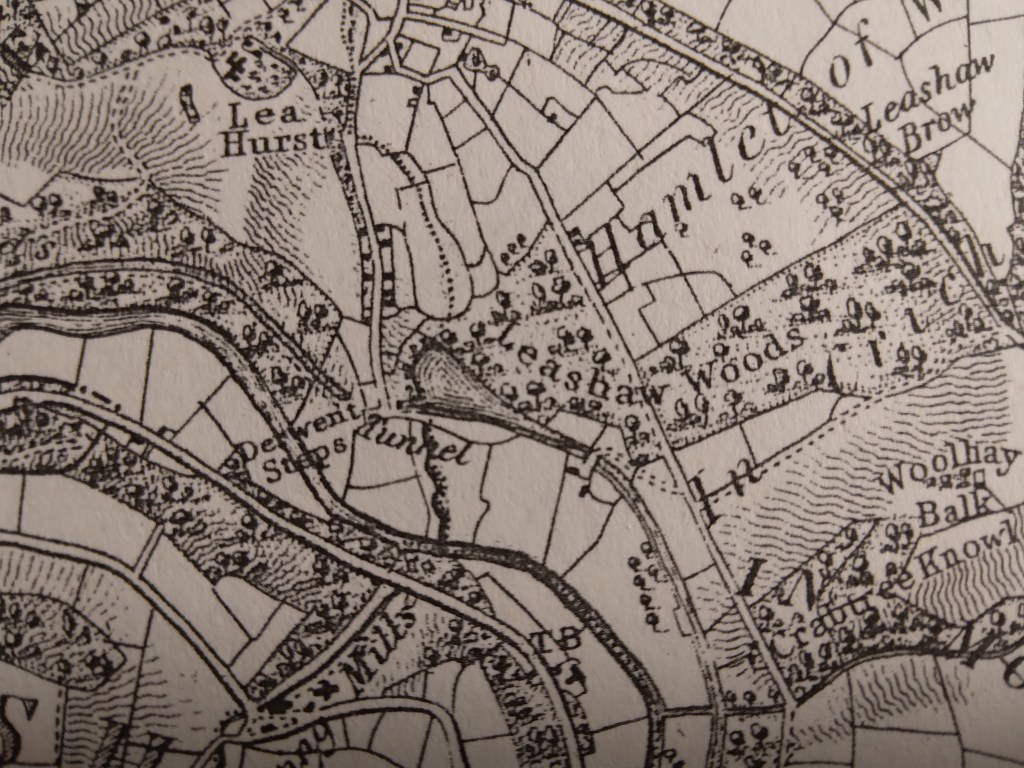
A few miles downstream, the Homesford Cottage pub (still advertised as selling Kimberley Ales) has become a guest house, and the name Homesford is not found on the OS map. Yet Sanderson’s map from 1835 shows a road from Upper Holloway running down past Lea Hurst (Florence Nightingale’s home) and over Gregory Tunnel on the Cromford Canal. The name ‘Derwent Steps’ by the river suggests a well-established set of stepping stones, with presumably a ford beside for carts and livestock. Today the Derwent can still be crossed here on a footbridge, suggesting that this was an ancient route, but there is no sign of any steps in the currently fast-flowing, turbulent river!.

The name of the lane

Road name near Holbrook

Although name signs like this are relatively modern, roads have been named for hundreds of years, and today road names are a useful resource for historians. We do not know what names the Romans actually gave their routes, but after their departure they were called ‘streets’ as in Ryknild Street, which ran from Derby to Chesterfield. Many place names e.g. ‘Stretton’ reflect this. Anglo-Saxons used the noun ‘way’ for their roads, and this survives in many expressions such as ‘highway’ and ‘byway’. The word ‘road’ was not common until the seventeenth century, and may be derived from the verb ‘rode’.

The most obvious type of name gives the destination of the road, hence Chesterfield Road or Brassington Lane. Another refers to some feature found on the road, either natural or man-made, such as Chapel Lane or Cuckoostone Lane. In the case of an ancient route like Hearthstone Lane, running from Cromford to Riber, there is no obvious Stone, raising the question ‘Where was it?’

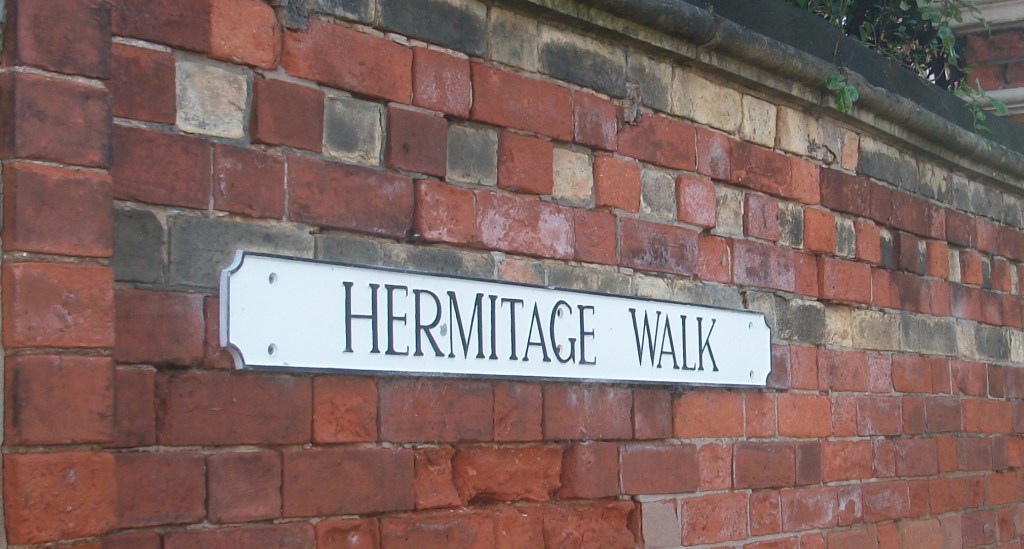
Hermitage Walk, Nottingham

This sign in The Park in Nottingham is a valuable clue that the ‘Walk’ led to an ancient group of caves (now inaccessible) that contained a rock-cut chapel. Other names refer to the state of the road: Long Lane, Marsh Lane, New Road. In this last case, the name suggests that there is an ‘old road’ that could be investigated.

Many road names refer to natural features using archaic vocabulary. ‘Shaw’ or ‘Carr’ names are common in Derbyshire, and mean a wood on a steep slope, as in Leashaw, Upper Holloway. ‘Sitch’ is Anglo-Saxon for a small stream. ‘Well’ endings as in Bakewell suggest a natural spring.

A few names refer to an individual, either familiarly in ‘Samuel’s Lane’ or more grandly with ‘Via Gellia’, named by Anthony Gell, the road developer, after himself in pseudo-Roman style.

Road sign on the Ridgeway near Heage

But there will always be names that elude discovery, or can only be the subject of wild guesswork. What’s the story behind Lickpenny Lane, for instance, or the Clatterway at Bonsall? Or did Wapentake Lane near Kirk Ireton really lead to the site of the ancient Wapentake?

Conquering the stoop

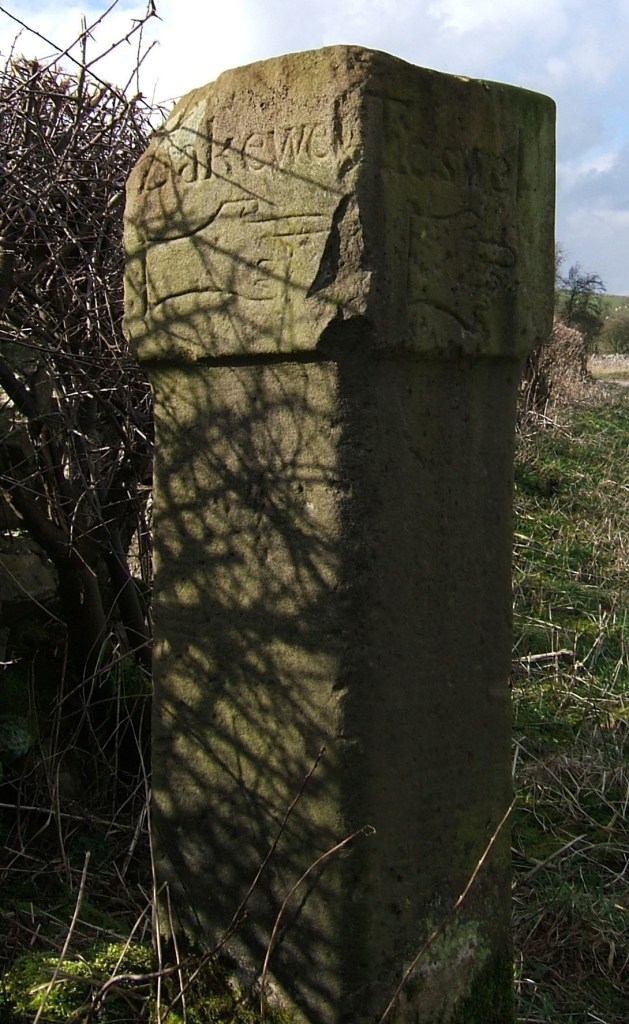
Guide stoop at top of Crowhill Lane near Bakewell

Nearly fifty of these stone pillars survive in Derbyshire, providing vital clues to the medieval road network. ‘Stoop’ is a Scandinavian word for stone, and they have proved suitably durable, many surviving for over three hundred years. They were erected about 1709 to (belatedly) comply with an Act of 1697 which required direction stones to be put up at road junctions in remote moorland areas, where travellers would be likely to get lost. The majority have inscriptions on four sides, and these should indicate the direction of the nearest market towns. The example above shows a hand pointing to ‘Bakewel’, while the other sides indicate the directions of Tideswell, Buxton and Winster. It is notable that the stone now stands at a T-junction; the fourth route was closed with the opening of the turnpike road on what is now the nearby A6.

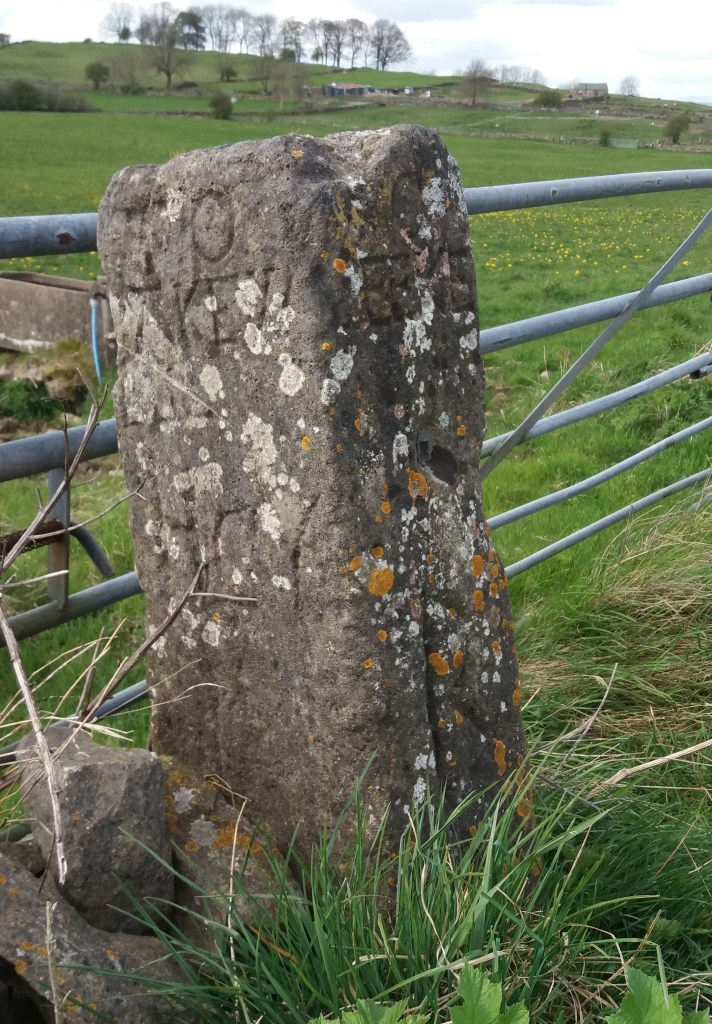
Guidestoop above Winster on road to Grangemill

This illustrates one of the values of these stoops: they show the routes that were in use pre-turnpike and pre-maps. The Winster stoop, above, provides another example. It is thought that originally it stood at the end of Bonsall Lane, and indicates Wirksworth, Bonsall and Bakewell. The fourth town marked, however, is Leek, over 15 miles away via Pikehall, but clearly a significant destination at that time. As with some other guide stoops, this one has been used as a gatepost, since most stoops would have become redundant with the arrival of better signposted turnpikes later in the eighteenth century. Nearby, at Shothouse Spring, another stoop (on private land) is no longer on any road or path, although it was clearly erected at a one-time crossroads.

Guidestoop at Alport Height

The Alport stone (showing Derby, Wirksworth and Ashbourne) is another example of a stoop at an apparently remote junction, but clearly thought worth marking in 1709. In fact its position on the Portway suggests that it would have been a more important route at that time. To properly envisage early eighteenth century travel we need to remove most of the dry stone walls and grassy pasture, and go back to a landscape of open scrubby moorland, crossed by the occasional track. In this setting it is easier to imagine the reassurance that the guidestoop would have given the uncertain traveller.

(For a detailed guide to all surviving stoops see ‘The Guide Stoops of Derbyshire’ by Howard Smith)