


John Metcalf, known as ‘Jack’, was a pioneer road builder in Yorkshire and Derbyshire, despite being blind from the age of six. His remarkable career began in 1717, when he was born to a poor family in Knaresborough. He was given fiddle lessons as a source of future financial support, and at age 15 became fiddler at the Queen’s Head in Harrogate. Horse trading, swimming and diving were other occupations, while his detailed local knowledge gave him employment as a guide. Among other achievements he ran a carrier business, using a stagecoach which he drove himself.

His career as a road builder began in 1765 when he tendered to build a section of turnpike road between Harrogate and Boroughbridge. Presumably his work as a carrier had given him insight into the problems of road maintenance, and his road engineering was based on the need for effective drainage, via a convex surface, into adequate culverts at the road side. He was also the first to find a way of laying a route through bogs, using floating rafts of ling and gorse as foundations. But his success must have also been down to effective calculation of costs when bidding for contracts, plus his man-management skills, such as being on site at 6 a.m. In total he was responsible for 180 miles of new or improved roads, mainly in Yorkshire but also in north Derbyshire, especially the roads around Buxton.
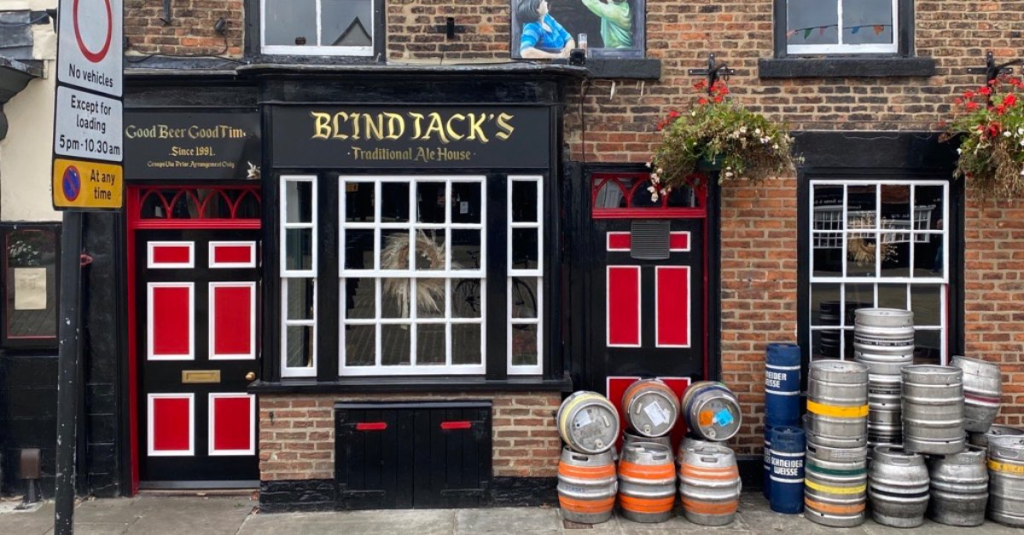
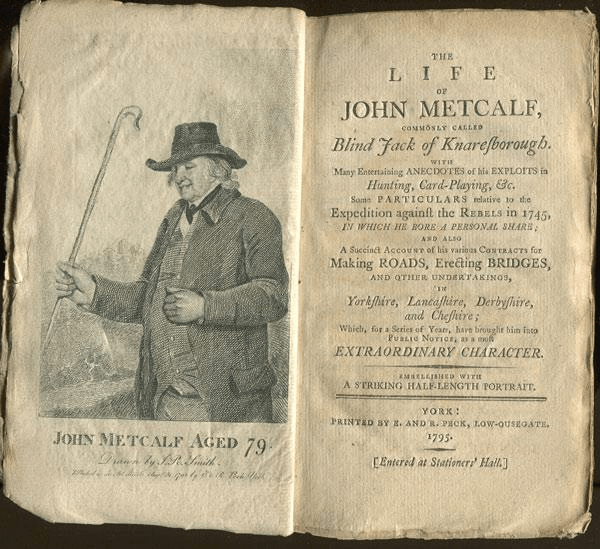
Today Jack is remembered in his home town by a seated statue (top) outside the pub that bears his name. His road-building contemporaries, Thomas Telford and John MacAdam, are better-known, but his triumph over disability is quite remarkable. In old age he lived with one of his daughters, and at the age of 77 walked to York and told his life story to a publisher, who produced this volume (below).
Given the current state of Derbyshire roads, we might wish for Jack to get off his bench and come back to show us how to fill in the potholes …
 The Old Roads of Derbyshire