The lost fords of the Derwent – 1

Railway bridge on Ladygate leading to Old Matlock

River crossings have always been critical points on the road network, and originally these would have been fords, passable for riders in normal conditions, and possibly having stepping stones for those on foot. From medieval times onwards fords on the Derwent were mainly replaced by stone bridges, though their location is still remembered by the place names Bamford, Grindleford, Cromford, Homesford and Milford (from north to south). The original name for Matlock appears to have been Mestesforde (i.e. in the Domesday Book), and many historians have assumed that this ford was near the site of the current bridge. But the nucleus of old Matlock is actually at Starkholmes, not near Crown Island, and so it has been argued that the ford was near the point where Ladygate Lane now crosses the river on a footbridge.

Well below St John’s Chapel

The westward route would have climbed up the hill, past the nineteenth century St John’s Chapel (built over a perpetual spring), and up to Bonsall, near where it linked up with Salters’ Way. The more modern route of Salters’ Lane, leading to Matlock Bridge, developed after this bridge was constructed, although the date of the original bridge is not clear. The access to the bridge on the east side was easy, but because this land (i.e. Hall Leys) flooded regularly (and still does) development may have continued around St Giles for some time.
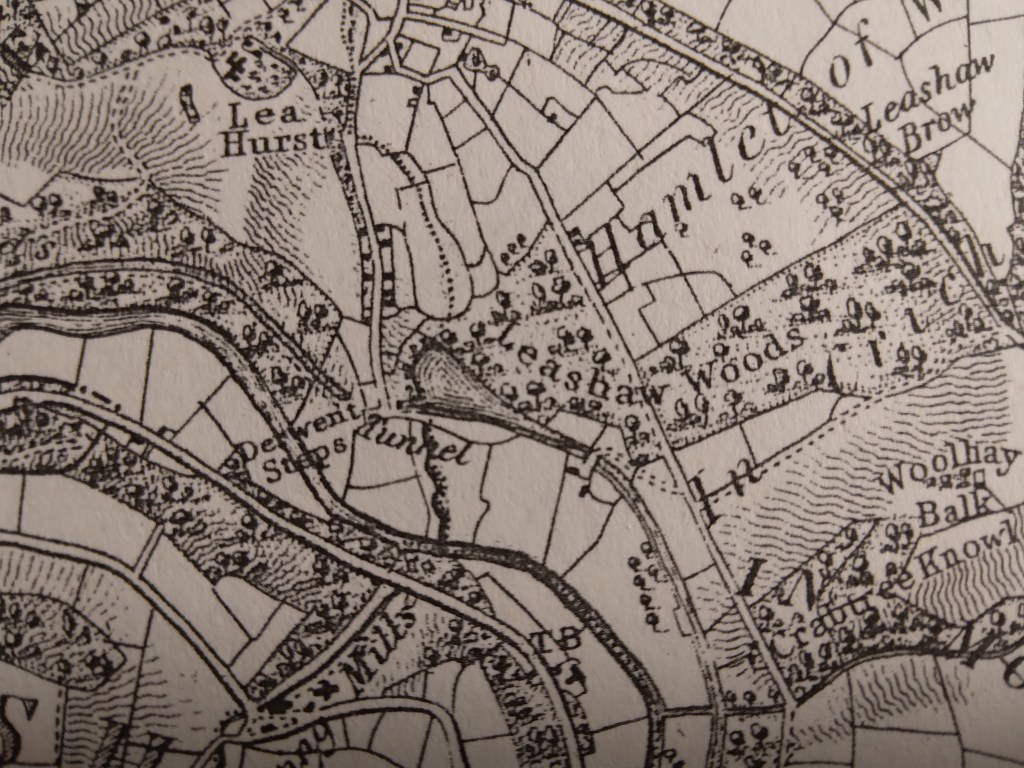
The site of Homesford from Sanderson’s 1835 map

A few miles downstream, the Homesford Cottage pub (still advertised as selling Kimberley Ales) has become a guest house, and the name Homesford is not found on the OS map. Yet Sanderson’s map from 1835 shows a road from Upper Holloway running down past Lea Hurst (Florence Nightingale’s home) and over Gregory Tunnel on the Cromford Canal. The name ‘Derwent Steps’ by the river suggests a well-established set of stepping stones, with presumably a ford beside for carts and livestock. Today the Derwent can still be crossed here on a footbridge, suggesting that this was an ancient route, but there is no sign of any steps in the currently fast-flowing, turbulent river!.

Wells, springs and troughs

Dressed well, Tissington

Travellers have always needed to drink, and so have their horses and dogs. Yet on the ancient ridgeways, crossing the limestone hills of north Derbyshire, there are few streams or ponds, and so providing drinking places has been critical. Stone troughs fed by springs are found by many old roads, though it is not clear who first installed them. The four horses needed to haul a stagecoach uphill for a mile or two would have needed a long drink by the time they reached the top of the climb.

St Alkmunds Well, Derby

Wells were another source of water, though usually designed just for human use. and more commonly found in villages. Well dressing is a famous Derbyshire custom, and is normally seen as a celebration of a reliable and plentiful water supply – possibly pre-Christian, although now, as the example above shows, co-opted by the Church. Wells have frequently given their name to streets, as with Coldwell Street in Wirksworth or Coldwell End in Youlgrave. Others were sanctified with a saint’s name, such as St Alkmund’s well above, or St Anne’s well in Buxton. It seems likely that the tradition of ‘holy wells’ pre-dates the Reformation in 1539, and in some cases the water from these wells was thought to have a healing value.

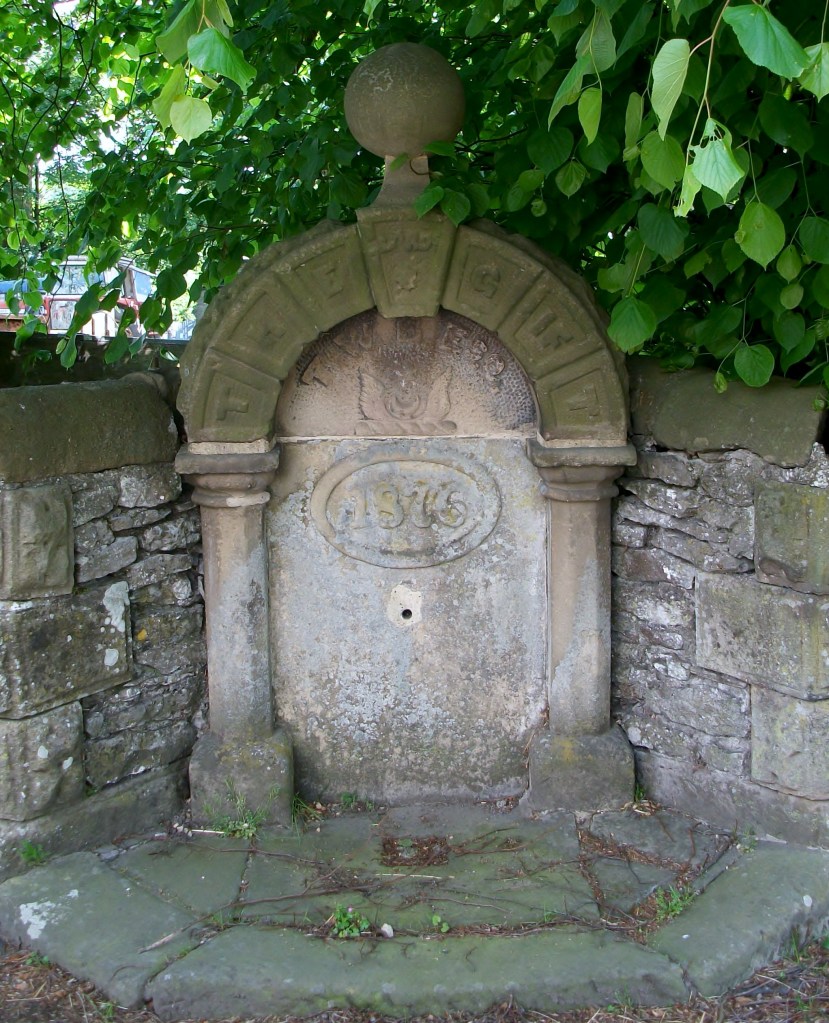
Well in Youlgrave ‘The Gift’ 1876

Today it seems shocking how long it took to provide a piped, clean water supply in many Derbyshire villages. Youlgrave was unusual in that it installed its stone reservoir in the centre of the village in 1829 (below), from which local wells such as the one above were supplied. Even today Youlgrave still has its own water supply, independent of Severn Trent. But right up to 1940 nearby Elton people relied on carrying water in buckets from a spring at Burycliffe, half a mile from the village.

Water reservoir, Youlgrave

The names of some old wells can be found on large-scale OS maps, for example Lady Wall Well, north of Baslow on the old route over the moor to Sheffield. Sadly, many of these have become filled with rubbish and are easily overlooked. Cleaning and renovating a local well would be a valuable project for a volunteer neighbourhood group, and help to preserve a link with the not-so-distant past.

Cromford Bridge

Upstream view of bridge

It is easy to forget how crucial bridges were to the medieval traveller, who could otherwise be delayed at a ford for days, waiting for the river to be passable. Many bridges, including Cromford, were probably originally timber structures with stone piers.

The name ‘Cromford’ means a ford on a (river) bend, and it seems likely that the ford was roughly in the same place as the bridge, just below the point where the Derwent curves out of Matlock Bath. This must have been a vital crossing point, linking the route descending Cromford Hill from Wirksworth and beyond with the road to Starkholmes and old Matlock, plus the older route up along Hearthstone Lane, and the road to Lea Bridge going through Bow Wood.

Dating bridges is always difficult since most have been widened and frequently repaired. In this case it can be seen that the arches are pointed on the upstream side, but more rounded on the downstream, suggesting a substantial rebuild from an original packhorse width. It is generally thought to be fifteenth century, but may be older.

What makes this bridge so special are the ruins of a bridge chapel on the west bank – not to be confused with the later fishing house. Bridge chapels were built to allow travellers the chance to pray for a safe journey and perhaps leave an offering for the upkeep of the bridge. Only a handful survive in Britain, and this example may have been built at the same time as the bridge. It became ruined after the Reformation, but was excavated and repaired by the Derbyshire Archaeological Society in 1951.

Next door to the chapel ruins is the more recent fishing lodge, which has very recently been given a new stone roof. Over the door is the inscription ‘Piscatoribus sacrum’ meaning sacred to fishermen. It may well have been built by the Arkwrights, possibly for their water bailiff. Their grand house, Willersley Castle, dominates the view on the opposite side.

The fishing lodge

Another, easily overlooked feature of this busy bridge is a stone inscription ‘THE LEAP OF MR B H MARE JUNE 1697’ on the southern parapet, marking the spot where a Benjamin Hayward leapt on horseback from the bridge into the river. Presumably the river was in full flow at the time as apparently both horse and rider survived.

Mare’s leap

The bridge is near the terminus wharf of the Cromford canal, opened in 1794. But it was also the rather unlikely starting point of the Cromford Bridge and Langley Mill turnpike road, which ran from there along the east bank of the river towards Lea Bridge, and then on to Holloway, Crich and Bullbridge. This road seems to have opened in the early nineteenth century, and would have provided a faster link with Nottingham and district, replacing the old hilly route past Castletop and through Bow Wood. This is the road which was badly affected by flooding in late 2019 and has been closed ever since.