Beating the bounds

Boundary stone near Fritchley

This stone, partly broken, can be found lurking in the hedge of the minor road that links Fritchley with Wingfield. Although partly broken, one side still reads ‘Winfiel(d)’ and the other ‘Crich’. Easily mistaken for a milestone, this is actually a boundary stone marking the limits of these two parishes, marked BS on Ordnance Survey maps. The boundary here can still be followed on public footpaths, southwards to a footbridge over the River Amber and Sawmills, northwards (briefly) to Park Head. The OS maps mark the boundaries with black dots, though they can be difficult to see.

A custom revived

The parish system of local government is thought to have been established in Saxon times, although individual parishes were originally much larger. In the past, parishes were the only kind of local authority that affected most people’s lives, being responsible, for example, for road maintenance. Therefore the limits of the parish were important, and in a largely pre-literate society this knowledge had to be handed down orally, hence the annual perambulation known as ‘Beating the Bounds’. This involved the priest, various landowners and some unfortunate young lads, whose fate was to be beaten at critical points so they would remember them. Who knows whether this beating was symbolic or real?

Another stone in North Derbyshire

Rivers and streams were often used as boundaries, since they were unlikely to move very much, but as they were not always available other marks, such as large trees, might be used, and clearly boundary stones were sometimes also needed. Where the line of a road (or footpath) is a boundary it suggests that the road is very ancient and important, such as sections of the old Roman road (The Street) running north from Pikehall, which was in use for at least 1,500 years. Today the custom of bounds beating is obviously redundant, but in places it has been revived as an enjoyable excuse for a group walk, as in the Macclesfield example above. More locally, a WEA group from Crich re-enacted the ceremony in 1984, and produced a very helpful written account of their route around the 14 miles of the parish boundary. See: https://www.crichparish.co.uk/PDF/beatingbounds.pdf

Waterloo sunset?

The hero of the hour

In an age of instant news, when an election result in the USA is available instantly on our phones, it’s hard to imagine a time when news of events even a hundred miles away could take weeks to reach Derbyshire. Before railways and national newspapers began to shrink distances a frequent source of information was the stagecoach, carrying the latest news from London. So on the 8th of July 1815, the people of Derby were finally sure that Napoleon had been decisively defeated at Waterloo when the Traveller Coach, one of the regular services from the capital, arrived in town. Celebrations were clearly called for, as the coach was decorated with laurels and lilies, and was pulling a French tricolor in the dust behind – a flag that was shortly burned by the crowd. So 20 days after the French defeat on June 18th the news began to percolate through the county.

Another Derbyshire coach, the Peveril of the Peak, starting from Islington

The battle was protracted and bloody, with some estimates putting the number of casualties at about 50,000, with equal numbers of dead and wounded on each side. Yet for civilians in Britain it decisively concluded over 20 years of warfare, and Wellington was widely honored for his victory, despite the fact that British forces were a minority of the Allied armies, and it was only the timely arrival of German troops that tipped the balance – even Wellington admitted that it was ‘the nearest run thing you ever saw in your life’.

The Wellington Cross, Baslow Edge and a visitor

Many monuments commemorate the battle, such as the cross above, although this was not erected until 1866, years after Wellington’s death. But not everyone welcomed the defeat of Napoleon. For many radicals and romantics, such as Byron, the French emperor was the heir to the revolutionary spirit of 1792, and British troops had died to replace a hated Bourbon on the throne of France. These sympathisers included the sixth Duke of Devonshire, who displayed a large marble bust of the emperor at Chatsworth, and as part of a liberal, Whig family had no time for the arch-Tory Arthur Wellesley, first Duke of Wellington.

Chelsea pensioners reading the Waterloo Despatch’. Wellington commissioned this picture from Wilkie for the enormous sum of £12,000.

Canal competition

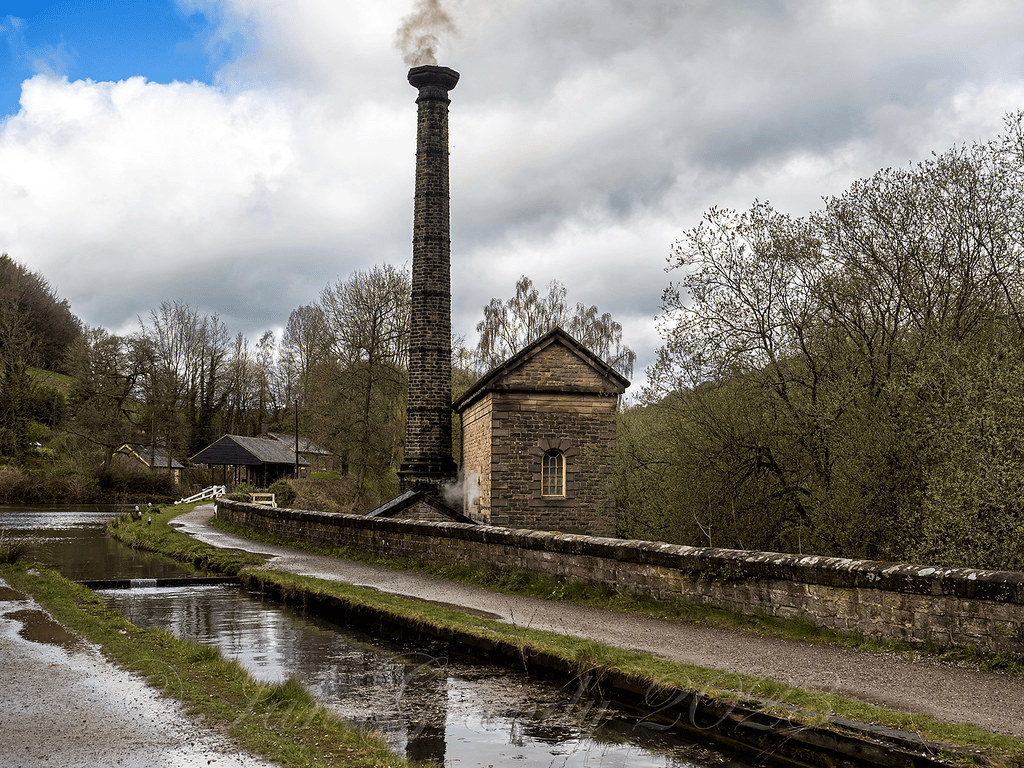
Leawood pump house in steam

For thousands of years goods had to be carried by roads, and a horse and cart could move about a ton of stone or coal. But with industrial growth in the eighteenth century increasing demand for raw materials canals became a feasible mode of transport, a horse-drawn narrowboat could carry 30 tons. From about 1760 the canal network grew quickly, and by 1788 a route was planned from Cromford to Langley Mill, where it would link up with the Erewash Canal and so gain access to the Trent basin. Local entrepreneurs such as Gell at Hopton and lead smelters at Lea and Crich were keen to promote this facility for their minerals, while also benefiting from cheaper coal deliveries.

The aqueduct at Bullbridge

Building the canal with nothing more advanced than shovels and wheelbarrows seems remarkable today, especially as aqueducts were needed to cross the Derwent by the Leawood pump house and over the Amber (above – the railway came later!). In addition, Butterley tunnel, about 3,000 yards long, proved difficult to cut and maintain. The entire route from Cromford to the Butterley tunnel was on a level, so no locks were needed. This saved water, which was always an issue given the original supply was the Bonsall Brook, shared with Arkwright’s mill. The pump house was a later addition, lifting water from the Derwent. The estimate for the canal’s construction was about £42,000, but inevitably the actual cost was nearly twice this when it finally opened in 1794.

The staff of Wheatcroft’s office at Cromford Wharf

The sign in the photo gives a good idea of the goods carried by the canal: not just coal and coke but also salt, pipes and straw. However, by the time this was taken the canal was in decline: from the 1850s the railway was providing a cheaper and faster service. At its peak in the early 1800s the canal carried 300,000 tons per year, and paid shareholders a whopping 20%. But in 1852, as profits declined, the canal was sold to its railway rival – which was already operating the High Peak line from Cromford to Manchester. The tunnel suffered several rock falls, which finally closed the through route in 1900, though local traffic between Hartsay and Cromford continued until 1944. It seems curious that such a substantial, splendid piece of engineering should have such a short life, effectively becoming redundant after only 50 years!

Millstoned

If you go down to the woods today …

The stone I found in my local woods recently is typical of the thousand-odd millstones scattered around the Peak District – and are used as a symbol for the National Park. Clearly fashioned from the gritstone of the ‘edge’ behind me, this example raises some intriguing questions: who made it? why was it abandoned? how was it transported?

On Stanage Edge

Both wind and water mills used pairs of millstones to grind grain between them; the stones were about 1.8 metres wide and each weighed nearly 2.5 tons. Millstone grit from North Derbyshire was considered the best material for these, and in the late seventeenth century a pair would cost about nine or ten pounds, reflecting the skill and effort required to make them. Most production seems to have been small-scale; perhaps providing winter work for farmers, and may have been concentrated in the Hathersage area and along the ‘edges’, but there is also documentary evidence of manufacture at Alderwasley, Crich and Holloway. However, in the eighteenth century, with rising standards of living, demand for white flour increased and milling this needed finer chert millstones. Quite suddenly, the traditional stones were unwanted, and this may account for the numbers that were abandoned – although some may have cracked or had other defects.

Keep them rolling …

One minor mystery is how such heavy, valuable objects were transported, given that they were sold all over England and exported to the Continent. The sites of the quarries were often remote from the nearest road, so they may have been rolled in pairs, fitted with a wooden axle, until they could be craned onto a cart. In 1676 a miller at North Elmshall paid seven shillings and sixpence for carrying his new stones 22 miles. At Baslow there were complaints about loads of millstones weakening the bridge over the Derwent, and fines for offenders, which suggests fairly heavy traffic. As with lead, Bawtry was the main inland port for shipping millstones, both for export and to other English regions. But perhaps the biggest mystery is how the semi-amateur masons were able to produce such precisely cut stones with the crudest of tools.

Rambling around Ryknild

Ryknild Street was the only long-distance Roman road that crossed Derbyshire, coming from Lichfield to the camp at Little Chester and then on to Chesterfield. Part of its route is still used today, notably the A61 from Higham through Stretton and Clay Cross to Chesterfield. There is little trace of the first part, through Breadsall and up to Brackley Gate, but then the route is picked up by Golden Valley and runs very straight to Smithy Houses and Street Lane. This last name, of course, and the village of Stretton, are reminders that Roman roads were always ‘streets’. Ryknild Street is the name given on the OS map, but there are many variations of the spelling, and this name was almost certainly not used by the Romans. The map above, of the area around Pentrich, is one place where public footpaths give access to the line of the road.

There’s a road here somewhere

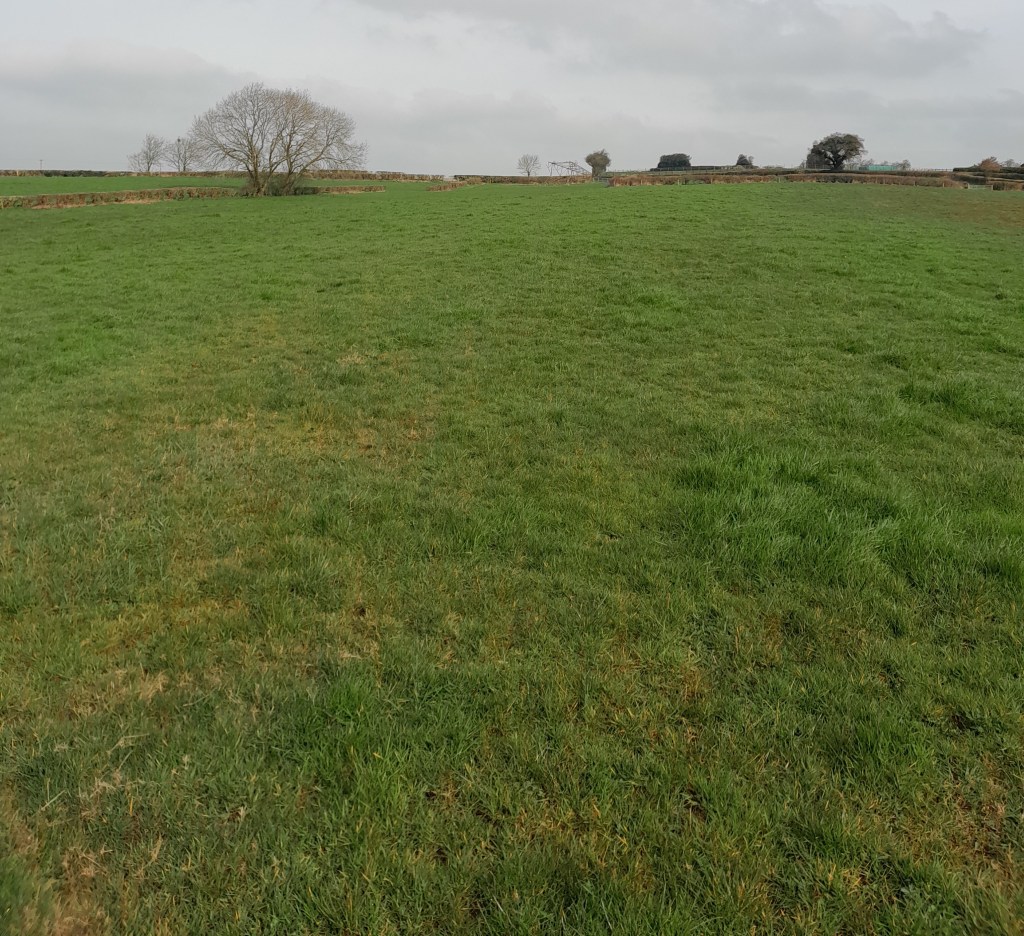
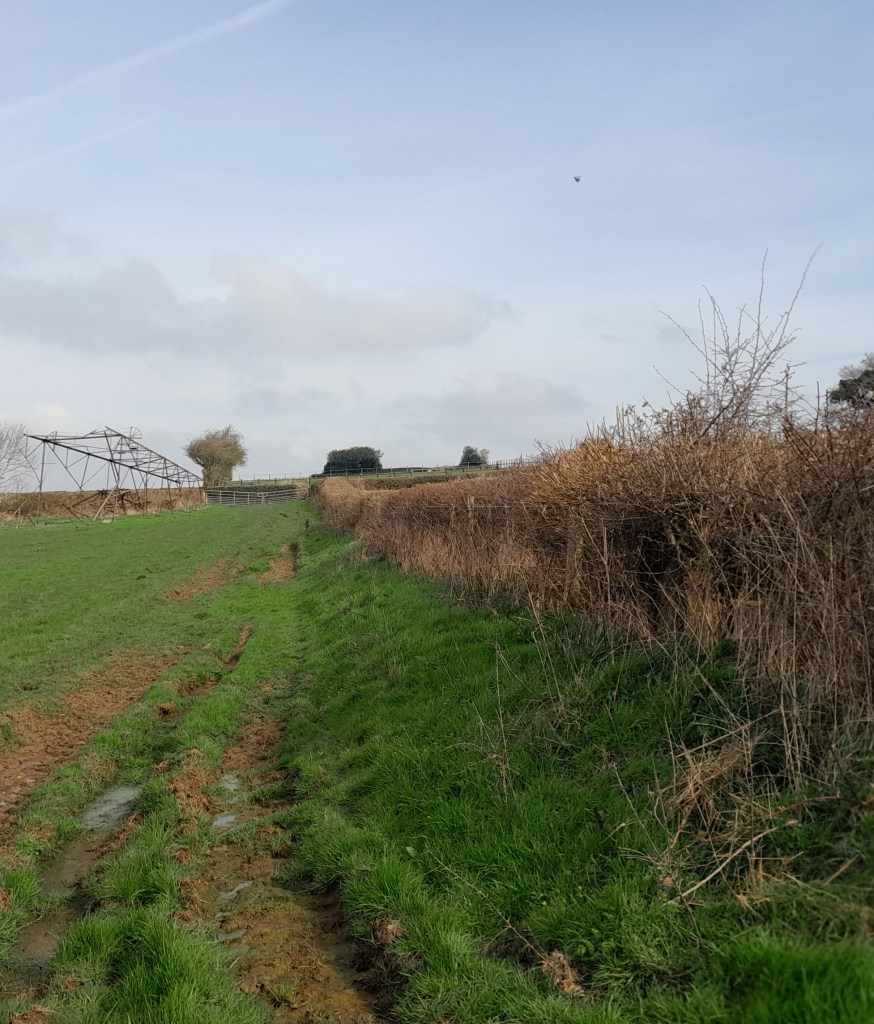
The footpath due west from Pentrich Church crosses the line of the old road at the top of a rise, and the raised platform for the road (known as an ‘agar’) can be just made out in the grass. Following this line north you come to another section of path which runs alongside a hedge – this is one of the few places Ryknild Street can actually be followed (see lower photo). On the other side of Riley Lane there is no trace of the road as it runs through ploughed fields east of Coneygrey Farm. However, just west of the road’s course, on Castle Hill, is what the OS map calls a ‘Roman Fortlet’.

The view is worth the climb

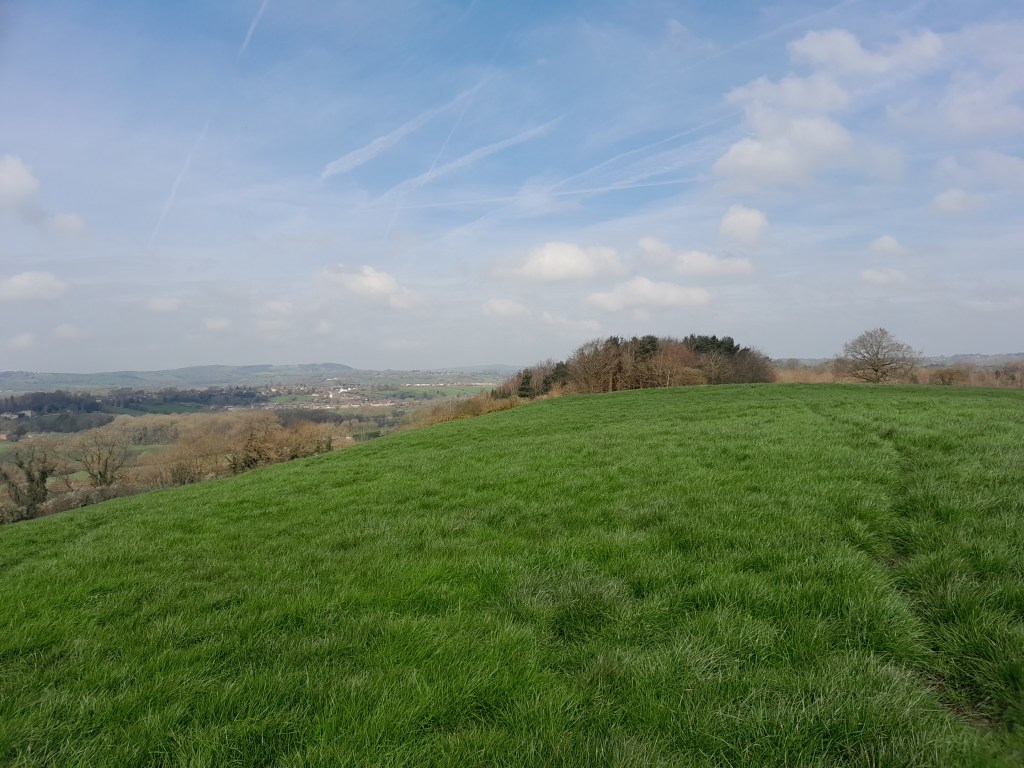
Roughly half-way between Little Chester and Chesterfield, this fort might have offered some shelter to road users but was unlikely to be manned regularly. It can be reached by climbing the quite steep bank from the Oakerthorpe road, but the view from the top is brilliant, and shows that the road builders were keeping to high ground, well away from the Amber floodplain to the west. Possibly they were just upgrading an older route which followed the ridge?

All roads lead to ….

One obvious question is why such well-built roads as the Romans constructed were allowed to go out of use? Of course, in places they were maintained and improved, such as the modern A38 from Lichfield to Derby but other areas such as this may have preferred older routes, or have been unable to organise maintenance, for instance when trees were blown down or drains and culverts became blocked.

For a detailed report on the fortlet see:

Leashaw: A road to nowhere?

Follow diversions

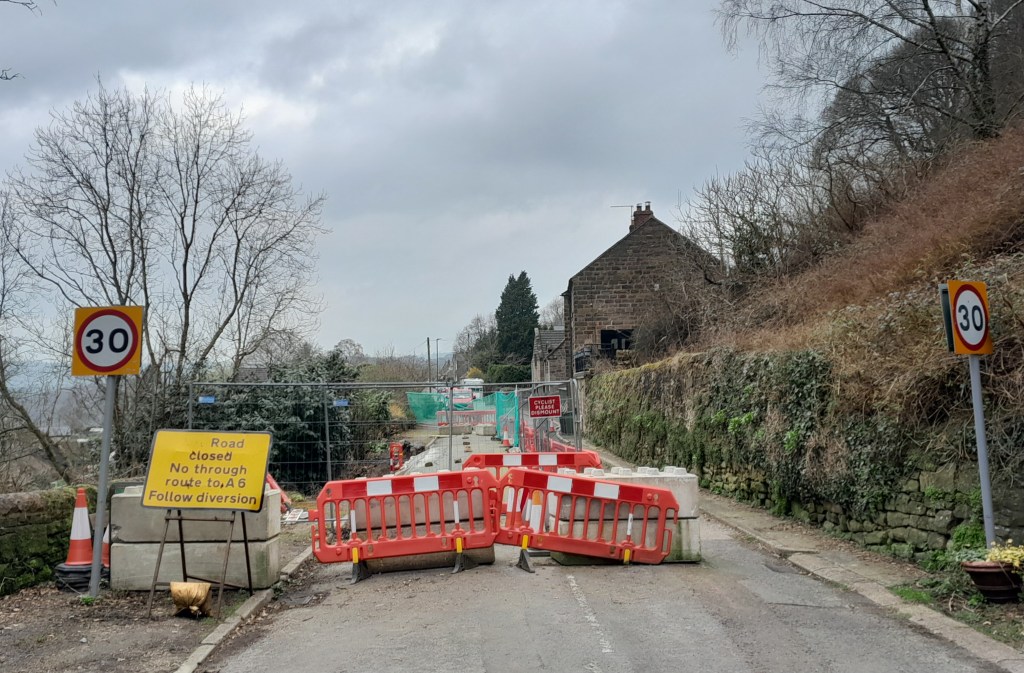
Road building in Derbyshire can be fraught, especially on steep-sided valleys. At times roads become too expensive to maintain, as happened with the road below Mam Tor, which was abandoned in the 1970s after frequent landslips due to the unstable geology. Following the exceptionally wet autumn and winter of 2023-4 several routes are currently closed, such as Beeley Lane. The village of Holloway has been badly affected; first the Cromford to Lea Bridge road was closed for over a year after flooding from the River Derwent in 2019, and then shortly after that was re-opened the Holloway to Crich road was closed due to a landslip undermining the pavement. This has now been blocked for over a year, and the County Council is not planning to start repair work until mid-2025.

This stretch of road was originally part of the Cromford Bridge and Langley Mill turnpike of 1766, built before the A6 provided a smoother, lower route. The house on the left, above, was one of the toll collectors’ cottages. At that time this would have been a narrow lane with just enough width for two carts or carriages to squeeze past. A report in the Derby Mercury in 1897 of a public meeting in Crich shows that the problems with this road are longstanding:

Mr Shaw brought forward an important matter, that of repairing the turnpike road leading from Bull Bridge to Holloway, stating that he thought, with many others, that the road ought to be taken over by the Derbyshire County Council. It was, however, clearly proved by Mr Dawes and other gentlemen that the County Council had been repeatedly requested to take over this road, but would not do so, their excuse being that there was insufficient through traffic. 

Walkers and cyclists only

It appears that the road was widened, surfaced and the pavement built in the 1930s, by which time the DCC had been obliged to take over maintenance. ‘Shaw’ in place names can mean a wood on a steep bank, and this accurately describes the route on both sides of Wakebridge, and explains why it is so difficult to maintain.

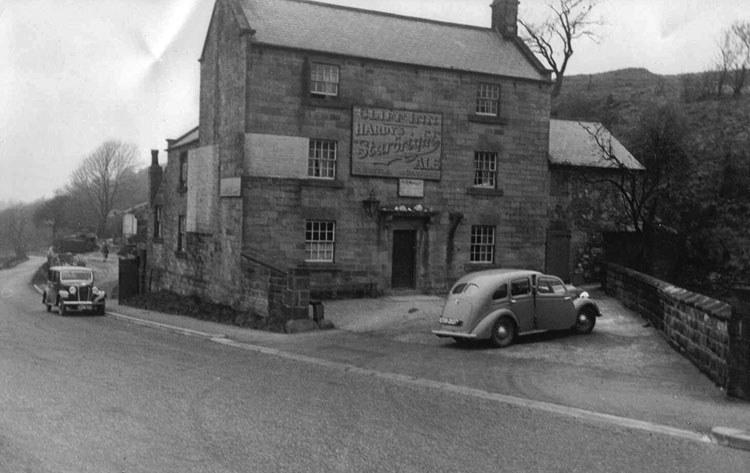
The good old daysthe Cliff pub

The situation is not just inconvenient for Crich and Holloway people. Several businesses are struggling with the lack of passing trade: Maycock’s Butchers and the Chase Cafe at the Holloway end, and the Cliff pub (above) at the edge of Crich. It seems that over 250 years after the turnpike was opened, a much wealthier society is unable to keep it open.

Down Ashover way

Tomb of Thomas and Edith Babington in Ashover church

These unusually colorful figures on the Babington tomb at Ashover are a reminder of a long-distance packhorse route that can be traced as far as Wirksworth to the west. Ashover parish used to be much larger, and included Holloway, Lea and Dethick, the home of the Babingtons. St John’s church at Dethick was built as a private chapel for the manor, but Ashover had to be used for burials. Most of the route can be comfortably walked today; leaving Ashover by the track beside the Old Poet’s Corner pub which drops to a bridge over the Amber, and then provides a steep climb up a remarkably complete stone causeway (below).

Onwards and upwards

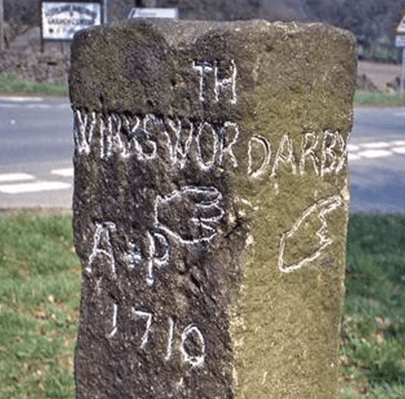
‘Causeys’ like this are found all over Derbyshire and are about two feet wide, thus providing a solid surface for horses’ feet at minimal expense. The track continues to climb towards Ravensnest and then meets Holestone Gate Road at the top. From there it’s road walking to the B6014 and along Lickpenny Lane to the Matlock-Alfreton road. At this point a guidestoop can be seen on the verge, dated 1710, marked A+P for Ashover Parish. Wirksworth is one of the directions shown, via Dethick Lane (NB the stoop has been moved from its original position, but not significantly). Dethick Lane is partly a holloway, Cross Lane marks the site of an old cross (only the base remains), and beyond the church the path leads down to a crossing of the Lea Brook on stepping stones, then uphill to cross Hearthstone Lane and down to Cromford Station and bridge.

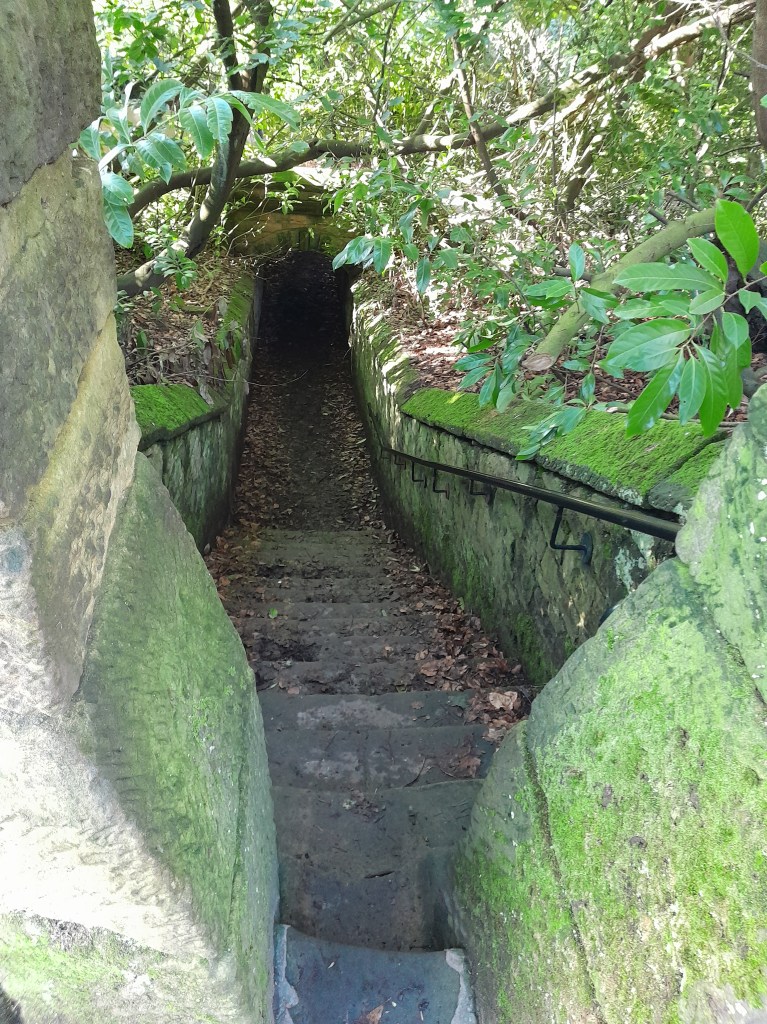
Looking down the steps at Eastwood Grange

Where did the route go to the east from Ashover? One likely possibility is the footpath which starts beside the Black Swan and runs up through the grounds of Eastwood Grange, today a school but which must have been built in Victorian times as a substantial private villa. The route (even if no longer used by packhorses) was clearly significant enough to be given a well-engineered stone-lined route through the gardens of the Grange, as can be seen above. Beyond this the path continues steeply up to the summit of Farhill, a popular viewpoint at 299 metres, from where Hardwick Hall, Chesterfield and Sheffield can be seen.

Reading the stone

The stone in the north wall of St Mary’s, Wirksworth

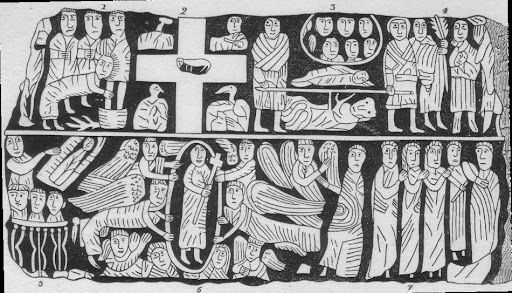
The Wirksworth Stone must be one of the most remarkable examples of sculpture from the Saxon era in England. Discovered in 1820 face down, buried under the church floor, it is thought to have been the lid of a sarcophagus belonging to an early saint, possibly Betti. It dates from about 700 CE, and displays a sophisticated iconography which reveals a strong Eastern influence e.g. the use of the Greek cross with equal arms. Perhaps the most interesting question is who produced this work 1,300 years ago, and was it carried here or made on the spot?

St Mary’s in its oval churchyard

Clearly the present thirteenth-century building (above) was not the first on this site; in fact the name of the local river, Ecclesbourne, suggest a very ancient foundation, probably a minster church for the whole wapentake of Wirksworth. Just as churches were built by travelling stone masons we can assume that sculpture like this was the work of itinerant artists, who would also produce crosses like those at Bradbourne and Eyam. It is claimed that the Wirksworth stone shows the work of two masons, the one responsible for the lower half being more skilled than his (or her) workmate. Although overall the workmanship is somewhat crude, the scenes portrayed cover the whole range of Christian teaching.

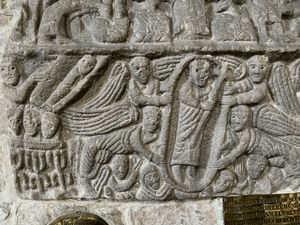
The ascent of Christ, in mandala (detail)

The left hand side of the stone has been broken off, so originally there were ten scenes but now only eight are visible. It appears that the stone should be read vertically, top to bottom, rather than left to right like a modern comic strip. So the top left scene shows Christ washing the feet of the disciples, and the one below the Harrowing of Hell, when the crucified Christ is supposed to have descended into Hades. The next pair are clearly the Crucifixion (with four evangelists) paired with the Ascension below. The third scene on the top represents the death of the Virgin, and below this the Annunciation is shown, with Mary seated. The final scene on top is the Presentation of the infant Christ in the temple, and under this the disciples prepare for their preaching mission (note the figure in the boat). Overall, and assuming the missing section showed the Nativity and the Baptism of Christ, the whole panel presents a remarkable statement of fundamental Christian beliefs. The position of Wirksworth on the Derbyshire Portway reinforces the theory that this was the work of travelling craftsmen, bringing the essentials of their religion in pictorial form to the (presumably) illiterate of the Peak.

Highways and Byways in Derbyshire – a good read

My somewhat battered copy

Macmillan published the first book in their Highways and Byways series in 1898 and, remarkably, the last in 1948; a total of nearly 40 titles covering most of Britain. All are detailed guides with plentiful illustrations by respected illustrators. Well-bound in hard covers with gilt lettering, the series must have been popular as copies can still be bought quite cheaply from second-hand sources. The volume on Derbyshire was quite early, in 1905, written by JB Firth and illustrated by Nelly Erichsen, who was from a Danish family.

An inviting title page

The author, unusually, writes from the viewpoint of a walker, so that the reader can follow his progress in detail, which is especially interesting if the reader knows an area well. Clearly there are many changes to the scenery 120 years later; for instance at Ambergate then-triangular station: ‘the station becomes simply a hideous deformity, and the adjoining kilns of Bullbridge throw up fleecy masses of white clouded smoke’. In Edwardian fashion there are many digressions in the form of stories of famous folk who have lived locally, and Firth is not afraid of copious quotations of poetry, but these rather add to the book’s charm.

Another value of the book is the recording of otherwise lost data. For example, the footpath that runs uphill from Pentrich mill to Pentrich church (see map above) is today simply a field path. but in the 1900s was clearly more: ‘This broad track used to bear the name of Deadman’s Lane, not from any relics which have been found there but because by this way dead men were borne to their last resting place in Pentrich churchyard‘. Firth also says that higher up, near the church, the line of the Roman road, Ryknild Street, was still marked with hedges.

Foul deeds in the wild Winnats

The sunny side of Winnats

Travel has always been seen as a risky undertaking, the dangers ranging from dirty sheets and greedy innkeepers to wild animal attacks and highway robbery. Poor roads were (and still are) probably more of a threat to life and limb than highwaymen, but some of these became notorious in the eighteenth and early nineteenth centuries, famed for their supposed style and cool demeanour on the gallows. Characters such as ‘Swift Nick’ (John Nevison) became folk heroes who allegedly displayed a kind of gallantry while robbing the wealthy coach passengers.

Up to no good

There are few references to such characters in Derbyshire history, presumably because an impoverished area like this had few travellers worth robbing. The majority of these ‘gentlemen of the road’ lay in wait on the outskirts of London, whence travellers might be carrying cash or other valuables, or en route to the Channel ports. The main period of robbery seems to have been from post-Civil War (about 1650) to early in the nineteenth century. Apparently better roads, more traffic and some attempts at policing diminished enthusiasm for ‘your money or your life’.

Not a robber in sight: Looking to Mam Tor from Castleton

However, one crime on Peak District roads is widely remembered: a double murder in the Winnats, then as now a steep-sided pass running west from Castleton. In 1758 a young couple, Allen and Clara, had eloped and were heading for Peak Forest Chapel where they could be married without banns. The legend is that she came from a wealthy family who had forbidden the match. While refreshing themselves at a Castleton inn they were observed by a group of lead miners, who noticed their smart clothing and suspected they were carrying cash. When the pair resumed their journey they were followed and attacked; both were killed and £200 stolen from them. Their bodies were then hidden in a cave and not discovered for ten years. The story has a highly moral ending: the last surviving murderer confessed on his deathbed, and all the others met evil ends. Although the details vary and may seem unlikely (£200 was a huge amount at the time, equal to over £20,000 today) the persistence of the story suggests some factual basis. Its evolution has been analysed in an academic article published in the journal Folklore: Murders in the Winnats Pass: Evolution of a Peak District Legend by Mark Henderson (2010).