Searching for St Alkmund

His stone sarcophagus?

Few people outside the Midlands have heard of this Saxon saint, but in Derbyshire he is commemorated by two churches, a well and a street, besides being the patron saint of the city of Derby. As with many saints from the Saxon period it is hard to sort the legends from the facts, but apparently he was King of Northumbria in the late eighth century until he was forced to flee south into Mercia when a rival branch of his family took the throne. He was murdered by Northumbrian agents about 800 CE and buried in Shropshire, after which a cult grew up around his name due to his reputation for acts of charity.

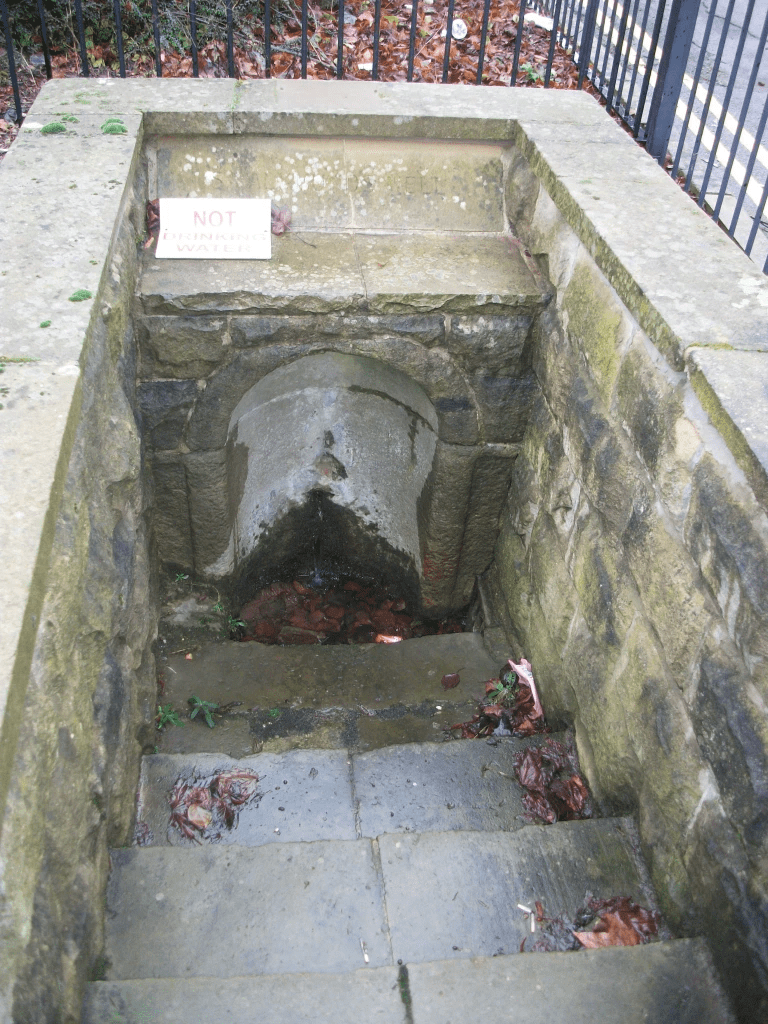
St Alkmund’s Well in Well Street

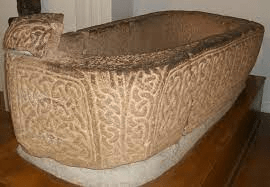
His remains were removed to Derby in 1140 and reburied in the church dedicated to him, which had a Saxon foundation, near the modern Jury’s Inn hotel. This church was re-built in the mid-nineteenth century but demolished in 1968 as part of Derby’s inner ring road development. A stone plaque marks the site today. The only positive aspect of this piece of urban vandalism (widely criticised at the time) was the discovery of what is believed to be St Alkmund’s stone sarcophagus, a fine piece of Anglo-Saxon stone carving, now in Derby museum. We must assume that this was brought from Shropshire, along with the saint’s remains, in the twelfth century, though this must have been a difficult operation, weighing as it does about a ton. The most likely route would have been by river, as the church was only two hundred yards from the Derwent. Not far away from the church, at the bottom of Well Street, which runs off North Parade, is St Alkmund’s Well. Now protected by iron railings, this had a rural setting until the early nineteenth century as it was in St Helen’s park. Today it must be one of the few holy wells in an urban setting, and was at one time the focus of church procession and well dressing.

Early postcard of St Alkmund’s Duffield

St Alkmund’s in Derby was conveniently near Ryknield Street, the old Roman road, which would have allowed regional pilgrims to travel to the shrine, while only a few miles north is another church with the same rare dedication, at Duffield. Here the church is sited curiously detached from the town and close to the river. Although the present church building is post-Conquest, this must have been a Saxon foundation in what was originally a very large parish. It is thought that the church’s siting may have been due to the use of the Derwent for baptism, although this has also led to severe and quite regular flooding of the building.

Hemlocked

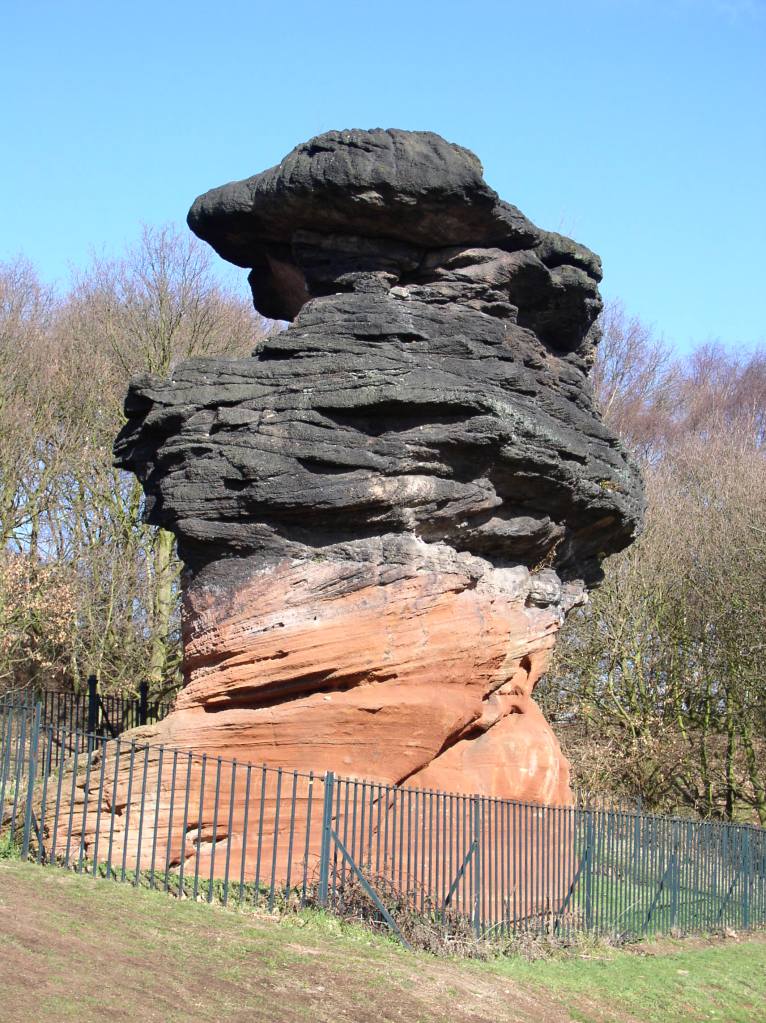
The Hemlock Stone

The Hemlock Stone on Stapleford Hill west of Nottingham is a sandstone pillar about five metres high, set in parkland. The name suggests that it may have acted as a boundary marker between Derbyshire and Nottinghamshire, and it is found near the Portway’s crossing of the Erewash (the county boundary). It seems to have had more significance in the past, with eighteenth-century references to its use for Beltane celebrations, and was famous enough for DH Lawrence to include it in Sons and Lovers as the destination for an Easter walk.

A barefoot Lawrence at the University of Nottingham

The walk from Eastwood to the Hemlock Stone had actually taken place in 1905, organised by Lawrence for his family and friends. Beginning in the town, the original route is now difficult to follow due to the construction of the A610 on the line of the old railway, but the walking party first crossed the semi-derelict Nottingham Canal, then the Erewash, and thirdly the Erewash Canal, soon coming to a footbridge over the Midland mainline railway, whose express trains linked Eastwood and Langley Mill to London. The party next joined the Heanor-Ilkeston road and followed this through Ilkeston, a town Lawrence knew from his teacher training. Their route then turned towards Stapleford: today mostly built up but following pleasant country lanes a hundred years ago. It is interesting that the Stone was seen as a significant destination, worth a fourteen-mile walk (at least), and was clearly a popular spot:

‘Everywhere in the field below, factory girls and lads were eating lunch or sporting about’.

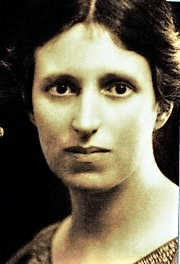
Jessie Chambers, the model for Miriam Leivers

In the novel the importance of this walk is the emerging love between the hero, Paul Morel, and Miriam, the girl from Haggs Farm (a thinly-disguised Lawrence and Jessie Chambers). Both felt rather alienated from the rest of the party, who were inclined to climb the Stone and carve their names there. On the way home they both fell behind the others, Lawrence struggling to repair an umbrella, and their mutual sympathy developed into a complicated affair which dominates the first half of Sons and Lovers and has become a classic of teenage angst.

Completing fishermen

The elegant Mr Cotton

Charles Cotton (1630-1687) was the owner of (the now demolished) Beresford Hall in Beresford Dale, on the upper reaches of the River Dove. As a Royalist sympathiser he found it prudent to live quietly in the country after the Parliamentary victory, but he was also a notable writer who wrote poetry in praise of the Peak District, as well as a best-selling handbook on games. But today he is mainly remembered as a fishing enthusiast who built a fishing ‘temple’ in his grounds on the Staffordshire side of the river. This still stands, on private land but visible from the footpath on the Derbyshire side. Over the doorway the initials CC and IW are intertwined, commemorating his friendship with Izaak Walton.

The fishing temple

Walton (1593-1683) was born into an innkeeper’s family in Stafford but seems to have been socially mobile, moving to open a linen draper’s business in London and becoming friendly with the local vicar, John Donne. But he was also a committed Royalist, and retired to Staffordshire after the War, where he bought land. His political leanings may have cemented his friendship with Cotton, but angling was probably the main tie, and Walton’s most famous work was The Compleat Angler (1653), to which Cotton later added some chapters. This book has gone through scores of editions in the past 370 years, yet is frankly almost unreadable today. Walton, who was 37 years older than Cotton, must have been good company, for he spent the last half of his long life staying with friends, and in some cases writing their biographies, including George Herbert and Richard Hooker.

Izaak on the job

In Cotton’s part of The Compleat Angler he describes a journey from Asbourne north to Milldale, in the form of a dialogue between a traveller (Viator) and a fisherman (Piscator), which emphasises the horrors of Derbyshire roads – this is the descent into the Dale:

Viator: It is as steep as a penthouse.

Piscator: To look down from hence it appears so, but the path winds and turns, and will not be found so troublesome.

Viator: Theses stones are so slippery I cannot stand. What’s here, a bridge? Do you travel in wheelbarrows in this country? This bridge was made for nothing else – ’tis not two fingers broad.

Piscator: I have rid over the bridge many a dark night.

Today the bridge at Milldale is still called Viator’s Bridge.

Unwillingly to school …

The young Alison

Today few young children walk to primary school alone, for a variety of reasons including parental perceptions of danger. In fact, the image of mum in a large Range Rover driving her offspring to the school gates has become a cliche. Yet 150 years ago children who were lucky enough to go to school often had to walk for miles, especially in rural areas. To some extent this walking may have formed part of their education, as was the case with Alison Uttley, who later became famous for her Little Grey Rabbit books. Alison grew up in a struggling farming family at Castletop Farm between Cromford and Lea Bridge. She didn’t go to school until she was seven, due to the remoteness of their farm on Hearthstone Lane.

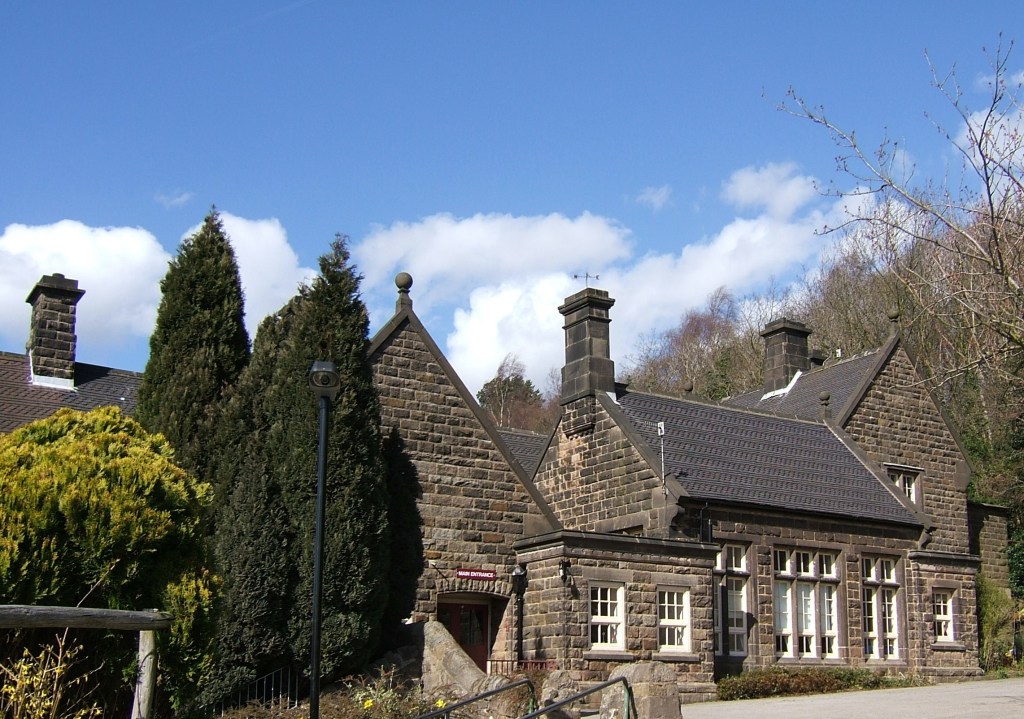
Lea Primary today

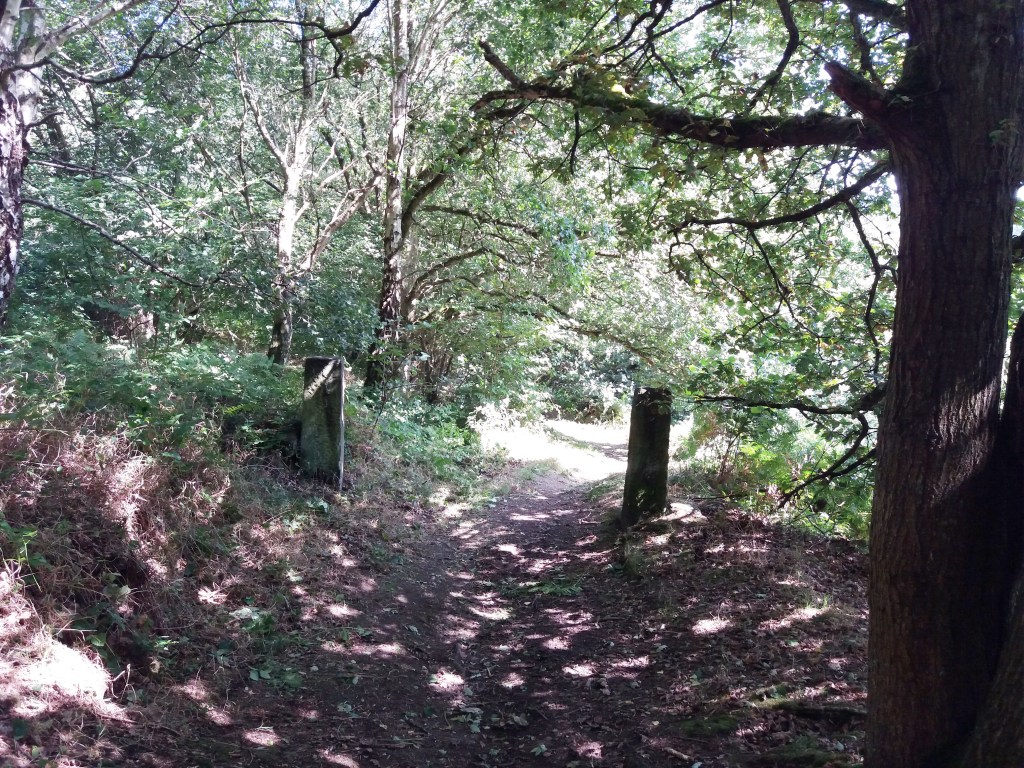
Lea Primary School on Church Street, Holloway was chosen by her parents due to its good reputation. But the journey home, although only a mile and a half long, meant walking from school down to Lea Road, past John Smedley’s mill at Lea Bridge and then climbing up through Bow Wood on what is now a rough track (but which was the old road before the turnpike was built by the Derwent), and emerging from the wood just below the farm. Alison had to do this walk twice a day, in all weathers, and in winter the homeward stretch would be in the dark, for which she was given a lantern.

The path through Bow Wood

Clearly the fears she felt on her walk had a major impact, for she describes the journey in several books:

“I set off home, running for the first mile, for it was downhill and easy. Then I passed a mill and walked up a steep field where cows grazed. I came to the wood, and stopped at the big gate to light the candle in my lantern. I shut the gate softly so that ‘they’ would not hear. The treees were alive and awake, they were waiting for me…”

She obviously had a powerful imagination, and perhaps this walk could be credited with launching her career as a storyteller, since she sometimes persuaded a school friend to walk with her, with the incentive of listening to the stories that Alison made up as they walked.

Alison’s walk to school can easily be followed today, either starting from Cromford Station and walking uphill to Castletop, and then through Bow Wood to Holloway, or the reverse route starting from Lea Primary School.

Sources

Judd, D (2010) Alison Uttley, Spinner of Tales, Manchester University Press

Uttley, A (1951) Ambush of Young Days, Faber & Faber

Mr Burdett, map maker and …

Peter and Hannah

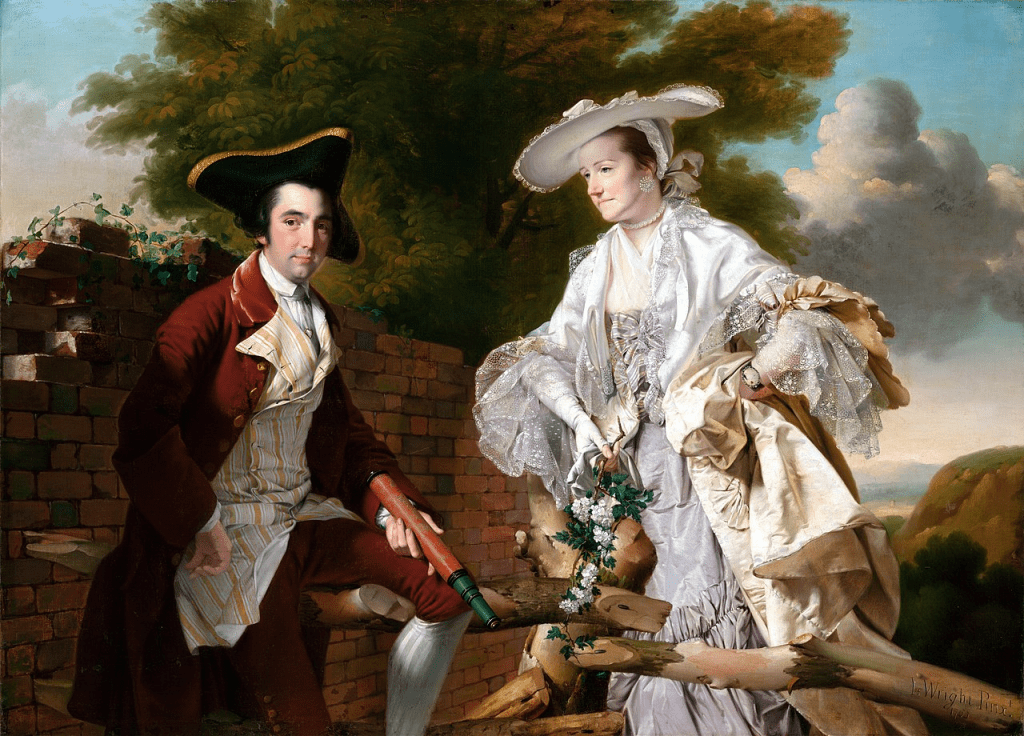
Peter Perez Burdett (c.1734-1793) is a fascinating example of an eighteenth-century artist, surveyor, amateur scientist and … serial debtor! His map of Derbyshire (1767) is the first accurate survey of the county, at the scale of an inch to a mile, and is invaluable to local historians. He was a friend of the painter Joseph Wright, whose portrait of Peter and his wife Hannah (1765) shows them al fresco, as if posing on their country estate. Apparently she was a widow, somewhat older than Peter, and the marriage may have helped him raise capital for his mapping project. He is holding his surveying telescope, while she appears most unsuitably dressed for a country ramble! (Wright was a master of drapery). This double portrait can now be seen at the Czech National Gallery in Prague.

Plan of Derby from Burdett’s map of 1767

Burdett appears in several of Wright’s paintings, notably as the figure making notes on the left in Wright’s masterpiece, A Philosopher Lecturing on the Orrery (see below). But despite their friendship and his map-making achievements, Burdett chose to move to Liverpool in 1768, possibly to seek a new range of clients, but certainly to evade his creditors. There he surveyed the Liverpool – Leeds canal, and was also involved in the development of the new technique of making aquatints in 1774, producing several himself, and thus demonstrating his versatility.

Burdett makes notes

However, Burdett seems to have been again less proficient at managing his finances, since in 1774 he had to flee to Baden, in modern Germany, to escape his debtors. Leaving Hannah behind he, curiously, took their joint portrait with him! In Baden he found a patron in the Grand Duke, and also found a new wife, Friederike Kotkowski, who he married in 1787 at the age of 53. They had a daughter, Anna, who married into the local aristocracy. Peter was clearly successful in his new milieu, surveying schemes for the Grand Duke until dying in 1793 at the age of 59. His story illustrates the extraordinary versatility of many men (and some women) in this period of rapid social change and scientific advances.

“A fine lady upon a white horse …”

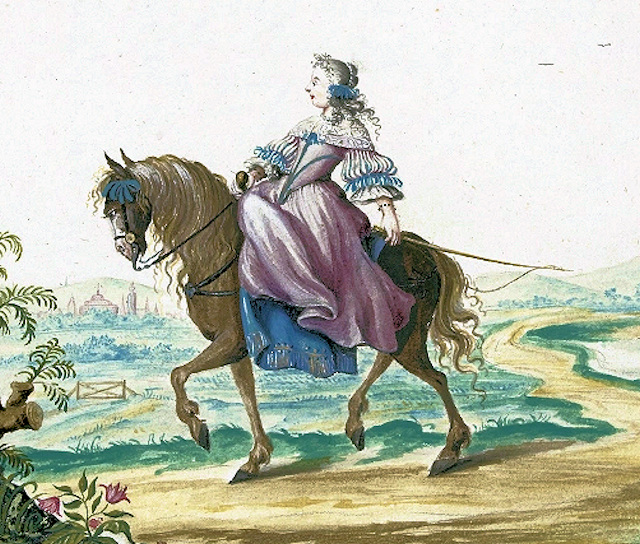
Woman riding side-saddle: No portrait of Celia appears to exist.

Celia Fiennes (1662-1741) was a well-connected lady who toured much of England on horseback around the end of the seventeenth century. Her journal provides a rare insight into the Peak District at this time, before turnpikes but when ‘tourism’ was just beginning. Although independent female travelers were rare at that time, her wealth allowed her to have two servants: an entourage that did not always protect her from the difficulties of travel. As the unmarried daughter of a Cromwell-supporting nobleman, Celia lived partly with a married sister in Hackney and seems to have traveled for both health and curiosity.

Woodcut of the old Buxton bathhouse

Like many more modern travelers Celia found much to complain of. At Buxton, where her party stayed at the Duke of Devonshire’s Buxton Hall, the beer was so bad that ‘very little can be dranke’. Worse were the bedrooms, which were overcrowded: ‘sometimes they are so crowded that three must lye in a bed’. Needless to say: ‘Few people stay above two or three nights it is so inconvenient’. It is easily forgotten that modern notions of privacy were quite foreign at this time. The main attractions were the bath and the water from St Anne’s Well. The former was about 40 feet long by 30 feet wide, and it was barely warm: ‘Just enough to open the pores of ones body’. Worryingly, the flow of water was weak, so that: ‘Its not capable of being cleansed after everybody has been in’. She must have questioned the health benefits of the process, but nevertheless plunged in.

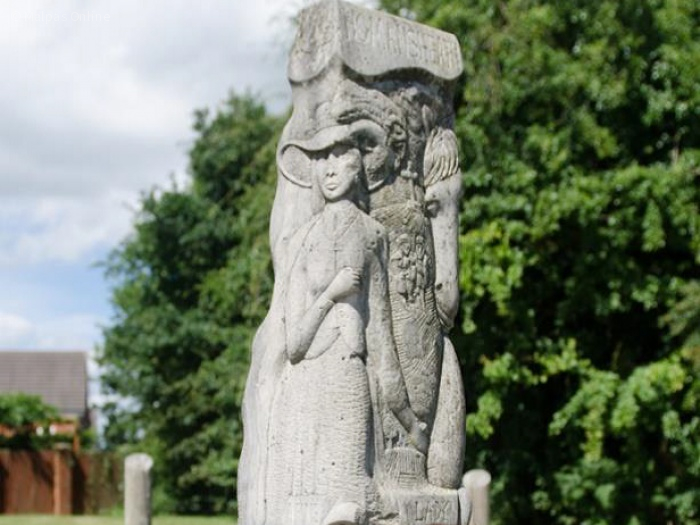
Memorial to Celia in the (suitably named) No Mans Heath, Cheshire

Celia Fiennes visited the so-called ‘Wonders of the Peak’ in the same way a modern tourist might tick off the local attractions in their guidebook. But equally interesting are her comments on travel generally, which she seems to have found extremely difficult in this area:

Indeed all Derbyshire is but a world of peaked hills, which from some of ye highest you discover ye rest like steeples or tops of hills as thick as can be, and tho’ they appear so close yet ye steepness down and up takes up yr time…

Even the guides couldn’t be relied on:

The country here about is so full of moore or quagmires and such precipices that one that is a stranger cannot travel without a guide, and some of them are put to a loss sometymes.

Her journals were not published in her lifetime, but eventually appeared in 1888 with the title Through England on a Side-saddle. The full text can be found at:

https://l4.tm-web-01.co.uk/lib/celia-fiennes-M171235.webp

The romance of the road

Give to me the life I love,
Let the lave go by me,
Give the jolly heaven above
And the byway nigh me.
Bed in the bush with stars to see,
Bread I dip in the river,
That's the life for a man like me,
That's the life for ever.

Robert Louis Stevenson wrote his poem The Vagabond in the 1870s, influenced by a mid-nineteenth century enthusiasm among some intellectuals for the open road and the free life. Before this only the poorest travelled on foot, but now writers began singing the praises of walking, and even mixing with nomadic outcasts such as gypsies. Stevenson reinforced his poetry with experience, his pioneering Travels with a Donkey in the Cevennes (1879) is his account of a 12-day hike through the hills of this French region, sleeping rough and struggling to control his animal. 

George Borrow

Twenty years earlier, the less well-known but probably more remarkable George Borrow had published his autobiographical novel Lavengro (1851), based on his wanderings in England and Wales and his meetings with gypsies, whose language (among many others) he claimed to have learned. Borrow was certainly physically remarkable, a tireless walker who went on to work for the British and Foreign Bible Society in their quixotic attempt to bring the Word to Spain. His account of his travels, published as The Bible in Spain, reveals a man of considerable stamina, riding around (Carlist) war-torn Spain with a donkey-load of Bibles while maintaining his flirtation with the world of Romany.

Mathew Arnold, swinging between poetry and philosophy

Another key work on this theme is Mathew Arnold’s The Scholar Gypsy of 1853. The longish poem tells the story of an Oxford student who becomes disillusioned with academia and joins a band of local gypsies, hoping to learn their secret lore:

The story of the Oxford scholar poor,
Of pregnant parts and quick inventive brain,
Who, tired of knocking at preferment's door,
One summer-morn forsook
His friends, and went to learn the gypsy-lore,
And roam'd the world with that wild brotherhood,
And came, as most men deem'd, to little good,
But came to Oxford and his friends no more.

Although it seems unlikely that Arnold took to the road himself, the poem expresses the doubts that were beginning to emerge about the destination of Victorian society, and the fascination with apparently more primitive or ancient cultures. In this sense Arnold was well ahead of his time, with these concerns becoming more prominent in the twentieth century. Writers such as Walter Starkie, an Anglo-Irish academic, who reprised Borrow with his wanderings in Hungary with the gypsies in the 1930s, as described in Raggle-Taggle (1933), continued this theme, while more recently there has been a positive flood of writers taking to the hills, tracks, lanes and even rivers in their eagerness to escape from the contemporary world.

Starkie in full flow

Wayside worship

Altar to the Quadruviae in Germany

For at least two thousand years European roads were marked by shrines and sanctuaries, giving travelers the chance to rest, make offerings and pray for a safe journey. The Romans dedicated some to well-known gods such as Hercules and Mars, but they also had divinities specific to travel: Biviae at the meeting place of two roads, Triviae for three and Quadruviae for four, as in the example above, found in Germany. These junction divinities were all female, and give us some insight into the mindset of the ancient world. Even in medieval times in England a crossroads was seen as a place of significance, suitable for the burial of suicides (finally abolished by act of parliament in 1832).

Roadside scene (detail). Eighteenth century

The painting above, in the Thyssen Museum in Madrid, provides a rare glimpse of what may have been a common sight in the pre-industrial world: at a small stone shrine one man is on his knees, while another, on horseback, makes an offering. Yet in Catholic areas of Europe this tradition continued into the twentieth century, as described by DH Lawrence in his essay ‘The Crucifix across the Mountains’. In 1912 Lawrence and Frieda made an epic journey, mainly on foot, from Bavaria to Lake Garda in Italy. Lawrence was struck by the carved wooden crucifixes they found by the roadside:

Coming along the clear, open roads that lead to the mountains, one scarcely notices the crucifixes and the shrines … But gradually, one after another looming shadowily under their hoods, the crucifixes seem to create a new atmosphere over the whole of the countryside, a darkness, a weight in the air …

Wheston Cross near Tideswell

Derbyshire roads had their share of shrines, although little is known of pre-Christian examples. However, it is difficult to judge which of the surviving crosses were boundary markers and which were wayside crosses. At the reformation in the sixteenth century the crosses, usually dedicated to a saint, were generally destroyed as being Popish. However, a few survived, such as the cross at Wheston, which has the Madonna and Child on one face and the Crucifixion on the other. It is about 11 feet tall, but part of the shaft is more recent. Such crosses must have helped travelers navigate generally, but may also have been used to point the way to pilgrimage churches. One clue to the previous existence of a cross is the name ‘Cross Lane’, found in various locations in the county, such as just above Dethick. The topic is fully explored in Neville Sharpe’s ‘Crosses of the Peak District’.

Gell the Roman?

When I was a child we were occasionally driven into Derbyshire as a holiday treat, and coming down the Via Gellia was one highlight of such trips. It seemed a very romantic route, winding and well-wooded within the steep-sided valley, with mysterious caves inviting exploration. Today the road seems a little less fascinating, more overgrown with trees, and with massive quarry trucks weaving round every bend, yet it is of historical interest in that we know (unusually) when and why it was built, and by whom.

Philip Gell the hunter

The Via Gellia is not the only road in Derbyshire to be named after a person; for instance there is the Sir William Hill near Eyam, but it must be a unique case of a Latinized family name! The Gell family had lived at Hopton Hall for generations, near where they had profitable quarries and lead mines. Philip Eyre Gell (1723-95) inherited the estate at the age of 16, but postponed marriage till he was 50, in 1773, when he married the 16-year-old Dorothy Milnes. Their first son, another Philip, was born in 1775.

Burdett’s map of 1791 shows a track from Cromford to the mill where the Bonsall Brook drops down the Clatterway, but nothing beyond that point. The building of the Via Gellia is generally dated to 1791/2, and was designed to allow carts of lead ore or stone to travel down from the Hopton area to the canal and lead smelters at Cromford. Nobody knows who gave it its name, but one possibility is Philip Gell’s second son Wiliam, an archaeologist who had visited the ruins of Pompeii. Perhaps his interest in Roman civilization and knowledge of Roman road names such as the Via Appia led him to christen his father’s road in Roman style, hinting at an improbable family history dating back over a thousand years?

Tufa Cottage, situated about half-way down the route, must have been built by the mid-nineteenth century, originally for a gamekeeper on the Gell estate. Tufa is a kind of porous limestone found locally, with a distinctive coarse texture. Today it is notable for the cable car in the front garden!

Mr Wright paints Cromford

Wright: Arkwright’s Mill in the late eighteenth century

Paintings and prints can help us understand the development of the road system, and reveal historical features not shown on maps. As Matlock Bath became an established tourist attraction in the late 1700s, visitors were also keen to visit Arkwright’s mill just up the road at Cromford, and be impressed by the scale of the buildings. One of these ‘industrial tourists’ was Joseph Wright of Derby, who painted the mill both by day and at night, when the rows of candlelit windows must have been a remarkable sight in this very rural location. The painting above appears to have been made from a location close to the modern High Tor cafe by the Cromford crossroads, looking down the road towards Cromford Bridge. But this area has been radically changed by cutting through the Scarthin Rock, a process begun in 1817 but not finally completed in modern form until 1962. The painting clearly shows the mill leat on the far side of the road, which led to the aqueduct above the road (damaged quite recently and sadly never replaced). The Bonsall Brook is shown on the nearside of the road (not visible today), and the main building is taller than today’s mill. In the distance the tower of Crich Stand can be clearly seen, which at the time of the painting had been recently (1785) rebuilt in stone by Francis Hurt, a major local landowner.

Wright: Willersley Castle and Cromford Church

Another view of the area has the Matlock Bath road in the foreground, and is framed again by Scarthin Rock. It is difficult to find this viewpoint today due to the increase in tree cover: in Wright’s time the valley was quite bare. Both Cromford church and Willersley Castle must have been very recent when this was painted; in fact the church was not finished until 1797, the year of Wright’s death. The painting illustrates the first appearance of the church; the current porch was added in the mid-nineteenth century. Next to the bridge the small fishing house is clearly visible.

Wright: Cromford Mill by night

The third painting is an example of Wright’s interest in dramatically-lit night scenes. Although the view is from a similar spot to the first picture, the road now runs to the left of the mill, not the right. It must be assumed that this is artistic licence, since the road in the first picture is so clearly on the line of the present one. Clearly, the details of such pictures cannot be assumed to be reliable, but it’s worth noting that the two-storey building in the foreground, which is not shown in the first view, survives today in the same form.