Millstoned

If you go down to the woods today …

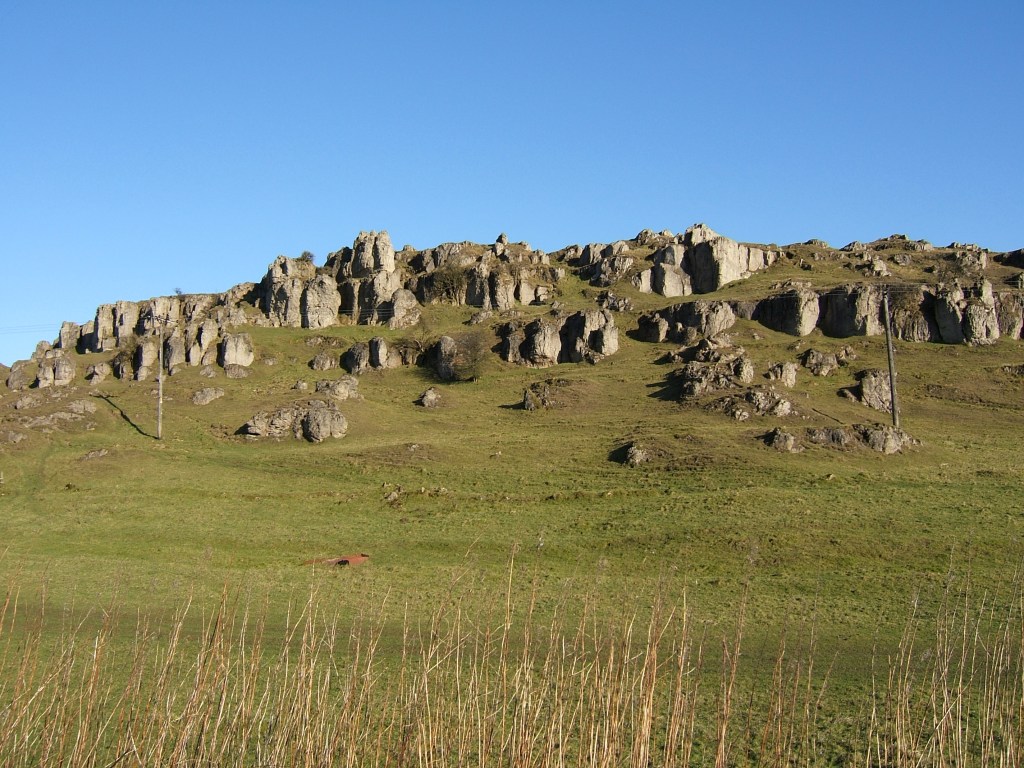
The stone I found in my local woods recently is typical of the thousand-odd millstones scattered around the Peak District – and are used as a symbol for the National Park. Clearly fashioned from the gritstone of the ‘edge’ behind me, this example raises some intriguing questions: who made it? why was it abandoned? how was it transported?

On Stanage Edge

Both wind and water mills used pairs of millstones to grind grain between them; the stones were about 1.8 metres wide and each weighed nearly 2.5 tons. Millstone grit from North Derbyshire was considered the best material for these, and in the late seventeenth century a pair would cost about nine or ten pounds, reflecting the skill and effort required to make them. Most production seems to have been small-scale; perhaps providing winter work for farmers, and may have been concentrated in the Hathersage area and along the ‘edges’, but there is also documentary evidence of manufacture at Alderwasley, Crich and Holloway. However, in the eighteenth century, with rising standards of living, demand for white flour increased and milling this needed finer chert millstones. Quite suddenly, the traditional stones were unwanted, and this may account for the numbers that were abandoned – although some may have cracked or had other defects.

Keep them rolling …

One minor mystery is how such heavy, valuable objects were transported, given that they were sold all over England and exported to the Continent. The sites of the quarries were often remote from the nearest road, so they may have been rolled in pairs, fitted with a wooden axle, until they could be craned onto a cart. In 1676 a miller at North Elmshall paid seven shillings and sixpence for carrying his new stones 22 miles. At Baslow there were complaints about loads of millstones weakening the bridge over the Derwent, and fines for offenders, which suggests fairly heavy traffic. As with lead, Bawtry was the main inland port for shipping millstones, both for export and to other English regions. But perhaps the biggest mystery is how the semi-amateur masons were able to produce such precisely cut stones with the crudest of tools.

Come back, Blind Jack

John Metcalfe relaxing in Knaresborough

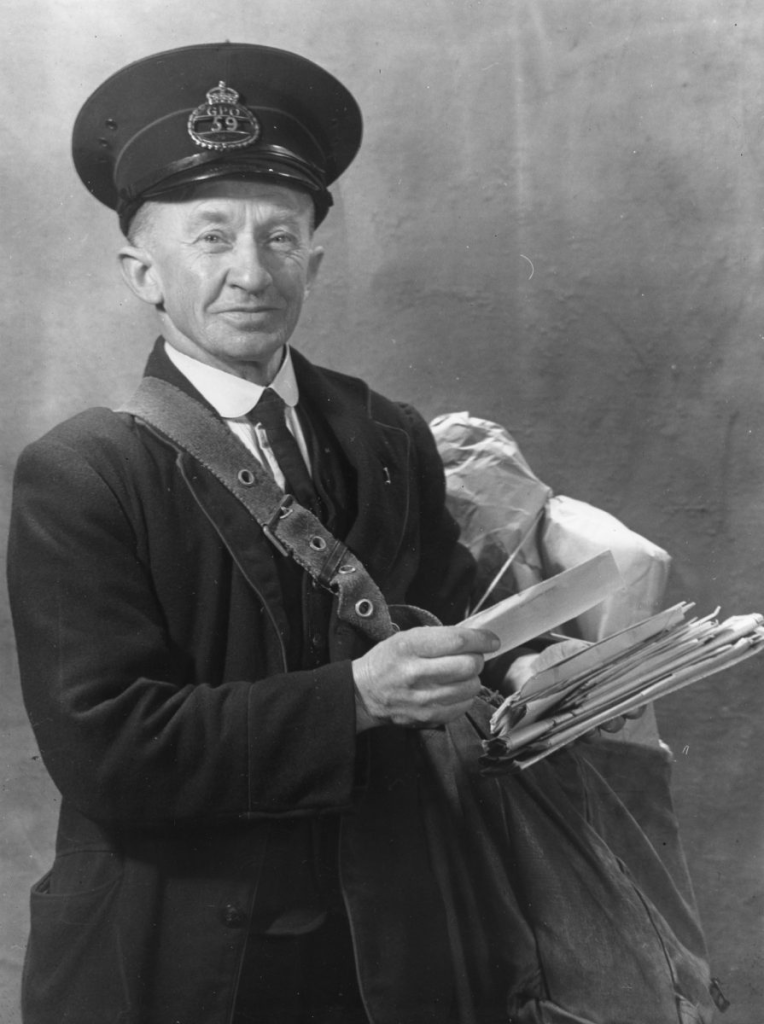
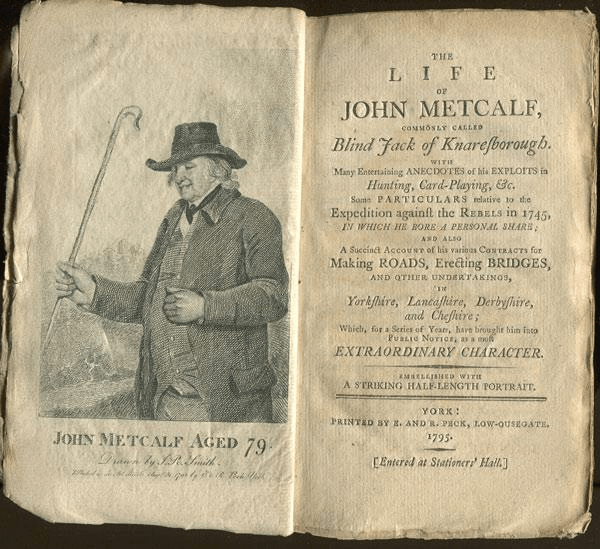
John Metcalf, known as ‘Jack’, was a pioneer road builder in Yorkshire and Derbyshire, despite being blind from the age of six. His remarkable career began in 1717, when he was born to a poor family in Knaresborough. He was given fiddle lessons as a source of future financial support, and at age 15 became fiddler at the Queen’s Head in Harrogate. Horse trading, swimming and diving were other occupations, while his detailed local knowledge gave him employment as a guide. Among other achievements he ran a carrier business, using a stagecoach which he drove himself.

Jack on a rare sunny day in Yorkshire

His career as a road builder began in 1765 when he tendered to build a section of turnpike road between Harrogate and Boroughbridge. Presumably his work as a carrier had given him insight into the problems of road maintenance, and his road engineering was based on the need for effective drainage, via a convex surface, into adequate culverts at the road side. He was also the first to find a way of laying a route through bogs, using floating rafts of ling and gorse as foundations. But his success must have also been down to effective calculation of costs when bidding for contracts, plus his man-management skills, such as being on site at 6 a.m. In total he was responsible for 180 miles of new or improved roads, mainly in Yorkshire but also in north Derbyshire, especially the roads around Buxton.

A well-stocked pub

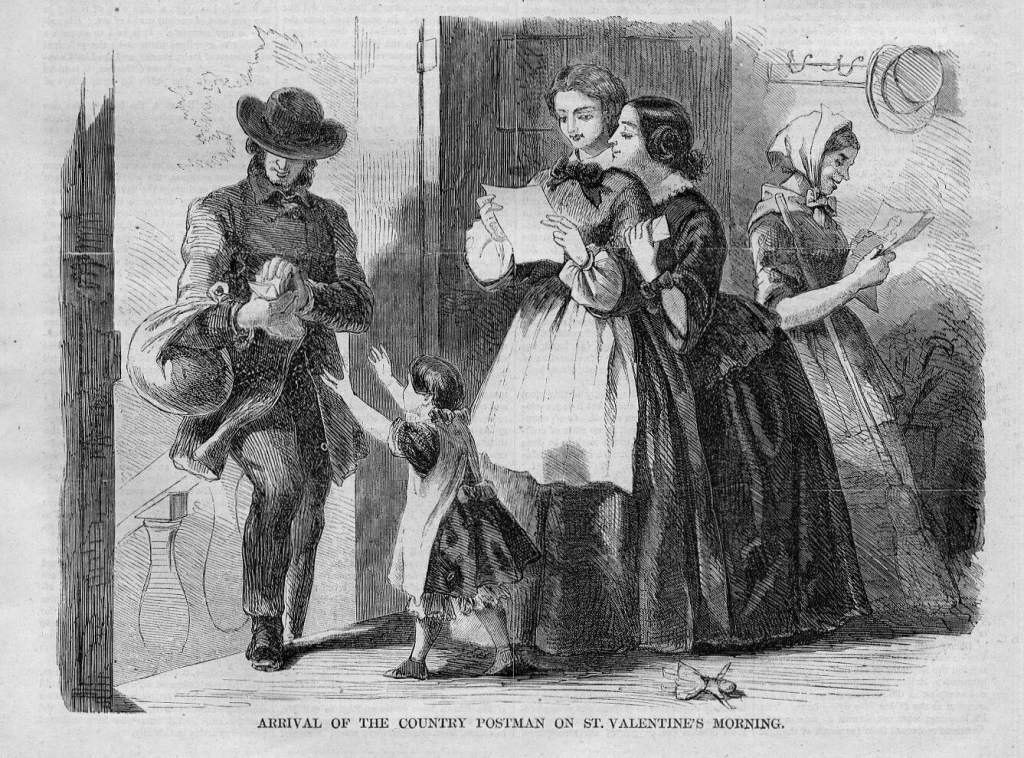
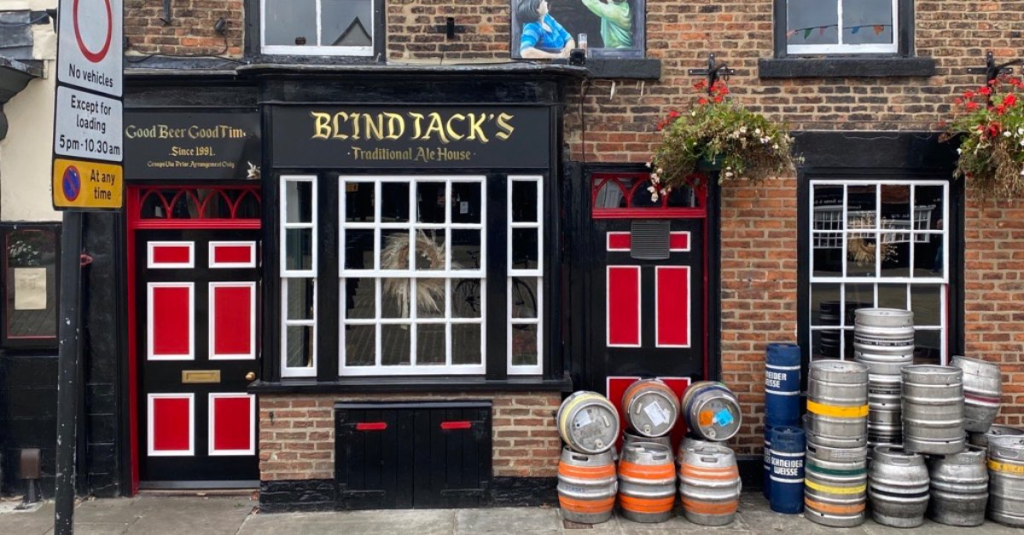
Today Jack is remembered in his home town by a seated statue (top) outside the pub that bears his name. His road-building contemporaries, Thomas Telford and John MacAdam, are better-known, but his triumph over disability is quite remarkable. In old age he lived with one of his daughters, and at the age of 77 walked to York and told his life story to a publisher, who produced this volume (below).

Given the current state of Derbyshire roads, we might wish for Jack to get off his bench and come back to show us how to fill in the potholes …

Reading the stone

The stone in the north wall of St Mary’s, Wirksworth

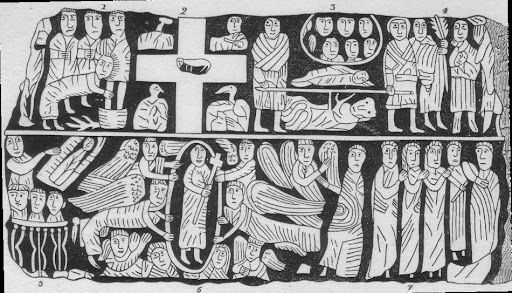
The Wirksworth Stone must be one of the most remarkable examples of sculpture from the Saxon era in England. Discovered in 1820 face down, buried under the church floor, it is thought to have been the lid of a sarcophagus belonging to an early saint, possibly Betti. It dates from about 700 CE, and displays a sophisticated iconography which reveals a strong Eastern influence e.g. the use of the Greek cross with equal arms. Perhaps the most interesting question is who produced this work 1,300 years ago, and was it carried here or made on the spot?

St Mary’s in its oval churchyard

Clearly the present thirteenth-century building (above) was not the first on this site; in fact the name of the local river, Ecclesbourne, suggest a very ancient foundation, probably a minster church for the whole wapentake of Wirksworth. Just as churches were built by travelling stone masons we can assume that sculpture like this was the work of itinerant artists, who would also produce crosses like those at Bradbourne and Eyam. It is claimed that the Wirksworth stone shows the work of two masons, the one responsible for the lower half being more skilled than his (or her) workmate. Although overall the workmanship is somewhat crude, the scenes portrayed cover the whole range of Christian teaching.

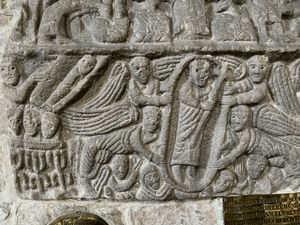
The ascent of Christ, in mandala (detail)

The left hand side of the stone has been broken off, so originally there were ten scenes but now only eight are visible. It appears that the stone should be read vertically, top to bottom, rather than left to right like a modern comic strip. So the top left scene shows Christ washing the feet of the disciples, and the one below the Harrowing of Hell, when the crucified Christ is supposed to have descended into Hades. The next pair are clearly the Crucifixion (with four evangelists) paired with the Ascension below. The third scene on the top represents the death of the Virgin, and below this the Annunciation is shown, with Mary seated. The final scene on top is the Presentation of the infant Christ in the temple, and under this the disciples prepare for their preaching mission (note the figure in the boat). Overall, and assuming the missing section showed the Nativity and the Baptism of Christ, the whole panel presents a remarkable statement of fundamental Christian beliefs. The position of Wirksworth on the Derbyshire Portway reinforces the theory that this was the work of travelling craftsmen, bringing the essentials of their religion in pictorial form to the (presumably) illiterate of the Peak.

Highways and Byways in Derbyshire – a good read

My somewhat battered copy

Macmillan published the first book in their Highways and Byways series in 1898 and, remarkably, the last in 1948; a total of nearly 40 titles covering most of Britain. All are detailed guides with plentiful illustrations by respected illustrators. Well-bound in hard covers with gilt lettering, the series must have been popular as copies can still be bought quite cheaply from second-hand sources. The volume on Derbyshire was quite early, in 1905, written by JB Firth and illustrated by Nelly Erichsen, who was from a Danish family.

An inviting title page

The author, unusually, writes from the viewpoint of a walker, so that the reader can follow his progress in detail, which is especially interesting if the reader knows an area well. Clearly there are many changes to the scenery 120 years later; for instance at Ambergate then-triangular station: ‘the station becomes simply a hideous deformity, and the adjoining kilns of Bullbridge throw up fleecy masses of white clouded smoke’. In Edwardian fashion there are many digressions in the form of stories of famous folk who have lived locally, and Firth is not afraid of copious quotations of poetry, but these rather add to the book’s charm.

Another value of the book is the recording of otherwise lost data. For example, the footpath that runs uphill from Pentrich mill to Pentrich church (see map above) is today simply a field path. but in the 1900s was clearly more: ‘This broad track used to bear the name of Deadman’s Lane, not from any relics which have been found there but because by this way dead men were borne to their last resting place in Pentrich churchyard‘. Firth also says that higher up, near the church, the line of the Roman road, Ryknild Street, was still marked with hedges.

‘There is not a finer county in England than Derbyshire’

Jane Austen 1775-1817

A significant tourist industry has grown up around Jane Austen and Derbyshire. It is often claimed that she visited the county in 1811, stayed at the Rutland Arms in Bakewell, looked around Chatsworth and based Mr Darcy’s fictional house of Pemberley on this model. At least one film of Pride and Prejudice has used Chatsworth as a setting. However, there is no actual evidence that Jane ever visited the county, let alone wrote about it.

As it wascould this have been Pemberley?

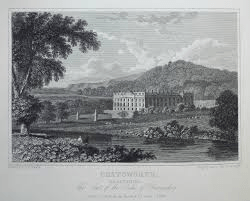
In Pride and Prejudice the heroine, Elizabeth Bennet, is taken on a tour of the Peak District by her aunt and uncle. There is mention of Matlock, Chatsworth, Dovedale and the Peak as being the main attractions. They base themselves in ‘Lambton’, often taken to be Bakewell, from where Pemberley is a three-mile drive. When they visit the house its setting makes a positive impression on Elizabeth: ‘…it was a large handsome stone building, standing well on rising ground, and backed by a ridge of high, woody hills – and in front a stream of some natural importance is swelled into greater …’ . This description has encouraged the identification with Chatsworth, but there are three objections to the theory. First, as mentioned above, there’s no record of her visiting the area, second the description of the house is generic, and could apply to many mansions from this period. Landscape fashion from the eighteenth century had created dozens of similar park-like vistas and Austen would have seen engravings such as the one above. Finally Pride and Prejudice, although only published in 1813, was largely written in 1797, 11 years before her supposed visit to the county.

A post-chaise

The search for originals of fictional people and places is quite pointless, since it assumes that authors have no powers of invention. More interesting is the light that the story sheds on early tourists in the Peak. Even if she had never visited Derbyshire, Austen was well aware of the tourist sights, which wealthy travellers could best enjoy by hiring a chaise, a small light carriage for two or three people. Complete with driver, this would cost about a guinea a day, roughly £100 in modern money.

Mather’s Grave

Mathersgrave near Brackenfield

Just north of the Matlock-Alfreton road (A615), the hamlet of Mathersgrave commemorates both a family tragedy and a medieval mindset. Set in the retaining wall to a cottage garden is a block of stone inscribed ‘SM 1643’ and nearby is a guidestoop with three inscriptions: ‘Matlack (sic) Road’, ‘Bakewell Roade’ and ‘Alfreton Road 1730’. The presence of the guidestoop shows that this was a significant crossroads in the early eighteenth century; building the turnpike bypassed the junction.

Guidestoop and grave stone

Christian teaching in the Middle Ages insisted that suicide was a serious sin, and this was reinforced by English law which viewed it as a crime, punishable by the forfeit of property to the crown. Suicides were denied burial in consecrated churchyards, and thereby lost their chance of going to heaven. Instead they were buried at crossroads, where it was thought their spirits would be unable to choose the right route back to the land of the living, and so be unable to plague their kin. To make doubly sure, a stake might be driven through the heart of the sinner to further immobilise them. Incredibly, the last case of a crossroads burial was in 1823, while suicide remained a crime until 1961.

Trinity Chapel near Brackenfield

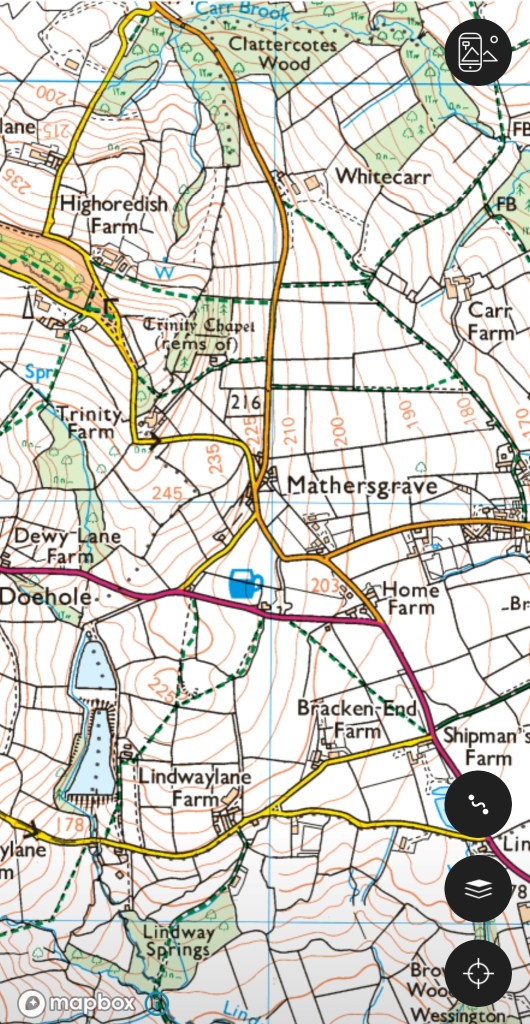
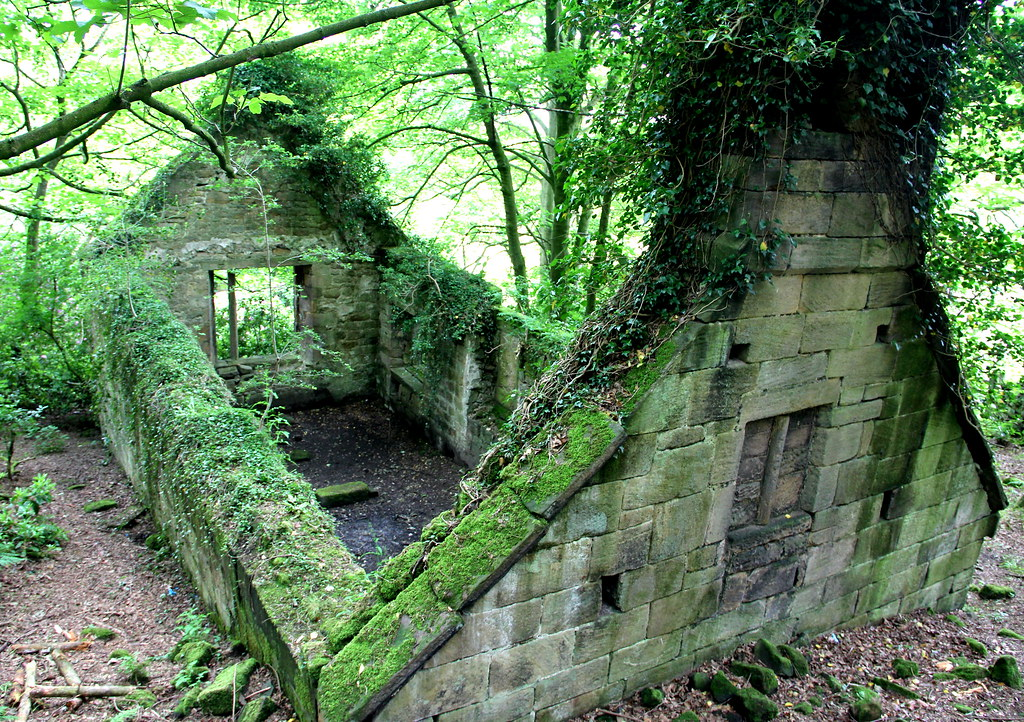
Apparently SM was Samuel Mather, a local man who had fathered an illegitimate daughter, and social condemnation forced him to kill himself, and possibly kill his wife also. (Details of the story are vague). This happened in 1716, so the date on the marker stone is wrong. This occurred well before the Matlock-Alfreton turnpike was constructed, and further evidence of the shift in road pattern is the romantic nearby ruin of Trinity Chapel. Half a mile to the north, (see map above), this was in use before Brackenfield Church was opened in 1857, but is now quite deserted. In the past this must have stood on a busy lane, but today is only reached by footpath.

On the slow road to Wirksworth

The Road to Wirksworth/ George Turner

This painting is one of several with the same or similar titles and visual ingredients. The artist, George Turner, seems to have specialized in rustic views of his corner of Derbyshire, such as the example above, which must have been painted looking north at a junction on today’s B5023, Duffield to Wirksworth road. Dating from the start of the twentieth century, there is clearly little traffic, given the small flock of sheep dozing on the carriageway. The unsurfaced track looks quite stony, while the shepherd and his collie seem rather under-employed. Turner must have found this a successful formula for his work, since many other landscapes have similar content.

The other Turner

George Turner (1841-1910) was born in Cromford, and became a self-taught artist and art teacher. With his first wife Eliza he also farmed near Barrow-on-Trent, as depicted in some of his work. When she died in 1900 he moved back to the region of his childhood, first to Kirk Ireton and then to Idridgehay, which is on the Wirksworth Road. He then remarried Kate Smith, 30 years younger than him, who was also an artist. They lived there for the rest of his life, and he is buried in the churchyard. His son William, by his first wife, continued painting in the same vein. Turner’s work is in several local municipal galleries and currently can sell for several thousand pounds.

Lane at Gorseybank, Wirksworth/ George Turner

This view seems to be just outside Wirksworth, at Gorseybank, possibly on Prathall Lane. Some perennial themes are included, such as the shepherd with his mini-flock dozing away, but this time he has company: presumably his wife, and their child playing on the verge. Once again traffic must be minimal, and judging by the foliage it is early autumn. In the background can be seen the higher ground that encloses the town. Clearly Turner found it profitable to present the Derbyshire countryside as a static, timeless setting; even the sheep are motionless. The sky is quite blue, the branches wave about a bit, but nothing much else happens. A far cry from the nearby mills, quarries, mines, forges and railways which by this date had moved into the Ecclesbourne Valley!

How Bess went to London

Bess of Hardwick in later life

In August 1557 Bess, living at Chatsworth, was summoned to London by her then husband, William Cavendish; he was facing charges of financial malpractice and needed her support. The details of her journey provide an insight into lordly travel in the Elizabethan period. Although her exact route is uncertain, she was travelling for three days, and her final stops were in Northampton and St Albans. The total journey length was about 150 miles, so she was travelling quite fast, given the state of the roads.

An early coach

Among her entourage were her six-year-old son, Henry Cavendish, his nurse, two footmen and a guide. Presumably the family would have ridden in their coach, while the men rode alongside. Given that she must have made the journey south many times (she was 30) it is curious that they still needed a guide – presumably road conditions could vary from year to year. Bess kept a record of her expenses on the trip, which show that she ordered a fire in her chamber at every stop.

Hot work

Travel in the mid sixteenth century was not for the faint-hearted. Their horses had to be re-shod twice, the second time at Northampton, where Bess took the opportunity of shopping for some shoes for her younger daughter. There was another halt to repair broken tack, while several ferries had to be boarded and disembarked. Then one of the horses needed treatment for a sore back. When they got to St Albans Bess, in her haste, decided to continue by herself, travelling overnight with some local guides for the last stretch into the City. She bought them drinks at Barnet and then paid them ten shillings on arrival at the Cavendish house. Despite her efforts her husband William was increasingly ill, and she was soon forced to take responsibility for their indebted estate, a process that would involve much more travel between London and Derbyshire.

Snakes and dukes

The Snake Inn: Still a challenge for cyclists

The Snake Pass on the A57 Sheffield to Manchester route was one of the highest turnpike roads in the country, and is still plagued by winter closures due to snow and landslips. Reaching a height of 1,680 feet, it offers the most direct route between the two cities and may have been in use for thousands of years, yet there is little agreement about its history. On the 1:25,000 OS map much of the route as shown as a Roman road, and is named ‘Doctor’s Gate’, but although there was a 16th century Vicar of Glossop called Doctor Talbot there is little hard evidence to date the road further back in time.

A winding story

The Derbyshire Portway can be clearly traced from the Trent to Mam Tor, and from there the best route north is eastwards along Edale, then to climb up into the Woodlands Valley which heads northwest to the Pass. Today the bridleway lies to the west of the main road at first, then switches to the east above Alport Bridge, since the going is easier on that side. However, apart from the place name ‘Alport’ there is little evidence for speculation about its history, not even for the ‘Roman’ road – Dodd and Dodd (Peakland Roads and Trackways) claim that some Roman paving can be found, but such stonework is almost impossible to date and at this altitude it seems unlikely to have survived on the surface. However, Doctor’s Gate may well have been a medieval packhorse route.

A slippery snake

In the early nineteenth century the Dukes of Norfolk and Devonshire – principal landowners in the area – decided to build a turnpike road over the Pass to encourage trade between South Yorkshire and Lancashire. Part of the route, from Glossop up to the top of the Pass, was a completely new route, and this partly accounts for the debts that the Trust, established in 1818, ran up. There is some confusion about the engineer responsible: the Glossop Heritage website claims it was John Macadam, while other sources (e.g. Dodd and Dodd) say Telford. The road opened in 1821, but the arrival of a railway in 1845 was powerful competition, and when the Trust was wound up in 1870 it had debts of many millions, in modern terms. Since then the Pass has posed continual problems for the highway authority, being regularly closed by snow and landslips: all of which must add to the difficulty of keeping the Snake Inn, near the top of the Pass, running.

What about that snake? Nothing to do with the winding road – it’s the emblem of the Cavendish family, joint financiers of the road, seen here at Chatsworth.

Striding along …

Another bullseye?

It’s hard to escape from Robin Hood in the north Midlands, with pubs bearing his name spread out over the region, from Macclesfield to Stoke and Sheffield to Nottingham. There are also Robin Hood wells, hamlets, fish and chip shops and the rock outcrop west of Winster, Robin Hood’s Stride. Clearly, the legendary figure has long had popular appeal, although in the case of the Stride the name must have been humorous, since the twin ‘towers’ are many yards apart.

A giant leap …

The Stride provides an excellent natural landmark, visible for miles around, handily for travellers on the Portway, which runs between the Stride and Cratcliff Rocks. Before the days of maps people must have memorized a series of landmarks to avoid getting lost: perhaps certain trees, river crossings or rocks like this. But the Stride seems to have been at the junction of several routes, not just the roughly north-south line of the Portway, but also an east-west track.

Darley bridge

This very scenic walk can be followed on public footpaths, starting from the layby below Cratcliff Rocks on the B5056. 100 yards north a footpath climbs the sharp slope, and then joins a track heading east and following the contour line. Go past a ruined stone barn and continue along the top of Birchover Wood. At Uppertown the path becomes a track; follow along Clough Lane and Oldfield Lane till you reach a road and then turn right into Darley Bridge village. Turn left on the main road, cross the bridge, and just to the right of the Square and Compass pub take the field path over the water meadows. The importance of the river crossing is shown by the position of this Robinson’s pub – it has been regularly flooded but stoically continues to provide refreshment for travellers. This probable packhorse route continues past the DFS showrooms and up into Two Dales, where it follows an ancient way known as Back Lane, heading for Darley Flash and (probably) Chesterfield.