The romance of the road

Give to me the life I love,
Let the lave go by me,
Give the jolly heaven above
And the byway nigh me.
Bed in the bush with stars to see,
Bread I dip in the river,
That's the life for a man like me,
That's the life for ever.

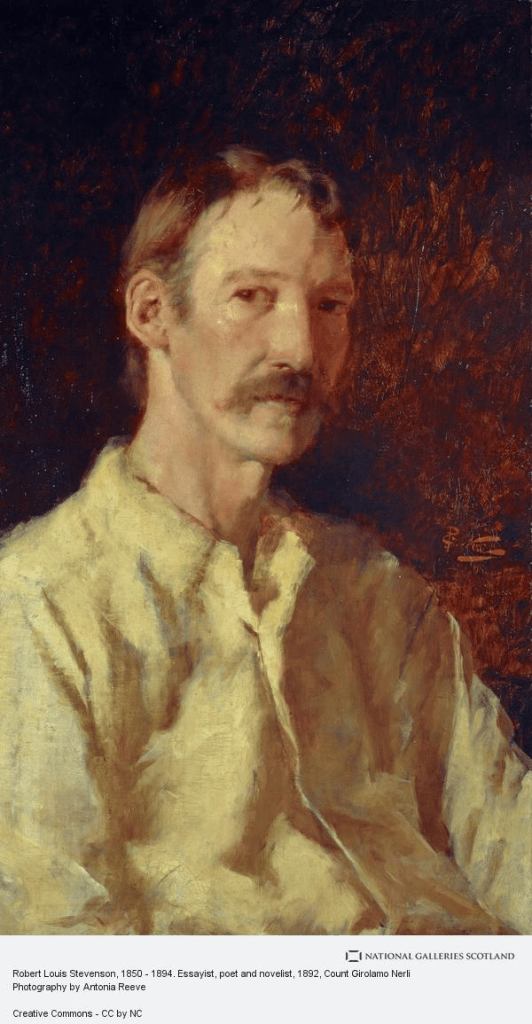
Robert Louis Stevenson wrote his poem The Vagabond in the 1870s, influenced by a mid-nineteenth century enthusiasm among some intellectuals for the open road and the free life. Before this only the poorest travelled on foot, but now writers began singing the praises of walking, and even mixing with nomadic outcasts such as gypsies. Stevenson reinforced his poetry with experience, his pioneering Travels with a Donkey in the Cevennes (1879) is his account of a 12-day hike through the hills of this French region, sleeping rough and struggling to control his animal. 

George Borrow

Twenty years earlier, the less well-known but probably more remarkable George Borrow had published his autobiographical novel Lavengro (1851), based on his wanderings in England and Wales and his meetings with gypsies, whose language (among many others) he claimed to have learned. Borrow was certainly physically remarkable, a tireless walker who went on to work for the British and Foreign Bible Society in their quixotic attempt to bring the Word to Spain. His account of his travels, published as The Bible in Spain, reveals a man of considerable stamina, riding around (Carlist) war-torn Spain with a donkey-load of Bibles while maintaining his flirtation with the world of Romany.

Mathew Arnold, swinging between poetry and philosophy

Another key work on this theme is Mathew Arnold’s The Scholar Gypsy of 1853. The longish poem tells the story of an Oxford student who becomes disillusioned with academia and joins a band of local gypsies, hoping to learn their secret lore:

The story of the Oxford scholar poor,
Of pregnant parts and quick inventive brain,
Who, tired of knocking at preferment's door,
One summer-morn forsook
His friends, and went to learn the gypsy-lore,
And roam'd the world with that wild brotherhood,
And came, as most men deem'd, to little good,
But came to Oxford and his friends no more.

Although it seems unlikely that Arnold took to the road himself, the poem expresses the doubts that were beginning to emerge about the destination of Victorian society, and the fascination with apparently more primitive or ancient cultures. In this sense Arnold was well ahead of his time, with these concerns becoming more prominent in the twentieth century. Writers such as Walter Starkie, an Anglo-Irish academic, who reprised Borrow with his wanderings in Hungary with the gypsies in the 1930s, as described in Raggle-Taggle (1933), continued this theme, while more recently there has been a positive flood of writers taking to the hills, tracks, lanes and even rivers in their eagerness to escape from the contemporary world.

Starkie in full flow

The ferryman at Anchor?

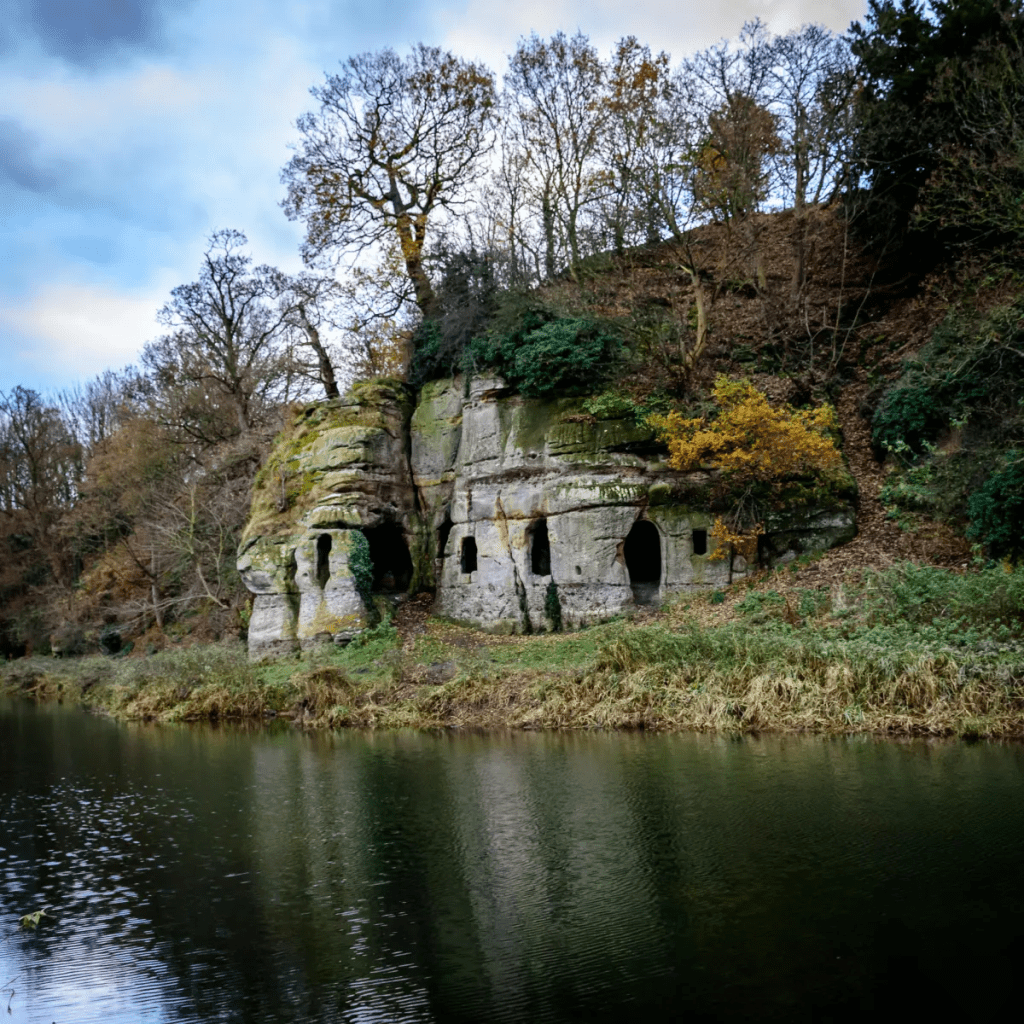
Anchor Church today

On the steep south bank of the River Trent, a short walk from Ingleby village, this rock-cut structure may have been used since the ninth century. Although the photo suggests that the river comes to the doorstep, in fact this is a pond, probably a remnant of an earlier course of the river, which has now shifted into a new channel to the north. Clearly cut out of sandstone, it is now thought that this was the refuge of the Saxon saint Hardulph, who had been deposed as King of Northumbria in 806 CE. He was buried at the nearby church of Breedon on the Hill, which is dedicated to him.

An interior view

The next stage in its history began in the thirteenth century, when it was the cell of an anchorite or hermit, hence the name Anchor. It is a mistake to imagine a hermit as a wild and solitary figure, leading a life of lonely meditation, and shunning contact with the world. Repton church and priory was quite near and may have been linked to the hermitage. It is also possible that the hermit was a part-time ferryman, at a time when the Trent ran at the foot of the rock. Burdett’s map of 1767 shows two ferry crossings nearby and upstream, one at Twyford and the other at Willington. Ferries were clearly quite common up to the nineteenth century, as a simple alternative to a costly bridge. Not only would this have given the hermit a useful function, but it could also have provided a small income.

An eighteenth century idyll

The hermitage presumably fell out of use with the dissolution of the monasteries in 1538, and the next records are from the eighteenth century when the landowners, the Burdett family of Foremark Hall, modified the structure for use as a summerhouse. This provided a suitably Gothic atmosphere for elegant alfresco parties, as can be seen in the print above. Sir Francis Burdett was a notable Radical who was actually briefly imprisoned in the Tower of London for libelling the House of Commons. Today the site is Grade II listed, and can be visited by footpath from Ingleby.

The hermit of the bridge

The causeway in the old days

Swarkeston Bridge was once the only crossing of the Trent between Burton and Nottingham, carrying traffic on the north-south route through the Midlands to Derby and beyond. At this point the river flows through low-lying meadows which flood regularly, and so the road is carried across these on a causeway about three quarters of a mile long. Most of this is medieval, although the actual river bridge was rebuilt in 1801. The whole structure is a clear illustration of the importance of river crossings in the past, and the resources that were devoted to constructing them. In this case, the legend tells of two unmarried sisters who lived on the north bank, and during a flood watched helplessly as their lovers tried to cross the torrent on horseback, before being swept away. As a result they spent all their resources on building the causeway, thereby impoverishing themselves.

Less peaceful today

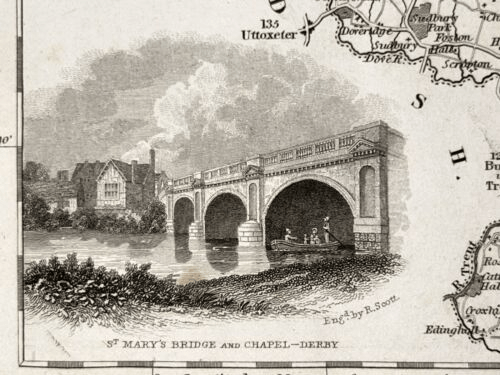
Even when wealthy donors funded a bridge, maintenance was a constant issue. The Church seems to have been responsible for most bridges, and consecrated a body of men called ‘bridge hermits’, who were given an adjacent chapel to live in and were responsible for collecting tolls to pay for repairs. There are records, for example, of the Bishop of Ely in 1493 appointing a Robert Mitchell to the post and giving him a special outfit to wear. Although the bridge chapel at Swarkeston has disappeared there was also a chapel of St James by Chesterfield Bridge, while ruins of a chapel remain by Cromford Bridge. The best surviving example is by St Mary’s Bridge in Derby, which until the nineteenth century was the only crossing of the Derwent in the town.

Bridge and chapel in 1835

A list of the tolls charged (pontage was the term) for Swarkestone Bridge in 1275 is evidence of the extraordinary variety of goods traded in the region in medieval times. Tolls ranged from a farthing to 6 pence a load, although pedestrians were apparently not charged. This is a short extract from the list, but one wonders how the bridge hermit could assess all these tolls:

  • Any load of grass, hay, brush or brushwood – a farthing
  • Any horse, mare, ox or cow – a farthing
  • Any skin of horse, mare ox or cow- a farthing
  • Any pipe of wine – a penny
  • 5 flitches of bacon, salted or dried – a farthing
  • A centena of skins of lambs, goats, hares, squirrels, foxes or cats – a halfpenny
  • Every quarter of salt – a farthing
  • Every pack saddle load of cloth – three pence
  • Every sumpter load of sea fish – a farthing
  • Every load of brushwood or charcoal – a farthing
  • Every burden of ale – a farthing

Snowmotion

A recent winter view of Youlgreave

Winter has never been the best season for travel, but in the past it must have been far more difficult than today. Not only were roads much worse, but at times the weather seems to have been much colder. Especially in the upland areas of Derbyshire farms and villages were likely to be cut off by snowdrifts, with the constant threat of hunger if people were unable to reach markets. According to the Youlgreave Churchwardens’ records:

This year 1614 began the greatyst snow that ever fell within many memorye. And for heaps or drifts of snow they were very deep; so that passengers both horse and foot, passed over gates and hedges and walls it fell at ten severall times, and the last was the greatest … it continued by daily increasing until 12th day of March …

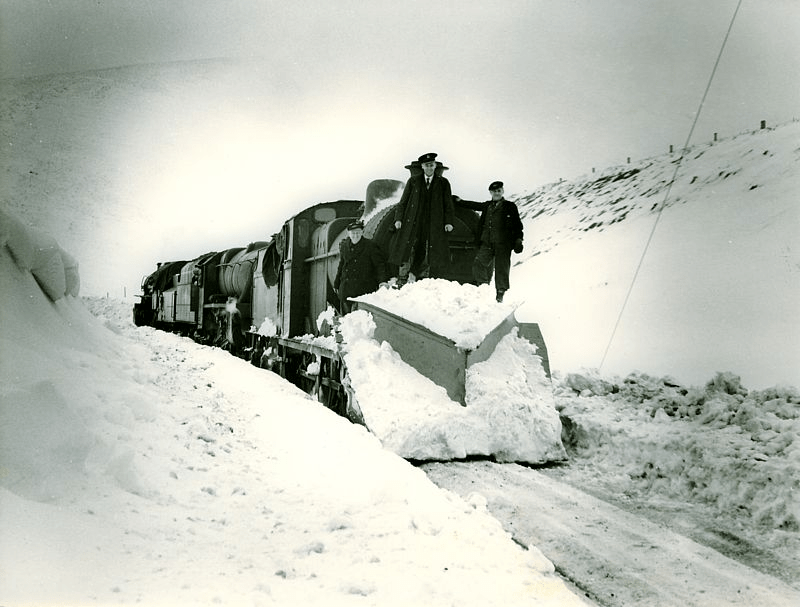
Snowdrifts at Farley above Matlock in 1947

The freezing winter of 1947, still within living memory, was made worse by the decrepit nature of the country’s infrastructure, worn out by years of war. Heavy snow began in late January and continued well into March. Conditions were primitive in many parts of Derbyshire, as recorded by a Mrs Alsop of Hulland Ward near Ashbourne:

All the local men were called by the council to leave their jobs to help clear the roads. This was all done by hand and shovels – no mechanical diggers in those days. The strong northeast, gale-force winds daily filled the roads. The men worked seven days a week for six weeks or more. … Younger folk trudged to Ashbourne (five miles or more) for bread.

In the Peak conditions were worse and neither roads or railways could be kept open, despite heroic efforts. Around Buxton, Longnor and the Staffordshire side of the Dove valley bombers were used to supply isolated settlements. Thousands of pounds of flour, sugar, jam and tinned goods were dropped by parachute. Tragically, one of the planes crashed on Grindon Moor, killing all eight on board. The weather finally relented in early March, when the landlord and landlady of the Barrel Inn at Bretton could leave the bedroom where they had been trapped for the past five weeks, having been dug out by rescuers.

Source: The Derbyshire and Nottinghamshire Weather Book (1994) Markam, L.

Traveller’s Tree

The yew tree in St Helen’s churchyard at Darley Churchtown is a well-known example of an ancient tree in a sacred setting. Growing near the west church porch, it is 33 feet in girth (which makes it hard to illustrate clearly), and is estimated to be 2,000 years old. Clearly it pre-dates the (twelfth-century) church, suggesting that this was a significant site even possibly in pre-Roman times. Certainly the nearby river crossing at Darley bridge has been part of an important west-east route for thousands of years.

There has been much speculation about churchyard yews, such as the idea that they were grown to provide wood for longbows, but their great age suggests a less prosaic function, as markers of significant sites for travellers.

The Darley yew is not the only ancient one in the county. The yew at St Edmund’s, Allestree may have given the name to the village, suggesting that the tree was already sizable when ‘Adelard’ had his settlement there. There are others at Beeley, Brailsford, Doveridge, Marston Montgomery and Muggington.

The Old Yew Tree, South Wingfield

Although native, the yew is not a common species in Derbyshire. However, it appears to be quite a common name for pubs and farms: with pubs at Dronfield, South Wingfield, Ednaston and (sadly now closed) Holloway. In some cases there is a yew growing on site – it would be interesting to know which came first, the tree or the pub? Pubs and inns were clearly important for travellers in the past, and before inn signs were displayed inn keepers hung an evergreen bush outside their door – usually holly or yew. This is the origin of the saying ‘A good wine needs no bush’. There are currently five Hollybush pubs in Derbyshire, at Grangemill, Makeney (which claims to be one of the oldest pubs in the county), Ripley, Breedon-on-the Hill and Church Broughton.

The Thorn Tree, Ripley

The most common pub tree name is the Royal Oak, which is the third most popular pub name in England. However, this is really a Royalist-type name, commemorating the escape of the future Charles II from Parliamentary troops by hiding up an oak. Other ‘tree pubs’, in descending order of popularity, are: Orange, Walnut, Pear, Oak and Cherry. It is notable that Matlock has a good variety of such pubs, all with rather unusual names: Thorn Tree, Laburnum, Sycamore and (until recently) Lime.

Sources

The Sacred Yew, Chetan and Brueton (1994)

The Place-Names of Derbyshire, Cameron (1959)

Bilberry crumble?

View of presumed stone circle on Bilberry Knoll

Writers of Matlock tourist guides in the nineteenth century described megalithic remains on Riber Hill, above Starkholmes, which are variously labelled dolmen, cromlech and rocking stone, and appear to have been four large stones, one balanced on another. But there was no trace of these a hundred years ago, and they appear to have been broken up, possibly on John Smedley’s orders, as idolatrous pagan survivals. It is easy to forget the role played by religious fanatics in destroying such remains.

However, there seems to have been a stone circle nearby, on the top of Bilberry Knoll, beside Hearthstone Lane, less than a mile south of Riber Castle. This site was explored by a John Simpson around 1905 and described in an article in the Derbyshire Archaeological Journal for 1915. He thought that such circles were evidence of prehistoric sun worship, and claimed that this circle aligned with the Nine Ladies circle on Stanton Moor at sunset on the Summer Solstice. Regrettably he did not draw a plan of the site, or include any useful photos, but estimated that the circle had a diameter of 144 feet.

The start of the path down through the beeches to Cromford

Today the site is remarkable for the jumble of stones in one area, although it is difficult to make out the shape of a circle. Some stones may have been broken up for walling. But whatever we may think of Simpson’s theories, two things are clear. Firstly, Bilberry Knoll is a remarkable viewpoint, ideally suited to some kind of monument, and secondly it is near the crossroads of two ancient tracks: Hearthstone Lane which runs from west to east, and another route which Simpson describes, coming from Lea Green, fording the Lea Brook and then climbing past Upper Lees farm to the ridge and down to Cromford bridge, Scarthin, Bonsall, Brightgate, joining the Portway to Robin Hood’s Stride and on to Youlgrave and possibly Arbor Low.

Field barns near Castletop, Hearthstone Lane above

Too much speculation, maybe, but Alison Uttley should have the last word. She was brought up in the late nineteenth century at Castletop farm, near the west end of Hearthstone Lane:

“… the old highway, dating from long before any of the roads in the valley. We knew, from family tradition, that the packhorses travelled along it, and that lead from the Roman mines in the hills was once carried on its winding slopes on ponies’ backs.”

Sources: Simpson, J. Megalithic Remains on Bilberry Knoll, Matlock. DAJ Vol 37, 1915

Uttley, A. Ambush of Young Days. Faber and Faber, 1937 p.107

Wayside worship

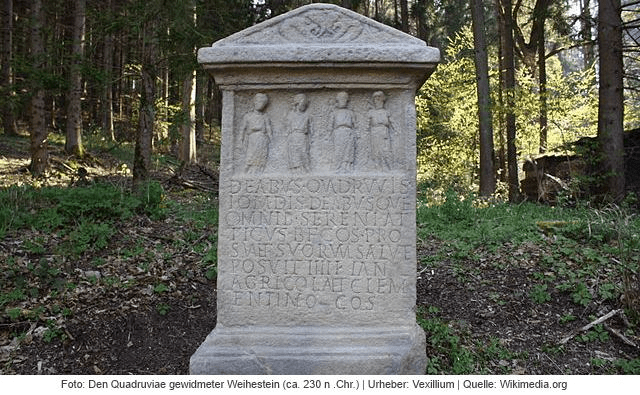
Altar to the Quadruviae in Germany

For at least two thousand years European roads were marked by shrines and sanctuaries, giving travelers the chance to rest, make offerings and pray for a safe journey. The Romans dedicated some to well-known gods such as Hercules and Mars, but they also had divinities specific to travel: Biviae at the meeting place of two roads, Triviae for three and Quadruviae for four, as in the example above, found in Germany. These junction divinities were all female, and give us some insight into the mindset of the ancient world. Even in medieval times in England a crossroads was seen as a place of significance, suitable for the burial of suicides (finally abolished by act of parliament in 1832).

Roadside scene (detail). Eighteenth century

The painting above, in the Thyssen Museum in Madrid, provides a rare glimpse of what may have been a common sight in the pre-industrial world: at a small stone shrine one man is on his knees, while another, on horseback, makes an offering. Yet in Catholic areas of Europe this tradition continued into the twentieth century, as described by DH Lawrence in his essay ‘The Crucifix across the Mountains’. In 1912 Lawrence and Frieda made an epic journey, mainly on foot, from Bavaria to Lake Garda in Italy. Lawrence was struck by the carved wooden crucifixes they found by the roadside:

Coming along the clear, open roads that lead to the mountains, one scarcely notices the crucifixes and the shrines … But gradually, one after another looming shadowily under their hoods, the crucifixes seem to create a new atmosphere over the whole of the countryside, a darkness, a weight in the air …

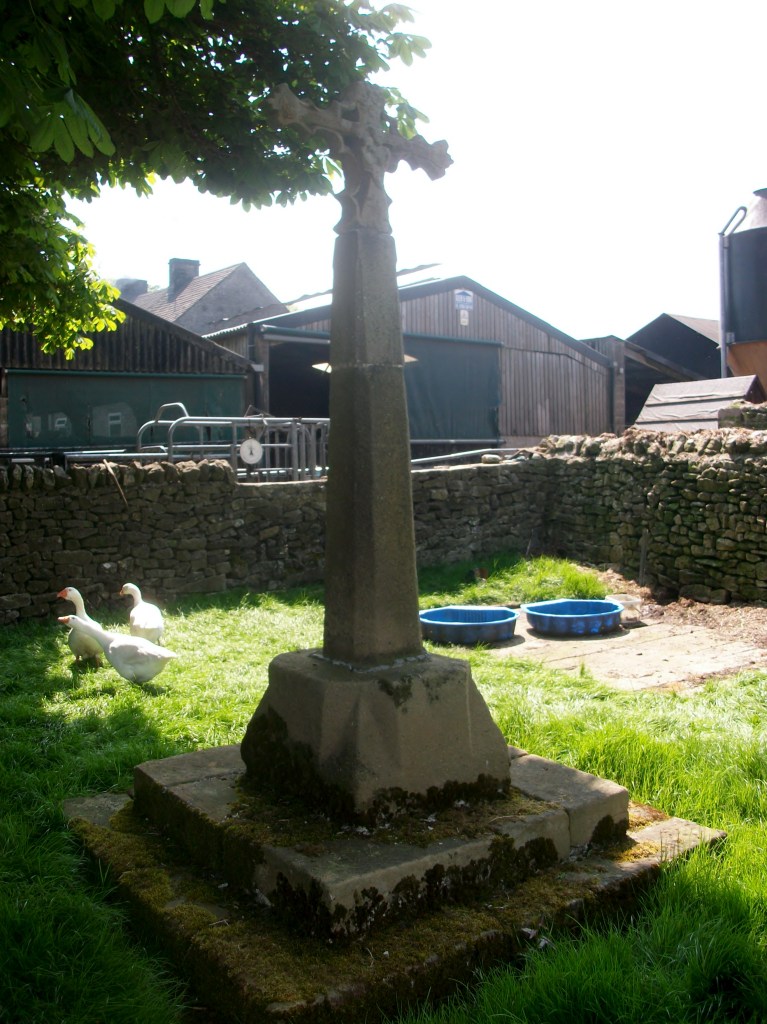
Wheston Cross near Tideswell

Derbyshire roads had their share of shrines, although little is known of pre-Christian examples. However, it is difficult to judge which of the surviving crosses were boundary markers and which were wayside crosses. At the reformation in the sixteenth century the crosses, usually dedicated to a saint, were generally destroyed as being Popish. However, a few survived, such as the cross at Wheston, which has the Madonna and Child on one face and the Crucifixion on the other. It is about 11 feet tall, but part of the shaft is more recent. Such crosses must have helped travelers navigate generally, but may also have been used to point the way to pilgrimage churches. One clue to the previous existence of a cross is the name ‘Cross Lane’, found in various locations in the county, such as just above Dethick. The topic is fully explored in Neville Sharpe’s ‘Crosses of the Peak District’.

551 signs … and counting!

An early sign being restored

Have you ever found your footpath ploughed up, or a stile that would challenge a mountain goat? Help is available, thanks to one of Britain’s oldest societies for the protection of walkers’ rights. The Peak and Northern Footpaths Society was formed in 1894, but has its roots in an even older Manchester footpaths society dating back to 1826. Today, post-pandemic, the Society is stronger than ever, with about 1,300 members spread over Lancashire, Yorkshire, Derbyshire, Cheshire and nearby areas. Although it does organise regular walks on both sides of the Pennines it is far more than a walking club, liaising with local authorities on a range of issues, and most noticeably erecting signs throughout its region.

A more modern version

There’s something very reassuring for a walker who finds one of their signs at an uncertain crossroads, and currently there are 551, maintained by a dedicated team who also repaint them when necessary. In addition the Society has 172 footpath inspectors who are responsible for monitoring the paths in one or more parish. All these, as well as the staff at the Stocktport base, are volunteers, so that thousands of miles of paths, spread over five or more counties, are effectively kept open by the combined efforts of hundreds of unpaid people who share an enthusiasm for the right to walk freely.

Bridge at Kirklees partially funded by the PNFS

Quite recently the Society has also started helping to pay for footbridges at critical points on the footpath network. This is a recognition that local authorities, who are actually largely responsible for footpath maintenance, either can’t or won’t do their job. Although there are responsive councils, due to years of ‘efficiency savings’ rights-of-way staff have been repeatedly cut back, so that in this region we are lucky to have such a dedicated voluntary body doing part of the job for them!

There are many benefits to joining the Society, which only costs £15 a year for an individual, but perhaps the main one is the knowledge that you are contributing to the maintenance of one of our greatest unsung assets, our footpath network. See:

http://www.peakandnorthern.org.uk/membership/index.htm

Harboro’ highlife?

Harboro’ Rocks seen from the High Peak Trail

A couple of miles west of Wirksworth, just above the High Peak Trail, Harboro’ Rocks are a distinctive limestone outcrop rising to 379 metres. The summit offers a splendid view of Carsington Water to the south and the Via Gellia valley to the north, while providing practice pitches for climbers. The Rocks have been the subject of several archaeological digs, the latest reported in the Derbyshire Archaeological Journal (Makepeace 1990 and 2004). According to these, evidence was found of a Late Bronze Age or Early Iron Age settlement: pottery fragments, domestic animal bones, a flint tool and a button. There is also a remarkable cave in which Daniel Defoe found a lead-ming family living in 1720, and which clearly could have been occupied in prehistoric times.

Cave at Harboro’

However, this picture ignores three factors. First, why should anyone settle on such a bleak and elevated spot, with no source of water? The thesis also fails to mention that the Rocks are near the junction of two important ancient routes: The Street, which was engineered by the Romans over an older ridgeway and ran from Wirksworth to Buxton, and the Portway, which headed north from Harboro’ towards Mam Tor and beyond. Finally, the name ‘Harboro” goes back to at least c. 1200 CE and may mean ‘shelter’ or ‘fortified place’, according to Cameron (1959). What must be significant is that this name crops up on two other hilltops along the Portway’s route: Arbour Hill outside Dale and another Arbour Hill in Wollaton.

Burdett’s map of 1762 showing roads west of Wirksworth and position of the Rocks (arrowed)

So my suggestion is that this was not the site of a Bronze Age ‘settlement’, but could have been a fortified campsite for travellers on these two important routes. This would account for the sparse nature of the finds from the excavations – people were travelling light. Similar to the caravanserai found in the Middle East, these campsites seem to have been spaced every six or seven miles along the Portway and would have given the travellers some security for themselves and their animals when they stopped for the night. The next, going southeast, is Alport Height, and to the north, Cratcliffe Rocks.

Inns for travellers were part of the Roman road system, but I doubt whether any were provided in such a backward area as Derbyshire. We can only guess how these campsites were organised; whether locals sold water and provisions to travellers, and how they were maintained. However, there is enough evidence to suggest that these places provided vital protection for long-distance wayfarers until the growth of towns and the development of the modern inn during the medieval period.

Baslow and beyond

East end of Baslow old bridge

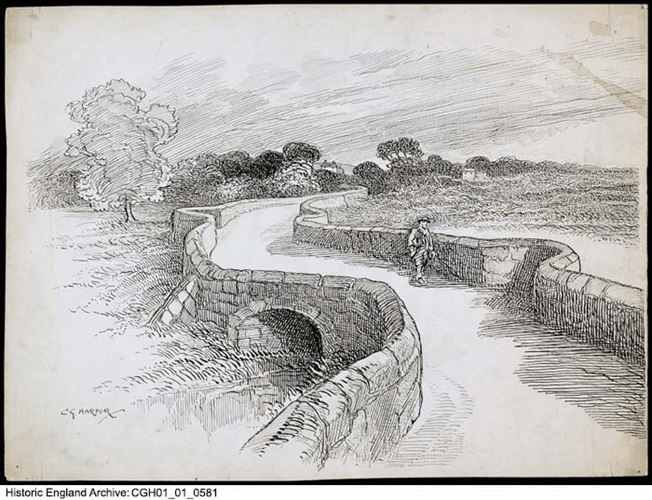
Driving on the busy A623 through Baslow today, it is easy to miss the medieval bridge next to St Anne’s church. Yet this was part of an important route in the eighteenth century: carrying the turnpike from Monsal Head to Chesterfield, while before then it carried packhorse traffic heading for East Moor and Sheffield. In 1500 an order was issued forbidding the carriage of millstones over the bridge; presumably their weight was damaging the earliest structure (which may have been wooden at that date). The small stone hut at the end of the bridge is sometimes called a watchman’s shelter, but elsewhere it is presumed to be for a toll collector. However the entrance is so low it is hard to imagine how this would work, unless the job was given to a child!

Lady Well, Bar Road

The old route can be followed from the bridge by crossing the main road and following School Lane uphill. This takes you through the heart of the old village but then continues more steeply uphill as Bar Road. Although this name may suggest a barrier or turnpike, according to Dodd and Dodd (1974) Bar was a name widely given to tracks that led down from the moors. Rather confusingly, Burdett’s map of 1762 tautologically names the river that flows through Baslow into the Derwent ‘River Barbrook’. Higher up Bar Road, beyond the houses, is the Lady Well, providing a welcome drink for travellers and their animals before climbing the last stretch up onto the moor. Once on the top, various landmarks such as the Eagle Stone and the Wellington Monument provide guidance.

Painting of the old bridge