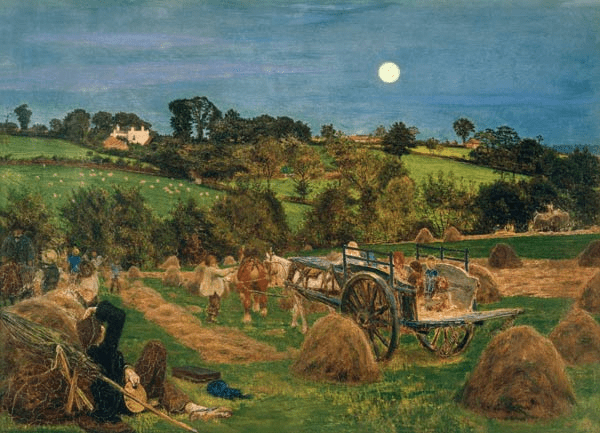
Uphill work in the Dale

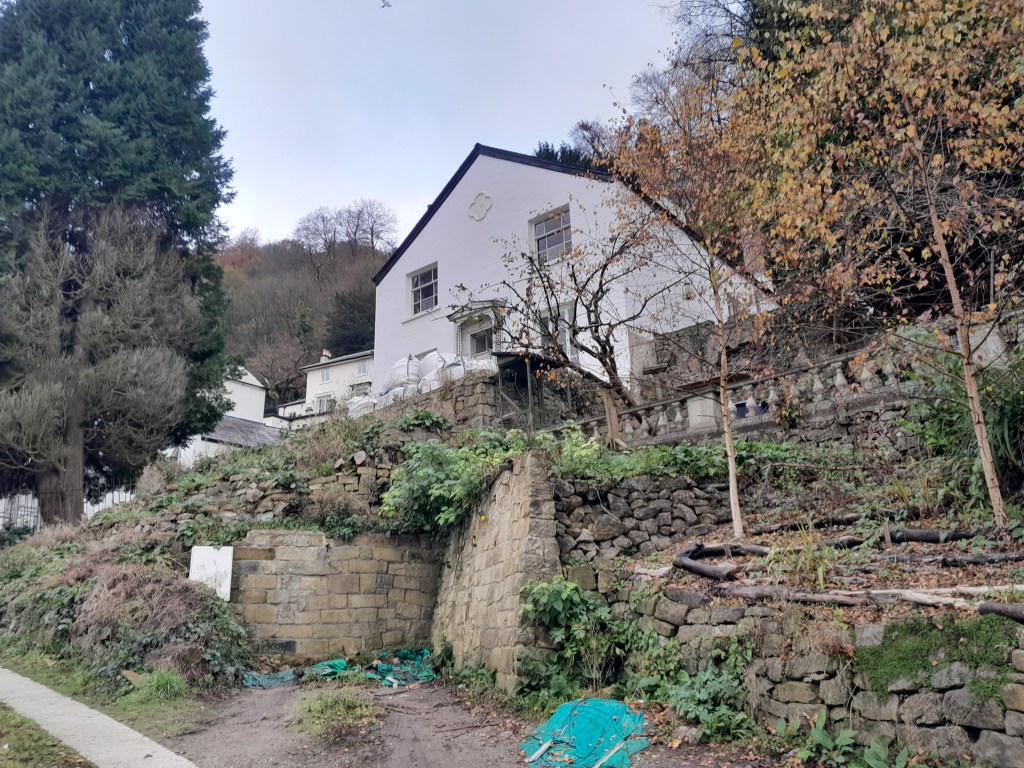
Village idyll: Farm and church seen from the wood above Dale Abbey village

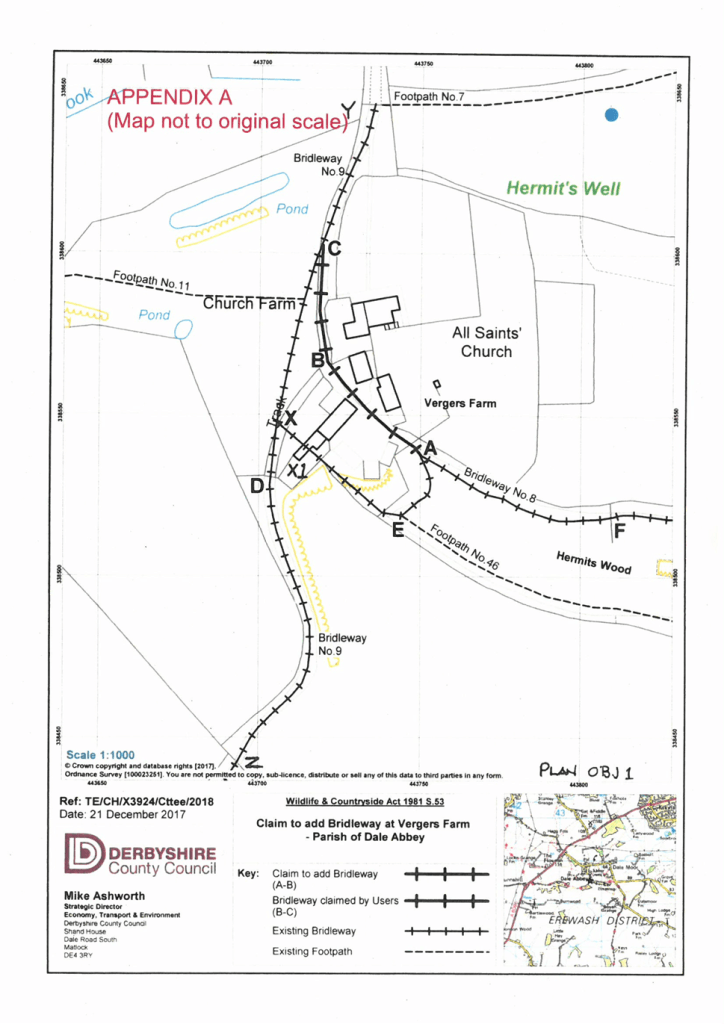
The importance of public rights of way – both footpaths and bridleways – in England is shown by the tremendous effort expended on settling disputes when these routes are challenged. A recent example is at Dale, near Ockbrook in the east of Derbyshire, where the Portway runs past the remains of Dale Abbey and the Hermit’s Cave. The ancient track leaves Hermit’s Wood, goes past the church and into the village, and this point has been the focus of the disagreement.

The bridleway in dispute at Verger’s Farm (A-C on map)

The owners of Verger’s Farm attempted to obstruct use of the route through their farmyard, claiming that an alternative route (E to X on map) should be used, although this involved a stiff climb. This led to an official inquiry opening in 2019, led by an inspector from Defra (Department for Environment, Food and Rural Affairs), who was unable to carry out a site visit until 2021 due to the COVID pandemic. 23 people gave evidence in support of the long-standing existence of the bridleway through the yard, including members of the British Horse Society, a powerful lobby. Against these were 14 objectors, including the family of the farm. A mass of documentary evidence was also presented, including old photos and guidebooks to the district. The inspector, in her final decision in 2023, confirmed the validity of the original route of the bridleway on the strength of the historical evidence, leaving aside the personal statements.

Dale Abby church, semi-detached to the farmhouse next door

This case illustrates the extraordinary passions that a right of way dispute can generate. The bridleway in question is only a few hundred metres long, but caused an argument involving dozens of people, the parish council, the county council (DCC) and Defra, which continued for over four years. Now that the way is officially waymarked, we should recognise their efforts by visiting the village; either walking from the Carpenters’ Arms in Dale village or taking the more ambitious route along field paths from the Royal Oak in Ockbrook.

Canal competition

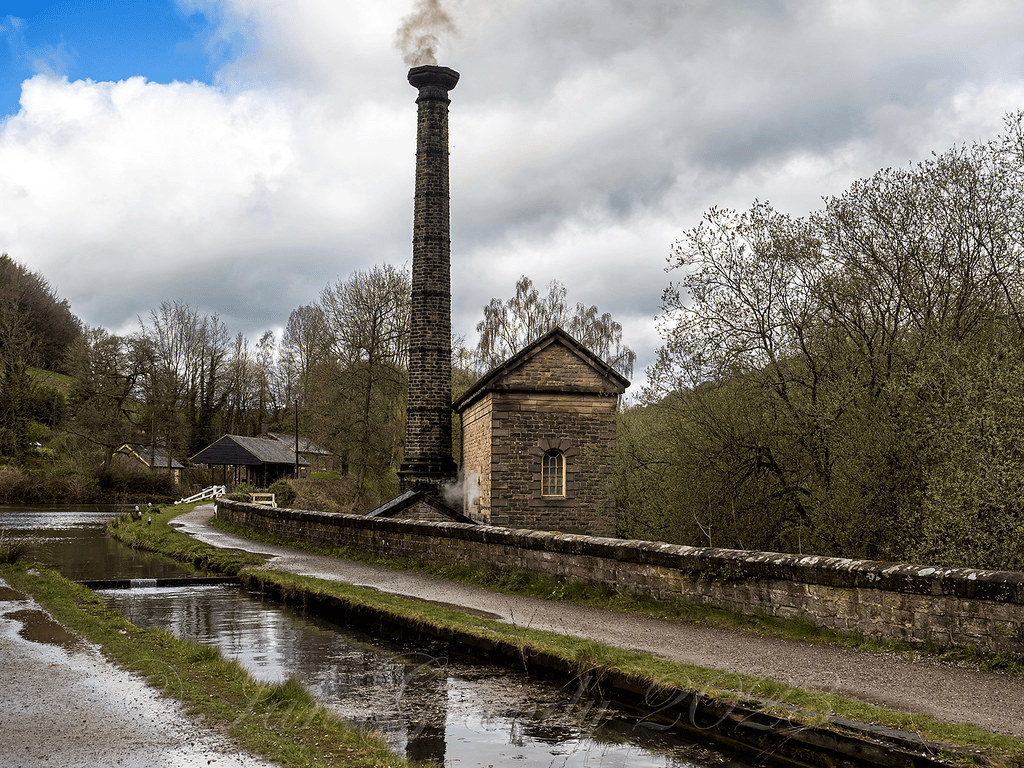
Leawood pump house in steam

For thousands of years goods had to be carried by roads, and a horse and cart could move about a ton of stone or coal. But with industrial growth in the eighteenth century increasing demand for raw materials canals became a feasible mode of transport, a horse-drawn narrowboat could carry 30 tons. From about 1760 the canal network grew quickly, and by 1788 a route was planned from Cromford to Langley Mill, where it would link up with the Erewash Canal and so gain access to the Trent basin. Local entrepreneurs such as Gell at Hopton and lead smelters at Lea and Crich were keen to promote this facility for their minerals, while also benefiting from cheaper coal deliveries.

The aqueduct at Bullbridge

Building the canal with nothing more advanced than shovels and wheelbarrows seems remarkable today, especially as aqueducts were needed to cross the Derwent by the Leawood pump house and over the Amber (above – the railway came later!). In addition, Butterley tunnel, about 3,000 yards long, proved difficult to cut and maintain. The entire route from Cromford to the Butterley tunnel was on a level, so no locks were needed. This saved water, which was always an issue given the original supply was the Bonsall Brook, shared with Arkwright’s mill. The pump house was a later addition, lifting water from the Derwent. The estimate for the canal’s construction was about £42,000, but inevitably the actual cost was nearly twice this when it finally opened in 1794.

The staff of Wheatcroft’s office at Cromford Wharf

The sign in the photo gives a good idea of the goods carried by the canal: not just coal and coke but also salt, pipes and straw. However, by the time this was taken the canal was in decline: from the 1850s the railway was providing a cheaper and faster service. At its peak in the early 1800s the canal carried 300,000 tons per year, and paid shareholders a whopping 20%. But in 1852, as profits declined, the canal was sold to its railway rival – which was already operating the High Peak line from Cromford to Manchester. The tunnel suffered several rock falls, which finally closed the through route in 1900, though local traffic between Hartsay and Cromford continued until 1944. It seems curious that such a substantial, splendid piece of engineering should have such a short life, effectively becoming redundant after only 50 years!

Comfort at the crossroads

Relief showing a Roman imperial messenger arriving at a mansio in a chariot

Roman military dominance depended on its well-known road system, which not only allowed troops to move quickly, but also allowed messengers to ride rapidly with news or orders. To accommodate such travellers a kind of guest house, called ‘mansio’ in Latin, was built at regular intervals on the main roads, offering fresh horses as well as food and lodging.

Just over the Staffordshire boundary, south of Lichfield, are the extensive ruins of a Roman settlement built at the junction of Watling Street (near the line of the A5) and Ryknield Street, which continues to Little Chester and beyond. Both were important Roman roads, and this was first the site of a fort, then a mansio was built, and subsequently a small town grew up around it, known to the Romans as Letocetum.

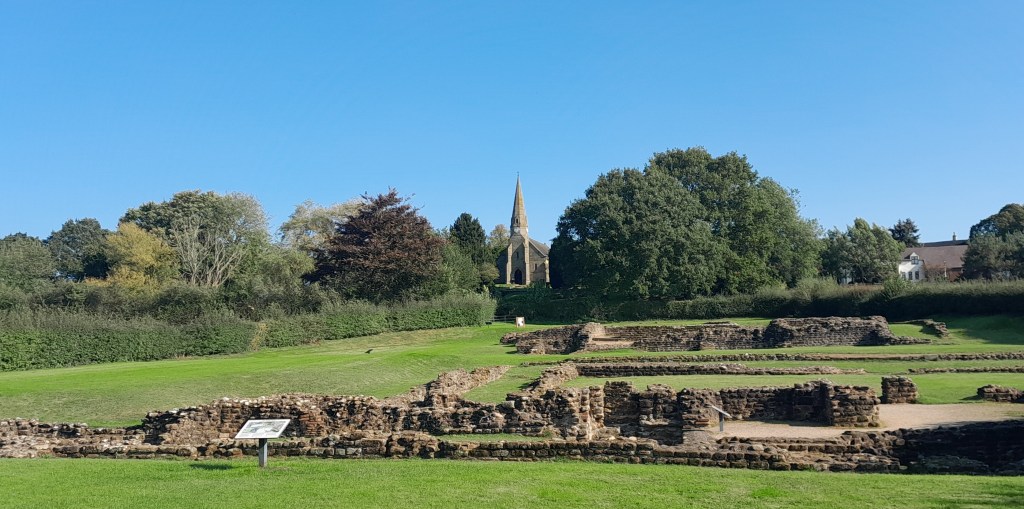
Excavated ruins at Wall

The remains of the settlement can be visited in the village of Wall, on a gently sloping site only a few hundred metres from the noisy M6 toll road. In the foreground of the picture above are the ruins of a bath house, so that tired wayfarers could have a warm soak after a day in the saddle. It seems strange to imagine public baths in such a remote spot, and it would be interesting to know who was allowed to use them.

Foundations of the mansio

Despite the care with which this site is preserved by English Heritage it is hard to imagine it in its heyday. But an inscription from Aesernia in Italy of the dialogue between an innkeeper and a departing guest gives more flavour, and can be translated as: ‘Innkeeper, let’s settle our account. One measure of wine and bread, one coin; some stew, two coins. Agreed. The girl, eight coins. That, too, is agreed. Fodder for the mule, two coins. That animal can take me to my destination…’.

Comings and goings at Haddon

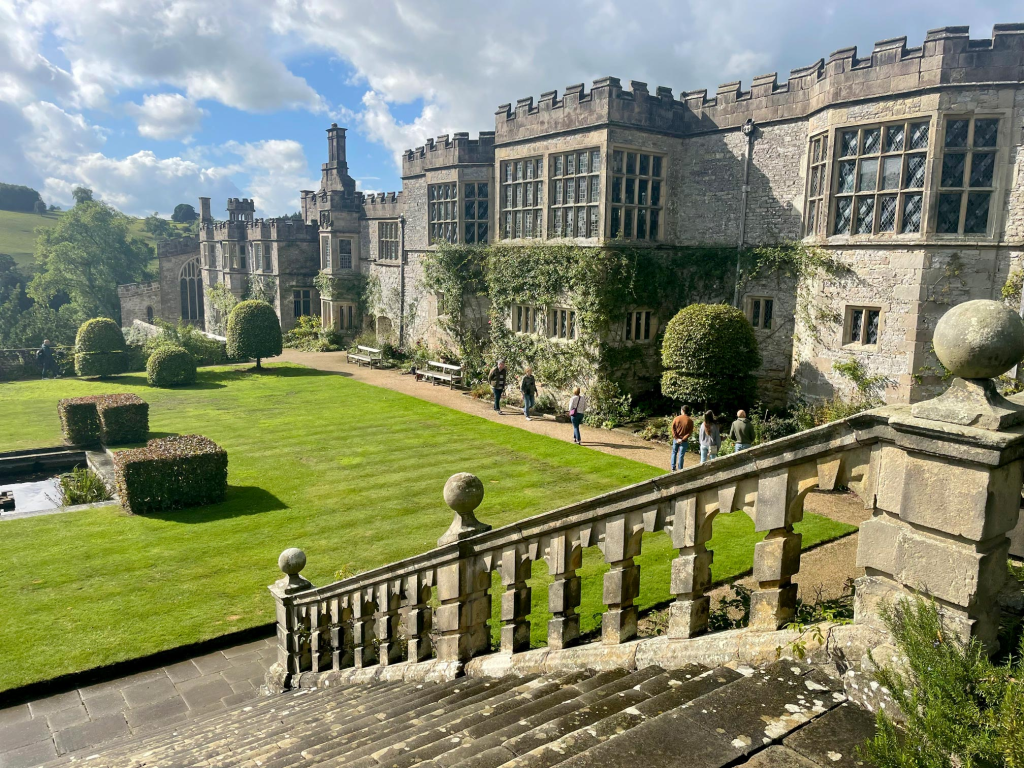
Desirable gentleman’s residence

Haddon Hall, near Bakewell on the River Wye is such a remarkably well-preserved late medieval house it has been irresistible to film makers. Firebrand, the story of Henry VIII and Katherine Parr, is currently on release, and previously Haddon has been the setting for two versions of Jane Eyre (involving burning the building down), Pride and Prejudice, and many others. In the mid-sixteenth century it was the home of Sir George Vernon (born 1503), whose steward kept an account book which gives us a glimpse of the network of transport links which sustained life in a great house at that time.

George Vernon at rest in Bakewell church

The accounts for the Christmas period 1564-5 include payments to entertainers as well as for food and drink. ‘The Earl of Worcester’s players, presumably a travelling theatre group, earned 14/3d (fourteen shillings and threepence), while ‘Wetton the minstrel and his fellows’ were paid over 30/- (nearly £600 in modern values). Hawkers must have been welcome visitors, since John Basford and ‘other hawkers’ were given a Christmas tip of 10/-. Drink was bought in huge quantities: the ‘tenants of Baslow’ were paid 12/3 for bringing a tun (supposed to be 250 gallons, but hard to believe this could be transported) of wine to the Hall, while a gallon of malmsey ‘for the cook’ cost only 2/-. Food was bought from various local markets, especially Chesterfield and Ashbourne, but also Lenton fair near Nottingham, and Derby. ‘Shoes for kitchen boys’ came from Bakewell (5/4), while 3 crannocks of salt cost 30/-, with carriage an extra 10/- (presumably carted from the ‘wiches’).

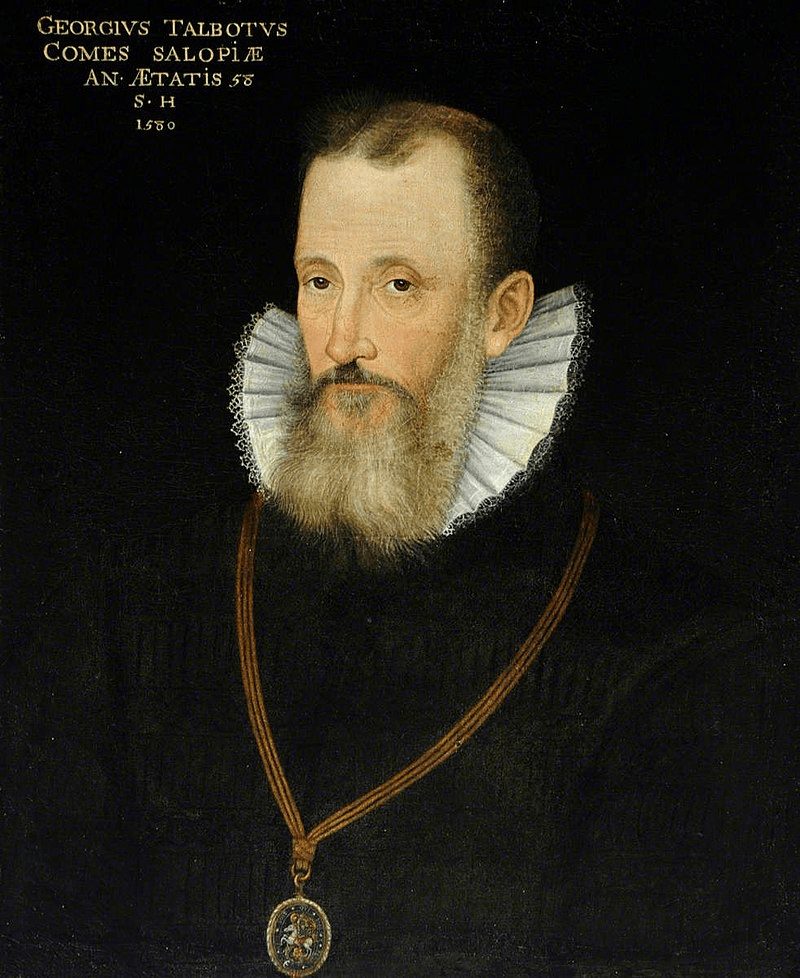
George Talbot, 6th Earl of Shrewsbury

The accounts also reveal regular travel between Haddon and Sheffield. ‘One of my mistress’s men’ was paid 2/- for carrying a letter to ‘my lord of Shrewsbury’ in Sheffield. At this time George Talbot was the Earl of Shrewsbury, who would soon (in 1567) marry Bess of Hardwick. On the 19th of September 1564 George Vernon had gone to Sheffield, presumably to visit Shrewsbury, and was provided with 10/- ‘to play at dice’. He must have gone with an entourage, since it cost 27/- to put them up in Sheffield for five nights. On the way home 4d was spent on ‘bread, cheese and drink’ for the men at Holmsfield, a village on a direct route from Sheffield to Haddon. Clearly a source like this raises as many questions as it answers, but nevertheless does give some fascinating insights into travel nearly 500 years ago.

Sources

Carrington, W. (1894) ‘Selections from the steward’s accounts preserved at Haddon Hall’. DAJ XVI pp 61-85

Hey, D. (2001) Packmen, Carriers and Packhorse Roads. Landmark pp 136-7

Driven by drovers

Well into the twentieth century herds of cattle or flocks of sheep were a common feature of rural roads. Even after the coming of the railways, farmers often had little alternative to walking their animals to and from markets. As towns such as Sheffield and Chesterfield grew, the demand for meat meant that beasts had to be walked from further afield. The major drove roads from Wales and Scotland to London passed around the Peak District, but within Derbyshire there was regular movement from upland grazing areas to the Derby and Nottingham markets.

Green lane near Minninglow

For more distant markets where better prices might be found, farmers entrusted their animals to a drover, a well-respected and licensed man who could take the animals to sale in good condition, and even more importantly, bring the cash home! Very few records of these men survive, but droving must have been a hard life, with a seasonal bent – busiest in the autumn when the grass stopped growing. A herd of a hundred cattle or more wouldn’t travel more than ten or twelve miles per day, and would have to be securely kept at night in a field with grazing and water. Drovers (and their essential dogs) would use the same routes regularly, and make arrangements with farmers and innkeepers en route, perhaps sleeping themselves in barns or outhouses. Identifying these routes today is difficult, but wide verges, such as can be seen in Minninglow lane above, may provide a clue, since the cows could have found some fodder on the hoof.

Bit of confusion

Drovers must have avoided turnpike roads where possible, not only to escape the tolls but also to save clashing with faster traffic. The foul state of the road surface after the passage of a hundred cattle can be imagined, especially in wet weather. The herds were not only taken directly to butchers, but were also driven to fairs such as Flash Fair above Beeley, which attracted buyers from a wide radius. One possible drove route identified by Dodd and Dodd runs from Hartington on the Staffordshire border to Biggin, Newhaven, Cardlemere Lane, Minninglow, Summer Lane near Wirksworth, Ambergate, Bullbridge and on to Nottingham. The first half of this provides a decent walk today, and is certainly more relaxing if you don’t have a hundred frisky bullocks to keep in order.

Sources:

Dodd and Dodd (1980) Peakland Roads and Trackways

Hey (2001) Packmen, Carriers and Packhorse Roads

On the road – in style

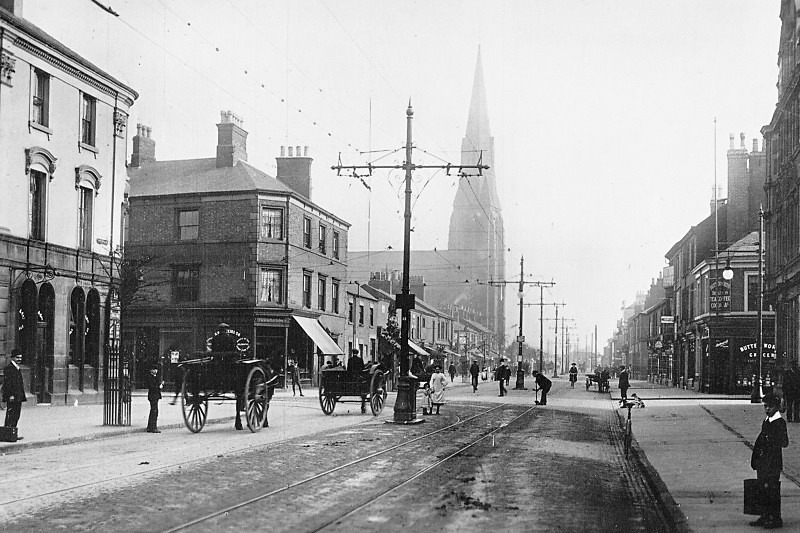
London Road, Derby in 1900

Although few people could have predicted it, in 1900 thousands of years of horse-drawn transport were coming to an end. Since the Bronze Age horses had provided the fastest means of movement, and thanks to better roads the range of vehicles increased dramatically in the nineteenth century, becoming more lightweight. For moving goods the two-wheeled tradesman’s cart, as seen above, was most common, but for personal transport there was a wide variety of choice. Many men and some women preferred the flexibility of riding, but for the elderly, or those who had never learned to ride, light, two-wheeled vehicles like gigs were an option in fine weather.

One lady owner

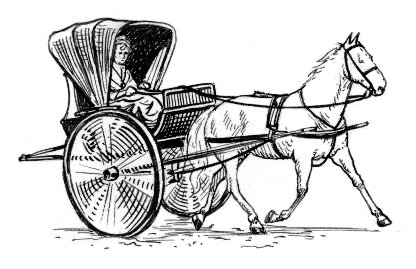
Readers of nineteenth-century novels may feel understandably confused by mention of phaetons, Broughams, Tilburys, Stanhopes, dogcarts and chaises. Clearly, only the wealthier classes could afford to keep any kind of carriage, as this would often mean stabling a horse and employing a driver. But there was considerable social prestige in keeping one’s own carriage, and savings could be made if the carriage could be driven by the owner and pulled by a single horse, such as with Tilburys, chaises and dogcarts.

A lightweight chaise, with folding hood

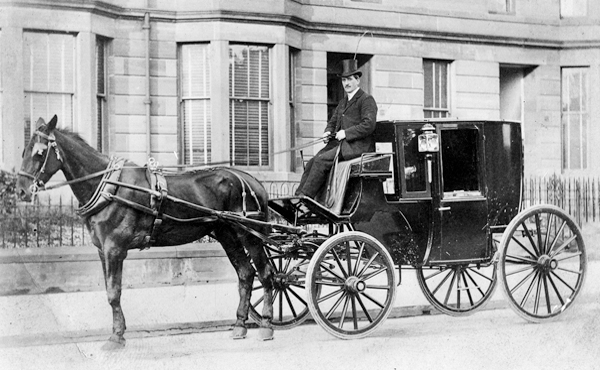
Richer folk could buy a four-wheeler which provided more protection from the weather but needed a pair of horses – an imposing status symbol. Examples include Clarences, Broughams and Victorias, the latter, of course, being the queen’s choice. No doubt she could afford the expense, which Charles Dickens in 1879 calculated at 45 guineas a month for keeping a two-horse carriage, including the coachman. In modern terms that is over £50,000 a year, which makes owning the flashiest car seem like a bargain!

A Brougham, named after a Lord Chancellor, Henry Brougham

Fixing a hole …

The Stonebreakers / Gustave Courbet 1858

Repairing holes in roads must have been one of the worst jobs in the pre-industrial world. Courbet was not the only artist attracted to the subject: his pair of stone breakers represent a class of unskilled labourers never previously regarded as a suitable subject for art, the viewer feels their dusty, sweaty toil . In contrast, John Brett’s The Stone Breaker (also 1858) portrays an almost idyllic scene; lovely weather, a handsome young lad on the job, and his dog amusing itself. The milestone in the corner (London 23) is a reminder that he is also filling in holes, and to do so required stone to be broken into small fragments to create an all-weather surface.

The Stone Breaker/ John Brett 1858

One of the earliest attempts to deal with the problem of road maintenance was made in 1555 when the Statute of Labour was passed, which gave responsibility for this to the parish. They were obliged to choose a Highway Surveyor, who had the unenviable task of getting all householders to work on the roads for four days a year (later increased to six). Farmers with horses and carts were also required to lend these to move stone. Clearly this system was unfair, since if the Great North Road ran through your parish there would be far more wear and tear than if, say, you lived in Bonsall. However, despite the drawbacks, roads were more or less kept open, and people and goods moved around. Even after the main routes were turnpiked from the mid-eighteenth century, unpaid labour was still required. This is shown locally in the diary of Rowsley farmer Mathew Gibbons, who records his father doing roadwork for six days in 1761-2.

That sinking feeling

Clearly this is not a problem that has gone away. A recent report states that potholes are the biggest worry for drivers today, which will surprise no-one who has tried driving or cycling on our Derbyshire roads in the last few years. Perhaps it’s time to go back to the parish system and get everyone out, once a month, for some DIY patching!

The name of the bridge

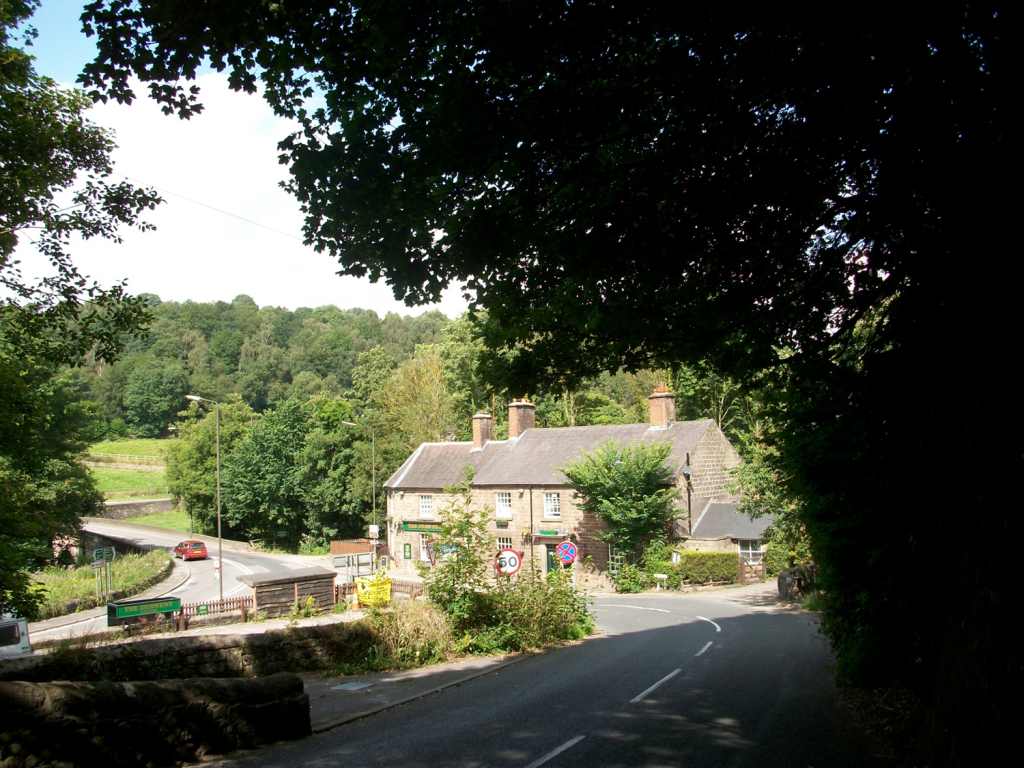
The Derwent Hotel at Whatstandwell Bridge, now The Family Tree

Whatstandwell must be one of the more bizarre place names in Derbyshire, mispelt on some old maps as ‘Hotstandwell’. In fact it commemorates Walter (Wat) Stonewell, who lived near the bridge, built by John de Stepul in 1391, according to records from Darley Abbey. The bridge was rebuilt in the late eighteenth century, and widened more recently. Although the bridge today carries the north/south A6, it was originally constructed for east/west traffic, moving between Crich, Wirksworth and beyond. Building a bridge here would have been a major expense, and John may have paid for it as an act of charity. Clearly the original bridge must have been narrower and more basic, but such an early date suggests the importance of this river crossing, which would have been a ford previously.

Causey between Whatstandwell and Crich

On the east side of the bridge there are two main routes which converge on the river crossing. The main road (B5035) climbs steeply over the canal and up towards Crich. This was part of the Nottingham to Newhaven turnpike of 1759, which eased the gradient of the climb up to Crich by adding a loop above Chasecliff farm. The original track can still be followed, climbing directly up the hillside, with a stone causey still visible in places, as shown above. The other route has been obscured by the building of the canal and railway, but can still be followed by taking the Holloway road towards Robin Hood and then taking the first path on the right. This leads up through Duke’s Quarry, named after the owner, the Duke of Devonshire, and this track would have carried stone to either the trains or barges. However, the path is much older than either types of transport, and continues up through pleasant, semi-wooded fields to Wakebridge.

The route to Shuckstone Cross

After crossing the Crich/Holloway road (currently closed) the track now runs to the left of Wakebridge Farm and climbs steadily to high ground at about 270 metres. As can be seen on the map, Shuckstone Cross in Shuckstone Field is the meeting point of at least five paths. Only the stone cross base now remains, but this is (possibly) marked with the destinations of the routes. The track from the bridge now continues northwards to meet the road, but can be walked to High Oredish and beyond that, Ashover. Although in practice it’s impossible to date routes such as these, the section from Wakebridge up to Shuckstone is exactly on the boundary of two of the historic Derbyshire hundreds, which suggest that it may have existed before the county was divided in the Saxon period.

Base of Shuckstone Cross

Derby at the crossroads

This early plan of the town of Derby, drawn about 1760, shows how small the town was 250 years ago. The central area is framed by the Derwent to the east and Markeaton Brook to the west, at that time still an open stream. The town is divided into five parishes: All Saints (now the cathedral), St Alkmund’s, St Peter’s, St Michael’s and St Werbergh’s. There is only one bridge (St Mary’s, still in use) giving access to the Nottingham road. The Silk Mill is shown, as are other signs of small-scale industry such as a ‘pot works’ and a ‘copper mill’. The urban core is surrounded by what look like orchards, but may be market gardens.

The second map, made at the same time, gives an equally vivid idea of the size of Derby then, when settlements like Chester Green or Darley were well outside the built-up area. The turnpike roads are clearly shown, with numbered miles. The London road runs through Osmaston, the Nottingham road goes past Spondon (or Spoondon), the Chesterfield road via Little Chester, and so on. By the second half of the eighteenth century regular coach services ran from the county town to all the major Midlands towns, and Derby was an important stage on the Manchester- London route, where passengers would spend the night.

The Old Bell Hotel, Sadler Gate

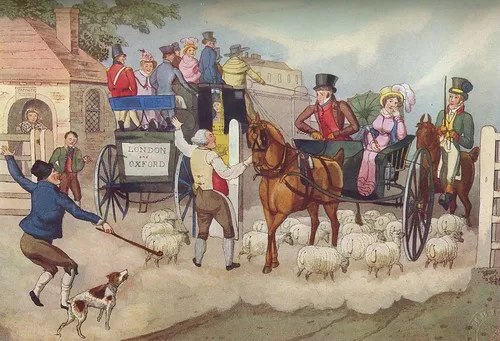
Road travel in the eighteenth century was transformed by both the use of steel springs on coaches after 1764, and the growth of the turnpike system. This is shown by the reduction in journey time on the Manchester to London route, from 62 hours (with two overnight stops) to 18 hours by the end of the century. ‘Flying Machines’ were advertised in the Derby Mercury in 1760 starting from Derby’s George Inn at a fare of £1-8 shillings. This is the equivalent of about £237 at modern values; a reminder that coach travel was not only uncomfortable but also very expensive. Among other Derby coaching inns were the Talbot and the Old Bell, the latter apparently the only survivor. Even on relatively smooth turnpikes, horses would soon tire, and would need changing regularly to maintain timing. By 1767 a coach left Derby three times a week at 9 pm and arrived in London by 7 pm the following day. Despite the (relative) speed, it’s easy to imagine the discomfort of this journey with only brief meal stops, and perhaps gain a new perspective on the comforts of travel on Midland Mainline!

Sources:

Burdett, P. (1791) Map of Derbyshire Derbyshire Archaeological Society

Twells, H. (1943) ‘Derby’s Flying Machines and earliest coaches’ DAJ 64: 64-82

All you ever wanted to know about paths

Jack Cornish is Head of Paths at the Ramblers, which must be an excellent qualification to write on the subject. His recent book, The Lost Paths, sets out to be ‘A History of How We Walk from Here to There’. Ambitious in scope, the 19 chapters include such familiar subjects as pilgrim routes and turnpikes, but also cover topics like the growth of railways and the effects of the new post-war towns on traditional paths. Some of his material, such as the enclosures of the eighteenth and nineteenth centuries, may be familiar to any reader with an interest in history, but other topics, for instance the loss of rights of way due to military requirements during the Second World War, are unusual.

The author has assembled a fascinating range of detail, such as the vogue for ‘pedestrianism’ in the nineteenth century, when large bets were put on improbable feats of walking, such as London to York and back in six days. But his concerns are not only historical, since he discusses the need to make access to the countryside more diverse and welcoming for minority groups. If anything, the reader may feel that he has tried to include too much: it is interesting to know how many bricks were used to build London’s first railway (six million) but not really relevant to the stated theme – there’s a certain loss of focus.

Yet his palette is impressively broad in terms of geography, and Derbyshire readers may enjoy his description of a walk from Cromford to Rowsley via Bonsall Moor, which he undertakes as a recreation of the ‘mystery hikes’ which were apparently popular between the wars – hikers would board a train for an unknown destination:

‘The drama of the landscape hits me quickly. Minutes after stepping off my train, my path takes me along the bottom of a massive cliff face. Trees grow up high, directly out of breaks in the rocks, their leaves rusting and falling to the ground’.

Cornish’s own involvement in the walking he writes about is clear, and he effectively balances these personal reports with the more historical details. He is also good at recounting disputes with landowners over rights of way, and sets the inevitable Kinder trespass story in the wider context of the long-standing struggles for access all over this country.

I would certainly recommend The Lost Paths to all fellow walkers, though with a couple of caveats. The title doesn’t really do justice to the scope of the book, which is much broader than it suggests, and the illustrations – small black and white engravings – add little beyond decoration.