The next station stop is Duffield … and then Duffield

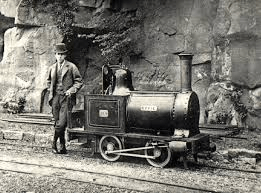
Sir Arthur with Effie, his early model

Today’s tech tycoons play with their spacecraft, but 150 years ago a wealthy Victorian built his own railway in his garden at Duffield Bank, complete with several tunnels and six stations. Sir Arthur Heywood had inherited money and the baronetcy from his father, and as a gifted amateur engineer wanted to test his belief in narrow gauge (15 inch) railways. Of course the standard gauge of four feet eight and a half inches had long been adopted in Britain, but Heywood thought that there was a role for much narrower gauge railways on private estates.

At the open day in 1894

Despite being a mile long, Heywood’s railway had no regular passengers and was really built as a testbed for his engineering experiments – a rich man’s passion. However, as can be seen, open days were held for people from the Duffield area. Remarkably, the rolling stock – all built in Heywood’s own workshop – included a dining car with a stove and a sleeper car, probably only used by his children! Several steam engines were built on site: the earliest was little Effie, pictured above at top, but later models were 0-6-0 tank engines Ella and Muriel.
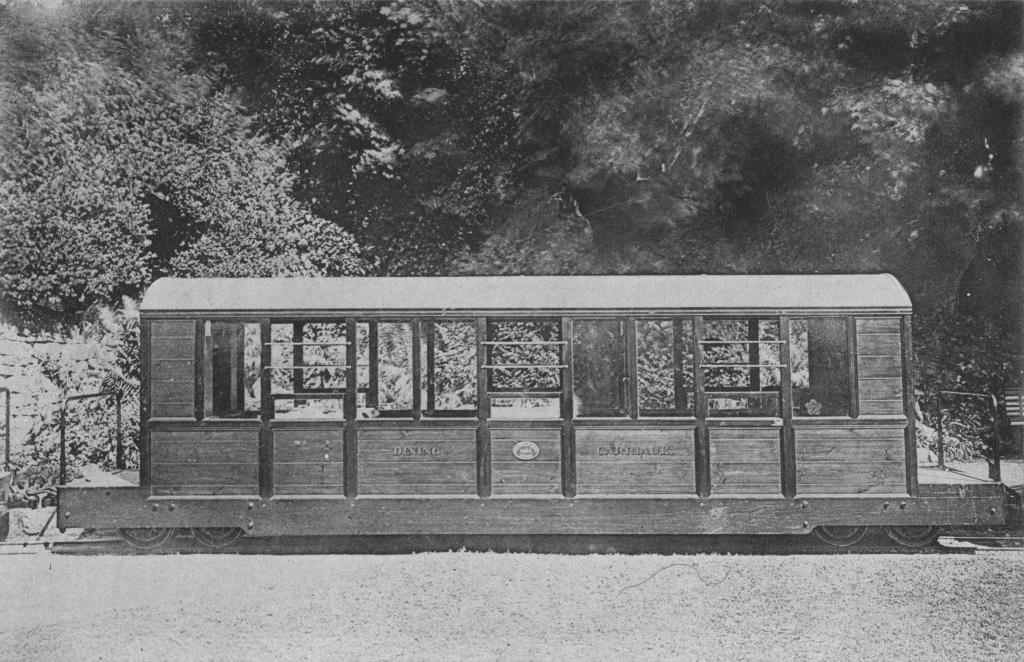
Fine dining at Duffield

Rather sadly, despite all his efforts, there was little interest in building new lines on this gauge, the only taker was on the Eaton Hall estate in Cheshire, owned by the Duke of Westminster. Sir Arthur died in 1916 and his railway was broken up, with some equipment sold to other narrow gauge companies such as the Ravenglass and Eskdale line. Clearly Heywood underestimated the advantages of road travel, as did various attempts to operate light railways for passengers in the district. The Ashover and Clay Cross Railway was a two foot gauge line that ran a passenger service from 1924 to 1934, while the Leek and Manifold Railway was a two foot six inch line that operated from 1904 to 1934. Obviously, by the mid 30s competition from buses and private cars was killing off these marginal railways.

Source: Duffield Bank and Eaton Railways, Clayton Howard

Christmas at Mountain Cottage

Mountain Cottage, Middleton by Wirksworth, today

In summer 1918, near the end of the First World War, DH Lawrence and his wife Frieda were forced to move from the south of England to Derbyshire, in the Midlands he thought he had escaped from years before. Out of work and hard up, having been harassed by officialdom for his wife’s supposed pro-German sympathies, Mountain Cottage offered them a refuge, with the rent paid by his relatively affluent sister, Ada, in Ripley. Refuge maybe, but in those days not a luxurious one. Steep field paths ran downhill to the Via Gellia, Cromford and Matlock Bath, or the road through Middleton would take him to Wirksworth station a couple of miles away. Water had to be fetched from a well in the lower garden, and of course there was no electricity, though this would be normal in rural Derbyshire at that date.

Happier daysLawrence (right) and Frieda in 1914

On Friday, December 27th, 1918, Lawrence wrote to Katherine Mansfield:

“We got your parcel on Christmas morning. We had started off, and were on the brow of the hill, when the postman loomed round the corner, over the snow … I wish you could have been there on the hill summit – the valley all white and hairy with trees below us, and grey with rocks – and just round us on our side the grey stone fences drawn in a network over the snow, all very clear in the sun. We ate the sweets and slithered downhill, very steep and tottering … at Ambergate my sister had sent a motor-car for us – so we were at Ripley in time for turkey and Christmas pudding”.

Remarkable to discover that the postman delivered on Christmas Day, and even more surprising that they must have walked at least seven miles to Ambergate – unless the trains were also running!

Smouldering passions

Later that winter, on February 9th, he again wrote to Katherine:

“But it is immensely cold – everything frozen solid – milk, mustard, everything …Wonderful it is to see the footmarks in the snow – beautiful ropes of rabbit prints, trailing away over the brows; heavy hare marks, a fox, so sharp and dainty … Pamela is lamenting because the eggs in the pantry have all frozen and burst. I have spent half an hour hacking ice out of the water tub – now I am going out”. (Pamela was his name for another sister).

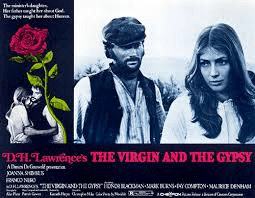
By spring the Lawrences had moved south, and were soon en route for Italy, which must have been a welcome relief after living above a frozen Via Gellia. But he never forgot this corner of Derbyshire, since he set his novella, The Virgin and the Gypsy in a village clearly based on Cromford, called Papplewick in the story:

“Further on, beyond where the road crosses the stream, were the big old stone cotton mills, once driven by water. The road curved uphill, into the bleak stone streets of the village”.

NB: Mountain Cottage can be seen from the road, on the right descending from Middleton to the Via Gellia. If walking take care as the road is quite narrow, busy, and there is no pavement.