Putting Brassington on the map

John Ogilby produced the first practical road map of England in 1675; a strip map which showed landmarks to guide the traveller, such as hills and rivers. The map above gives his route from Derby to Manchester, starting with Derby on the top right. In the next strip the section via Hognaston and Brassington can be seen, leading on to the old Roman road, then still in use, past Pikehall (Pikeham on map) and on to Buxton. The first stage of this itinerary became Derbyshire’s first turnpike road, the Shardlow to Brassington turnpike of 1720.

The Gate today: clearly older than the date on the porch

Today Brassington is a well-kept but rather isolated village, without a shop or cafe, but still having two pubs: The Miners Arms and The Gate. The former is a reminder of the glory days of the eighteenth century when some, at least, grew wealthy on lead mining, the latter must mark the end of the early turnpike; the last tollgate going north, since the Roman road lay on limestone, and was still passable after over 1,500 years! This is confirmed by Tollbar Cottage opposite. However, the Manchester route that Ogilby describes was too hilly for laden coaches, especially in bad weather, and by 1738 a newer, low-level turnpike via Ashbourne was in use, less direct but faster overall. There are other ‘Gate’ pubs in Derbyshire, all presumably marking a turnpike tollgate: for instance at Tansley, Swanwick and Belper.

St James Church, Brassington

St James Church must be the oldest building in the village: the tower and parts of the nave are impressively Romanesque. Although Brassington was originally part of Bradbourne parish, there was clearly a sizable congregation here in medieval times. Although it is dangerous to assume that church dedications have remained unchanged, St James is known as Santiago in Spanish, and he was the focus of the main West European pilgrimage routes in the middle ages. Could the dedication at Brassington suggest that the church wanted to be linked to the attraction of the saint’s burial in Galicia?

Sources:

Dodd A. & Dodd E., Peakland Roads and Tracks, 1980

Brassington Community Website: https://www.brassington.org.uk/

The woman behind the 95 Ethels

Ethel as a young woman

In 1917 the recently married Ethel Ward (1894-1986) became a 23-year-old widow on the death in combat of her husband, Henry Gallimore. She came from a wealthy Sheffield family; her mother was connected to the Bassetts of licorice fame, while her father was successful in the steel industry . The family suggested that Ethel should try to overcome her grief by walking on the nearby moors; a remedy that seems surprisingly modern a century later. This led to Ethel becoming aware of the need to preserve the natural landscape on the western fringes of the city, and in 1924 she helped to establish the Sheffield Association for the Protection of Rural Scenery, which later became part of the Council for the Preservation of Rural England (CPRE).

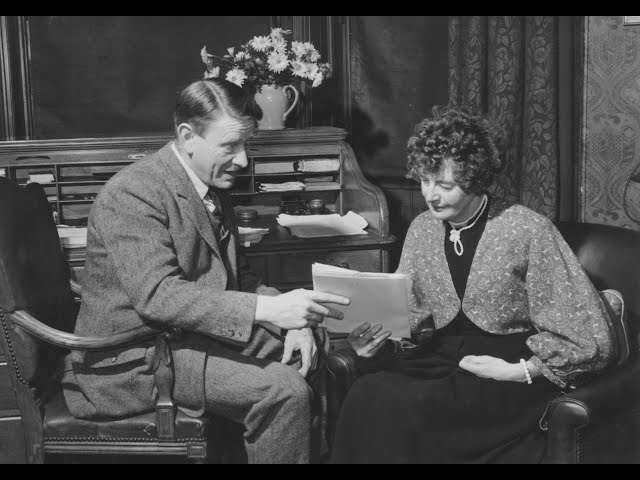
Gerald and Ethel in later life

In 1927 the 750-acre Longshaw estate, owned by the Duke of Rutland, came up for sale, and Ethel campaigned to raise funds for its purchase and protection from development. She was successful, and in 1931 the estate was given to the National Trust, who still run it today. In this decade she also helped to acquire land which became part of Sheffield’s green belt, the first British city to have one. By 1936 Ethel felt that she needed an assistant; her advert was answered by a young Manchester architect, Gerald Haythornthwaite, and they were married within a year.

On the Longshaw estate

During and after the second world war Ethel was closely involved with the CPRE and contributed to the creation of the Peak District National Park in 1951, Britain’s first. Today she is sometimes described as a forgotten figure, yet this seems a little exaggerated given that two books have recently been published about her (see below), a wood is named after her, there is a blue plaque near the site of her family home and, most impressively, a collection of 95 Peak District ‘summits’ have been collectively called ‘The Ethels’, similar to (but lower than) Scotland’s Munros. She and Gerald are buried in Crooke’s Cemetery in Sheffield.

Sources:

  1. Ethel: The biography of countryside pioneer Ethel Haythornthwaite, Helen Mort, 2024
  2. Wildly Different, Sarah Lonsdale, 2025