On getting lost

No danger of getting lost here

It’s difficult to get lost today. Google maps will display every street in the city, and spell out your quickest route, while in the country apps such as OS Maps will tell you exactly where on the path you are standing. The appeal of this technology is obvious – not just saving time, but also removing the fear that you’re heading the wrong way, into the unknown. In Derbyshire and the Peak District, with thousands of miles of footpaths, this reluctance to risk being lost results in crowds of visitors heading for the same honeypots such as Dovedale, Mam Tor, or the Cromford Canal, with predictable results.

The delights of a day in the country

It has been argued that the experience of getting lost can be valuable for our development, and we can cope better with that fear if we develop a strong sense of direction. Moreover, research has shown that the more children are allowed to roam freely, the better sense of direction they acquire. Although there must be marked individual variation, it seems that children today are restricted to a much small radius of ‘free movement’ – perhaps a few hundred yards – instead of the miles that children wandered away from home in previous generations. Of course, it can be argued that there is good reason for the restriction, but if children are barely allowed out of sight of their home they have little possibility of feeling lost – and then finding their way back.

Call Social Services?

How do we get a sense of direction? Moving through a landscape we notice and memorise a series of landmarks, while the position of the sun should provide an additional bearing (provided it’s at least partly visible). To return, the landmarks are revisited. The second time you make the journey, the landmarks are stored in your memory, even after a gap of months or years, as most walkers have found. Our nomadic ancestors, travelling through an unmapped countryside thousands of years ago, must have achieved an advanced ability to find their way, using perceptions unknown to us.
The Farley Moor megalith

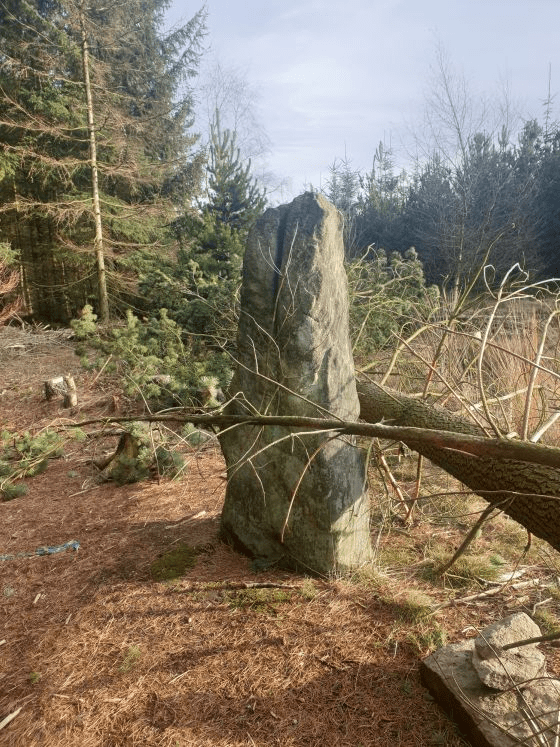
The two metre-high gritstone on Farley Moor

A recent Time Team programme reports an excavation on Farley Moor north of Matlock, where a single standing stone is thought to have possibly been part of a larger Bronze Age site. The researchers were able to date the site to 3,700 years ago, on the strength of radio carbon dating of charcoal fragments. But what is not clear is whether other stones in the vicinity were part of the monument or just erratic boulders. The stone is in a recent clearing in the Forestry Commission’s Farley Wood, which was planted about 50 years ago. One significant discovery was that below the stone there is a natural spring, so that the stone could have been a marker of this useful source, which might have been more significant when the water table was higher.

The timeless team

Although a good number of stone circles have survived in the Peak District, there is evidence that others have been lost, either through stone robbery or deliberate destruction by landowners who felt they were pagan symbols. However, it does not follow that every standing stone was part of a circle. Others were simply waymarks, such as the stone above Wirksworth on the route of the Portway. It is difficult to imagine the landscape in this area before the conifers were planted, but the ‘Moor’ name suggests an open and fairly treeless area in which a waymark would have been valued, especially if it also marked a spring. There was an ancient route which crossed the Derwent at Darley Bridge and headed up the hillside towards Chesterfield – was this connected?

The Cuckoo Stone

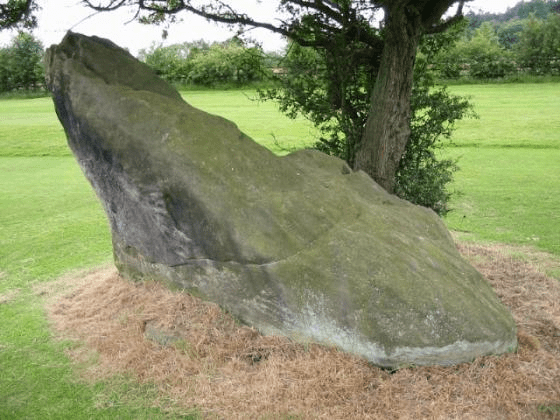
Despite centuries of speculation we really have no idea of the purpose or use of stone circles. Theories range from astronomical temples to assertions of tribal land ownership. Whether the Farley Moor stone is a circle or a solitary waymark, it is curious that in the vicinity are other named stones, such as The Cuckoo Stone on Matlock golf course or the Wire Stone half a mile to the north. While these both appear to be natural rock outcrops, the fact that they are named suggests that traditionally they were important landscapes features.

See: Youtube/ Time team/ Farley Moor