

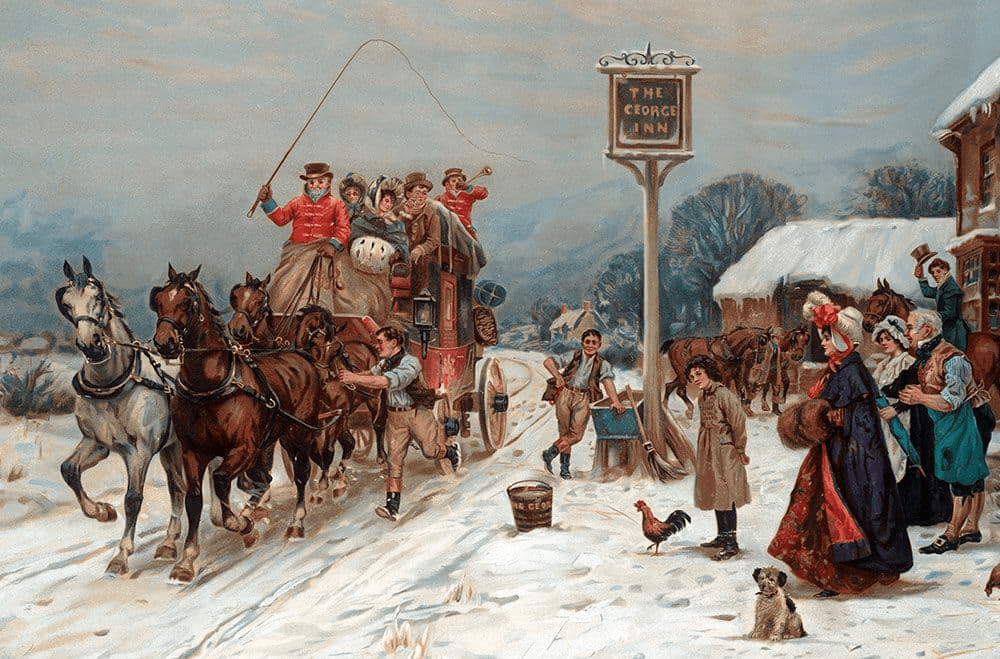
The image of a laden stagecoach arriving at a snowy inn has decorated millions of Christmas cards, along with robins and holly. The card above contains all the elements: the rural setting, icy roads, mine host on his doorstep to welcome the travellers, with the postern blowing his horn to announce (unnecessarily) their arrival, while the lady in the blue cloak is waiting to board. This kind of scene may have become popular because people wanted to travel at Christmas to visit their families, though in practice few would have gone by an expensive coach.

In practice most Christmas coach journeys must have been anything but romantic. Even without snowdrifts, the inside seats would have been both cramped and stuffy, while the cheaper seats on top would be bitterly cold and quite dangerous, as frozen fingers tried to hold on as the coach bounced over the ruts. In ‘Snowed Up’, above, the men have climbed down from the roof while the women passengers stay on board, no doubt hoping they won’t have to push. The scarlet coachman seems about to whip the horses, which are busy eating snow.

The Christmas card was invented in 1843 by Henry Cole (director of the V&A) and drawn by John Horsley, who has signed this example with a tiny self portrait (bottom right). It portrays the Cole family enjoying a seasonal meal, flanked by scenes of charity: feeding and clothing the poor. These form an interesting link with modern cards, which are often sold for charities. A financial comparison with today’s cards is also fascinating: Cole sold his cards for a shilling and they would have cost a penny to post, but translated into modern values the cards would be £5.37 each, while the postage would be just 44p. And not a robin, snowman or stagecoach in sight!
 The Old Roads of Derbyshire