A cold coming

Happy Christmas everybody

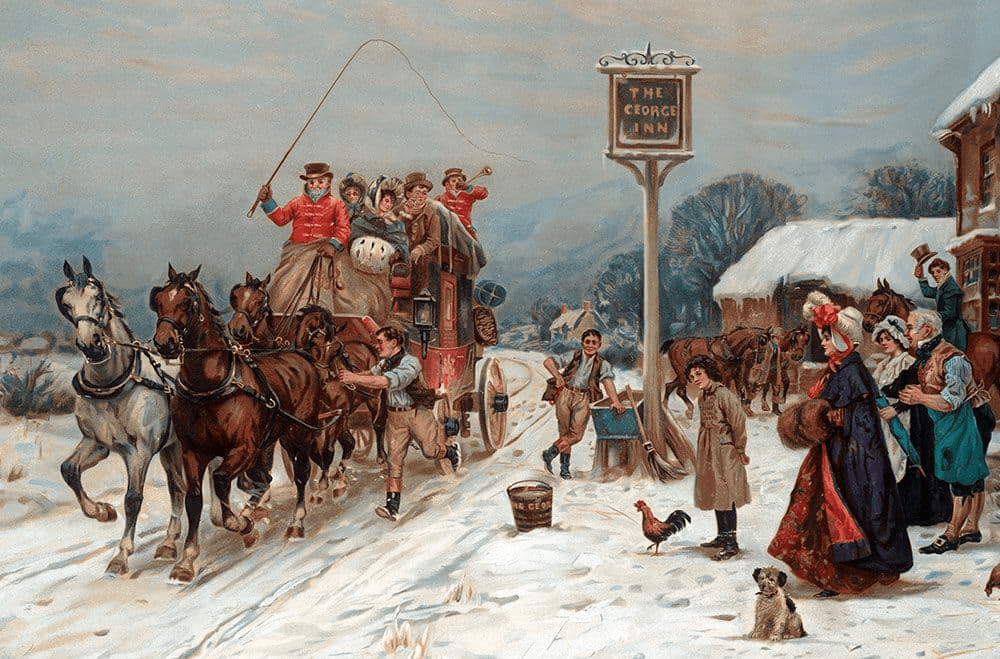
The image of a laden stagecoach arriving at a snowy inn has decorated millions of Christmas cards, along with robins and holly. The card above contains all the elements: the rural setting, icy roads, mine host on his doorstep to welcome the travellers, with the postern blowing his horn to announce (unnecessarily) their arrival, while the lady in the blue cloak is waiting to board. This kind of scene may have become popular because people wanted to travel at Christmas to visit their families, though in practice few would have gone by an expensive coach.

In practice most Christmas coach journeys must have been anything but romantic. Even without snowdrifts, the inside seats would have been both cramped and stuffy, while the cheaper seats on top would be bitterly cold and quite dangerous, as frozen fingers tried to hold on as the coach bounced over the ruts. In ‘Snowed Up’, above, the men have climbed down from the roof while the women passengers stay on board, no doubt hoping they won’t have to push. The scarlet coachman seems about to whip the horses, which are busy eating snow.

181 years ago …

The Christmas card was invented in 1843 by Henry Cole (director of the V&A) and drawn by John Horsley, who has signed this example with a tiny self portrait (bottom right). It portrays the Cole family enjoying a seasonal meal, flanked by scenes of charity: feeding and clothing the poor. These form an interesting link with modern cards, which are often sold for charities. A financial comparison with today’s cards is also fascinating: Cole sold his cards for a shilling and they would have cost a penny to post, but translated into modern values the cards would be £5.37 each, while the postage would be just 44p. And not a robin, snowman or stagecoach in sight!
The mystery of Fin Cop

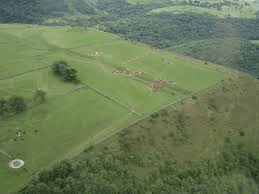
Aerial view of the site of Fin Cop: Curve of ramparts visible top left

Fin Cop lies on the route of the Portway, about two kilometres north of Ashford in the Water. It is perched on a headland high above the sharp curve in the River Wye in Monsal Dale, and consists of a ditch and incomplete ramparts enclosing an area of about ten acres. Pennyunk Lane, which is believed to be a Celtic name, passes nearby, and is a section of the Portway whose route been somewhat modified by field enclosures. The question is – what was the purpose of the site?

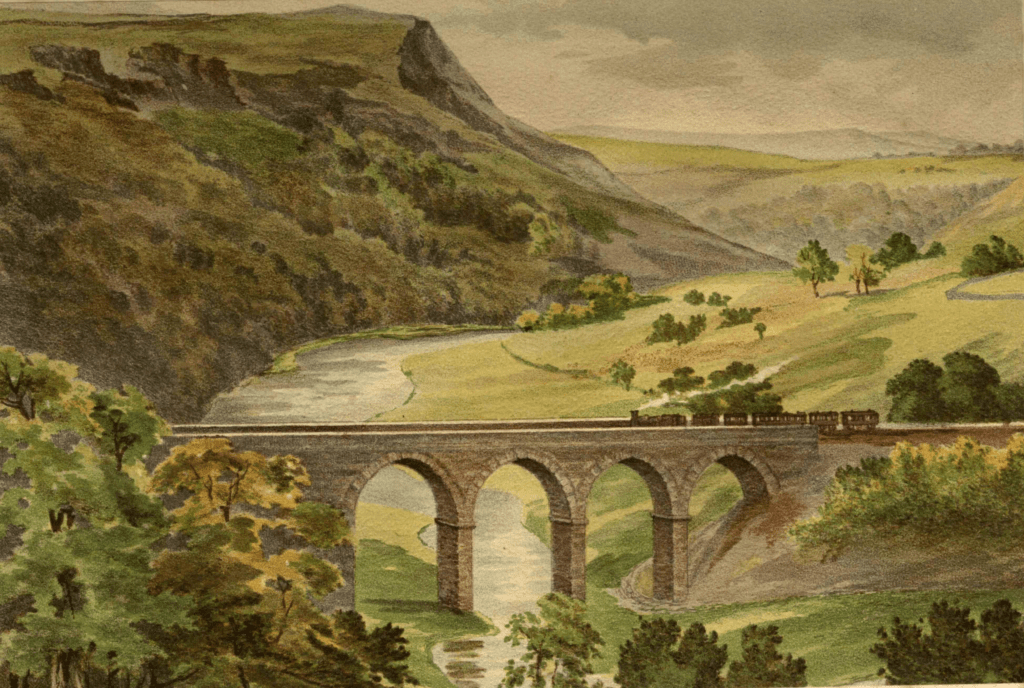
Monsal Dale viaduct with Fin Cop in distance

The OS map marks the site as ‘settlement’, although it is often labelled ‘hillfort’. In fact it may have had several functions, as revealed by the extensive excavations which were carried out in 2009 and 2010 by the local history group supported by Archaeological Research Services. These reveal activity on the site going back to the Mesolithic – the time of hunter gatherers, when local chert was worked into tools. During the Bronze Age there were a number of barrow burials on site, and some kind of enclosure, possibly for corralling livestock. However, the idea of a permanent settlement seems unlikely, at nearly a thousand feet and far above a water source – much more probable that this was a ‘caravanserai’ on the Portway, being about ten miles from the next at Mam Tor, enclosing enough pasture for travellers’ animals to graze on.

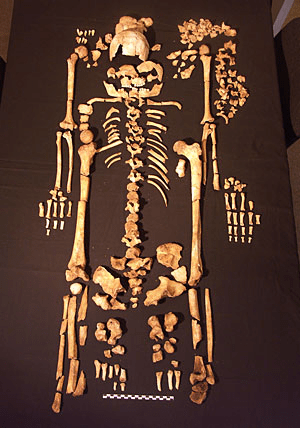
Remains of a woman in her 20s, found at Fin Cop in 2010

There seems to have been a change, possibly climatic, in the Peak District in the Iron Age, indicated by a reduced population. This theory is supported by the dramatic finds made by the excavation of 2010, which show that about 400 BCE the ramparts were hurriedly raised to a height of about three metres and a ditch dug alongside. In the excavated sections the skeletons of nine women and children were found, whose bodies appear to have been hurriedly thrown into the ditch before the walls were broken down. Given that only a fraction of the site was excavated, this suggests a massacre of possibly over a hundred people, and warfare on a serious scale. We will never know the full story of this fascinating place, but these recent finds give us a taste of one chapter in its long history.

Source: https://www.archaeologicalresearchservices.com/projects/site/index.html