Waterloo sunset?

The hero of the hour

In an age of instant news, when an election result in the USA is available instantly on our phones, it’s hard to imagine a time when news of events even a hundred miles away could take weeks to reach Derbyshire. Before railways and national newspapers began to shrink distances a frequent source of information was the stagecoach, carrying the latest news from London. So on the 8th of July 1815, the people of Derby were finally sure that Napoleon had been decisively defeated at Waterloo when the Traveller Coach, one of the regular services from the capital, arrived in town. Celebrations were clearly called for, as the coach was decorated with laurels and lilies, and was pulling a French tricolor in the dust behind – a flag that was shortly burned by the crowd. So 20 days after the French defeat on June 18th the news began to percolate through the county.

Another Derbyshire coach, the Peveril of the Peak, starting from Islington

The battle was protracted and bloody, with some estimates putting the number of casualties at about 50,000, with equal numbers of dead and wounded on each side. Yet for civilians in Britain it decisively concluded over 20 years of warfare, and Wellington was widely honored for his victory, despite the fact that British forces were a minority of the Allied armies, and it was only the timely arrival of German troops that tipped the balance – even Wellington admitted that it was ‘the nearest run thing you ever saw in your life’.

The Wellington Cross, Baslow Edge and a visitor

Many monuments commemorate the battle, such as the cross above, although this was not erected until 1866, years after Wellington’s death. But not everyone welcomed the defeat of Napoleon. For many radicals and romantics, such as Byron, the French emperor was the heir to the revolutionary spirit of 1792, and British troops had died to replace a hated Bourbon on the throne of France. These sympathisers included the sixth Duke of Devonshire, who displayed a large marble bust of the emperor at Chatsworth, and as part of a liberal, Whig family had no time for the arch-Tory Arthur Wellesley, first Duke of Wellington.

Chelsea pensioners reading the Waterloo Despatch’. Wellington commissioned this picture from Wilkie for the enormous sum of £12,000.

Mr Brown’s girls

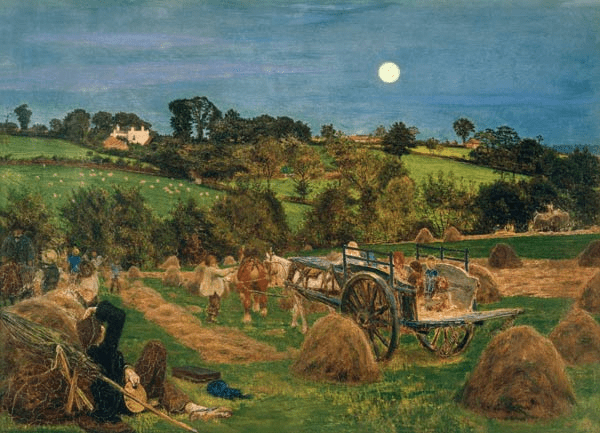
Ford Madox Brown – The Hayfield (1855)

By 1878 the painter Ford Madox Brown, at the age of 57, was suffering from severe gout, that classic Victorian ailment. His wife and model Emma had become alcoholic, probably as a result of the cuckoo in their nest, the 37-year-old poet Mathilde Blind, the object of his unresolved passion. It was Mathilde who proposed a family holiday in the fashionable resort of Matlock Bath that summer, along with his daughter Lucy and Lucy’s husband Frank. They would presumably have come by the Midland railway from their London home, and then by station fly to the house they had rented, ‘Belmont’, high above the river on Waterloo Road. The August weather allowed the younger members of the party to enjoy long walks along the valley, but Madox Brown was unable to join them, being literally bedridden with gout for most of the holiday. Perhaps that’s why he produced no Derbyshire paintings to rival those he painted in the London area, such as The Hayfield (above). As an associate of the Pre-Raphaelites he was faithful to their principle of working outdoors for authentic lighting effects, as can be seen in his iconic painting The Last of England.

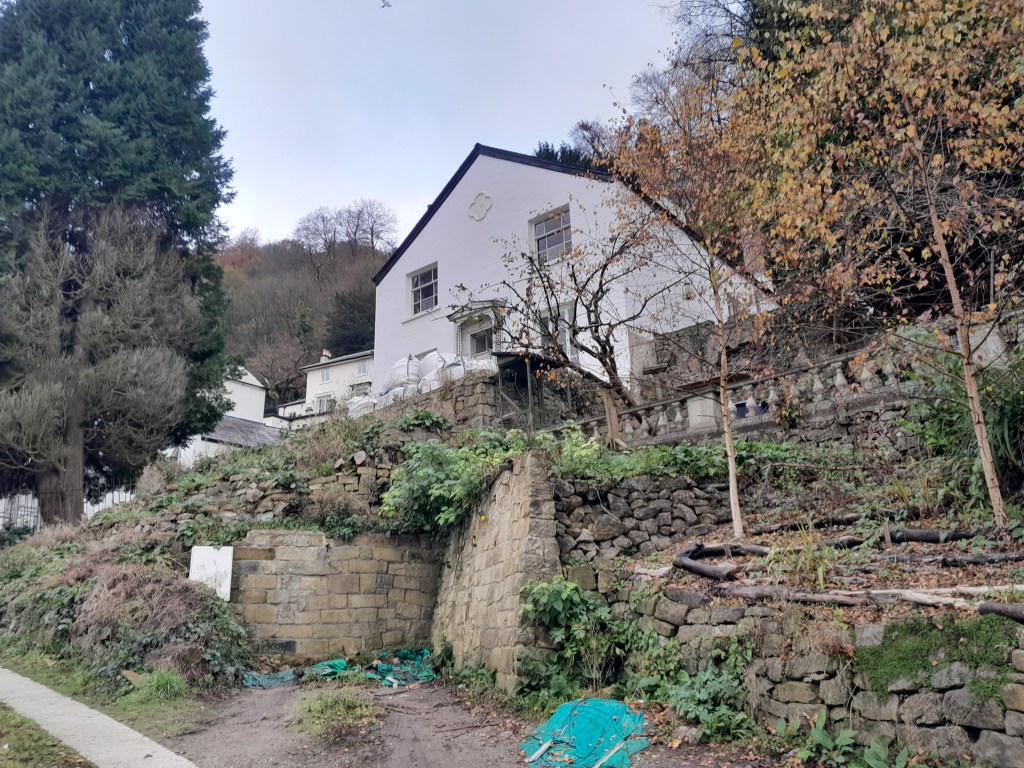
Belmont survives, a Grade II listed building which was constructed in 1847, one of the earliest houses on Waterloo Road. By 2021 it was in a dilapidated condition, and was auctioned that year for £203,000. Today it is freshly renovated and repainted, tucked away off the road, with views over towards High Tor.

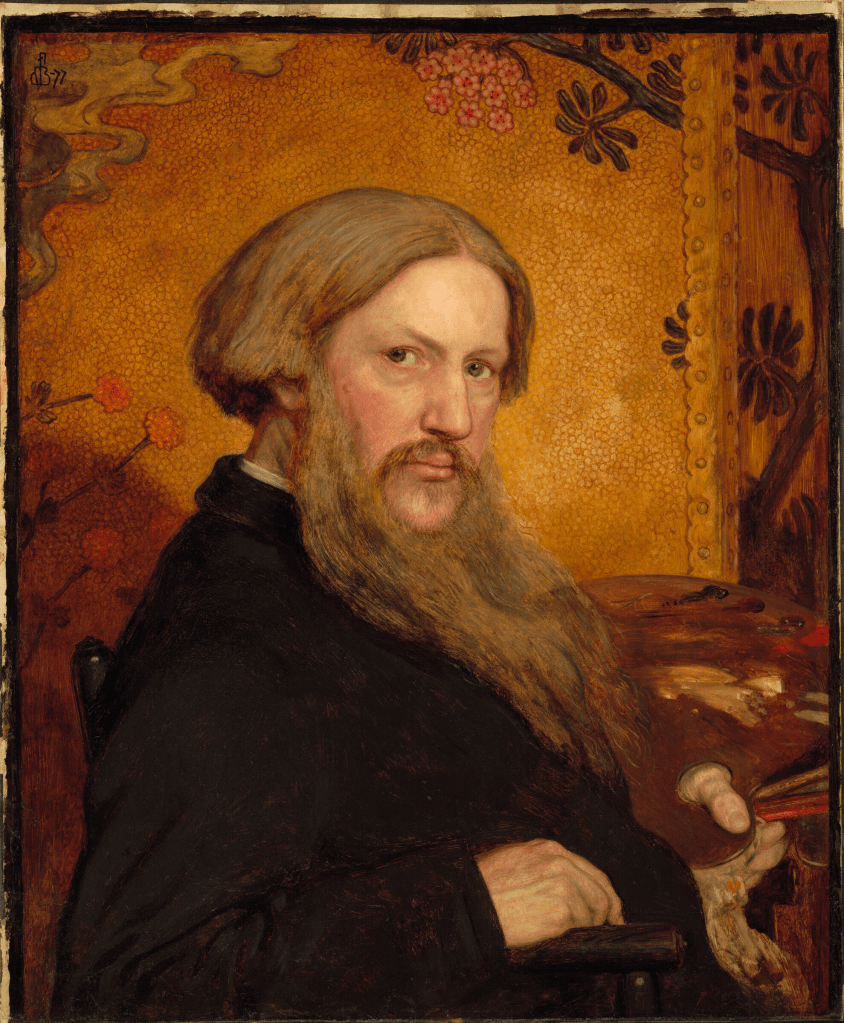
Brown in painterly pose

This self-portrait was made about the same time as Brown’s visit to Matlock. His lengthy beard and severe expression give him a patriarchal air, but friends such as Rossetti claimed that he was genial and sociable. He certainly had a difficult life: his parents were English but led a wandering life in the Low Countries for economy; his mother and sister both died before he was 20 and his father shortly after. He married a cousin, Elisabeth Bromley, who died of TB six years later, and then married his model, Emma, who posed as the emigrating wife in The Last of England. Her drinking increased as he became infatuated with two much younger and strikingly attractive women, Maria Spartali and Mathilde Blind, both part of London’s intellectual immigrant community, Marie from Greece and Mathilde from the German-speaking states. Yet neither of these relationships appear to have been consumated, while their consequence was to make all parties miserable – welcome to Bohemia!

The Clarion call

The invention of the safety bicycle in the late nineteenth century created the possibility of leisure travel for working-class people. Derbyshire and the Peak District, close to the industrial cities of Sheffield, Nottingham and Manchester, were prime destinations for Sunday rides. These early cyclists clearly felt the need to organise themselves into clubs for mutual support, and so adopted the name and outlook of the Clarion newspaper, a socialist weekly founded by Robert Blatchford in 1891 in Manchester. They not only took the name, but they also saw themselves as travelling propagandists, rather in the later Soviet style, spreading the good word to remote villages. Local Clarion Cycling clubs held a meeting in 1895 at the Izaak Walton Hotel in Dovedale to form the National Clarion Cycling Club.

BlatchfordThe man with the moustache

Robert Blatchford (1851-1943) had a remarkable life, despite being largely self-educated, including a period in the army and a successful career as a journalist. His best-seller, Merrie England (1894), was supposed to have won far more votes for the new Labour party than Das Kapital . However, his support for the Boer War led to a sharp drop in his popularity in left-wing circles. Perhaps his real achievement was to create the Clarion movement as an umbrella which inspired numerous groups, not only for cyclists but also for ramblers, drama, field studies, scouts and drawing. The Clarion Cycling Club is still active today, despite suffering a recent split over the word ‘Socialism’ on its masthead.

Sheffield Clarion Ramblers at the Barrel Inn, Bretton, 1930

Early cycling and walking groups had a strong ethical dimension. They were not out in the fresh air just for their health, but also for their moral betterment. The slogan of the Sheffield group was ‘A rambler made is a man improved’, though as can be seen in the photo above plenty of women were also keen on improvement. There was a distinct overlap between ramblers and non-conformist chapels: both offered a spiritual as well as a social opportunity. Sheffield Clarion Ramblers had their first meeting in Edale in 1900, led by the remarkable GHB Ward (still going strong in 1930 as seen above, with his arms around chap in the front). The group campaigned continuously for the right to roam, and reached a peak membership in the late 1940s with about 200. Perhaps their achievement is summed up in Ward’s adage: ‘A man who was never lost never went very far’.