Fixing a hole …

The Stonebreakers / Gustave Courbet 1858

Repairing holes in roads must have been one of the worst jobs in the pre-industrial world. Courbet was not the only artist attracted to the subject: his pair of stone breakers represent a class of unskilled labourers never previously regarded as a suitable subject for art, the viewer feels their dusty, sweaty toil . In contrast, John Brett’s The Stone Breaker (also 1858) portrays an almost idyllic scene; lovely weather, a handsome young lad on the job, and his dog amusing itself. The milestone in the corner (London 23) is a reminder that he is also filling in holes, and to do so required stone to be broken into small fragments to create an all-weather surface.

The Stone Breaker/ John Brett 1858

One of the earliest attempts to deal with the problem of road maintenance was made in 1555 when the Statute of Labour was passed, which gave responsibility for this to the parish. They were obliged to choose a Highway Surveyor, who had the unenviable task of getting all householders to work on the roads for four days a year (later increased to six). Farmers with horses and carts were also required to lend these to move stone. Clearly this system was unfair, since if the Great North Road ran through your parish there would be far more wear and tear than if, say, you lived in Bonsall. However, despite the drawbacks, roads were more or less kept open, and people and goods moved around. Even after the main routes were turnpiked from the mid-eighteenth century, unpaid labour was still required. This is shown locally in the diary of Rowsley farmer Mathew Gibbons, who records his father doing roadwork for six days in 1761-2.

That sinking feeling

Clearly this is not a problem that has gone away. A recent report states that potholes are the biggest worry for drivers today, which will surprise no-one who has tried driving or cycling on our Derbyshire roads in the last few years. Perhaps it’s time to go back to the parish system and get everyone out, once a month, for some DIY patching!
The name of the bridge

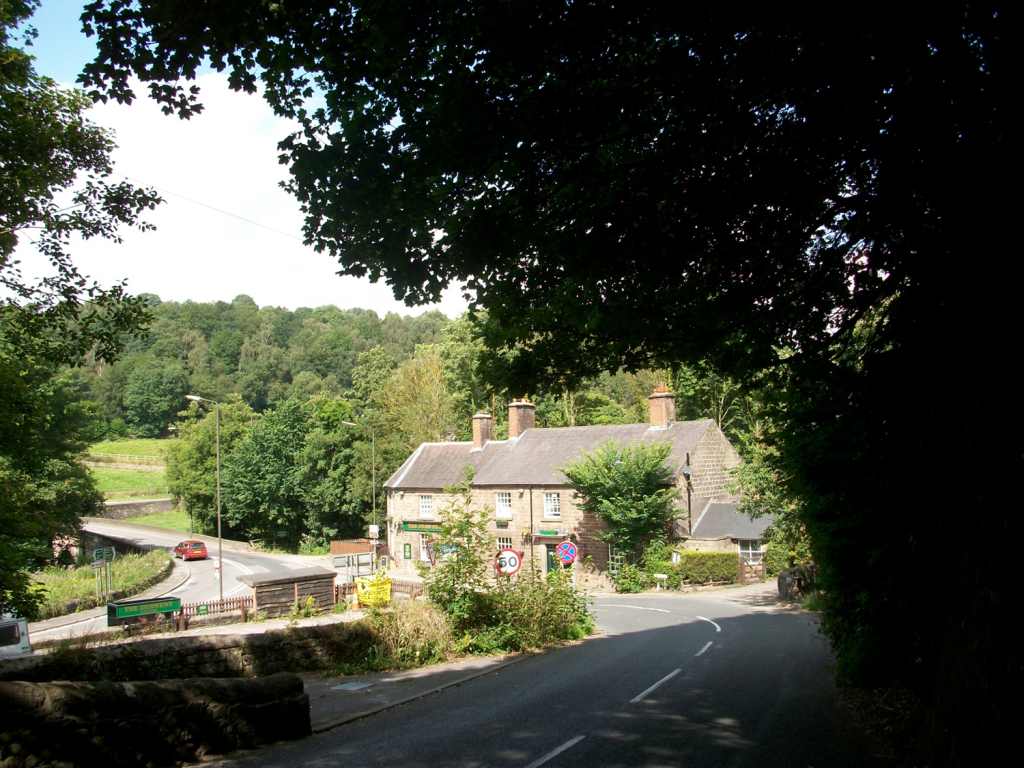
The Derwent Hotel at Whatstandwell Bridge, now The Family Tree

Whatstandwell must be one of the more bizarre place names in Derbyshire, mispelt on some old maps as ‘Hotstandwell’. In fact it commemorates Walter (Wat) Stonewell, who lived near the bridge, built by John de Stepul in 1391, according to records from Darley Abbey. The bridge was rebuilt in the late eighteenth century, and widened more recently. Although the bridge today carries the north/south A6, it was originally constructed for east/west traffic, moving between Crich, Wirksworth and beyond. Building a bridge here would have been a major expense, and John may have paid for it as an act of charity. Clearly the original bridge must have been narrower and more basic, but such an early date suggests the importance of this river crossing, which would have been a ford previously.

Causey between Whatstandwell and Crich

On the east side of the bridge there are two main routes which converge on the river crossing. The main road (B5035) climbs steeply over the canal and up towards Crich. This was part of the Nottingham to Newhaven turnpike of 1759, which eased the gradient of the climb up to Crich by adding a loop above Chasecliff farm. The original track can still be followed, climbing directly up the hillside, with a stone causey still visible in places, as shown above. The other route has been obscured by the building of the canal and railway, but can still be followed by taking the Holloway road towards Robin Hood and then taking the first path on the right. This leads up through Duke’s Quarry, named after the owner, the Duke of Devonshire, and this track would have carried stone to either the trains or barges. However, the path is much older than either types of transport, and continues up through pleasant, semi-wooded fields to Wakebridge.

The route to Shuckstone Cross

After crossing the Crich/Holloway road (currently closed) the track now runs to the left of Wakebridge Farm and climbs steadily to high ground at about 270 metres. As can be seen on the map, Shuckstone Cross in Shuckstone Field is the meeting point of at least five paths. Only the stone cross base now remains, but this is (possibly) marked with the destinations of the routes. The track from the bridge now continues northwards to meet the road, but can be walked to High Oredish and beyond that, Ashover. Although in practice it’s impossible to date routes such as these, the section from Wakebridge up to Shuckstone is exactly on the boundary of two of the historic Derbyshire hundreds, which suggest that it may have existed before the county was divided in the Saxon period.

Base of Shuckstone Cross