


In August 1557 Bess, living at Chatsworth, was summoned to London by her then husband, William Cavendish; he was facing charges of financial malpractice and needed her support. The details of her journey provide an insight into lordly travel in the Elizabethan period. Although her exact route is uncertain, she was travelling for three days, and her final stops were in Northampton and St Albans. The total journey length was about 150 miles, so she was travelling quite fast, given the state of the roads.
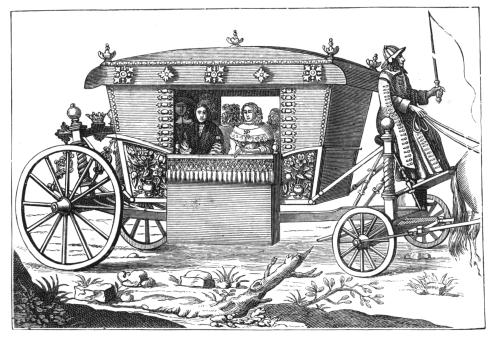
Among her entourage were her six-year-old son, Henry Cavendish, his nurse, two footmen and a guide. Presumably the family would have ridden in their coach, while the men rode alongside. Given that she must have made the journey south many times (she was 30) it is curious that they still needed a guide – presumably road conditions could vary from year to year. Bess kept a record of her expenses on the trip, which show that she ordered a fire in her chamber at every stop.

Travel in the mid sixteenth century was not for the faint-hearted. Their horses had to be re-shod twice, the second time at Northampton, where Bess took the opportunity of shopping for some shoes for her younger daughter. There was another halt to repair broken tack, while several ferries had to be boarded and disembarked. Then one of the horses needed treatment for a sore back. When they got to St Albans Bess, in her haste, decided to continue by herself, travelling overnight with some local guides for the last stretch into the City. She bought them drinks at Barnet and then paid them ten shillings on arrival at the Cavendish house. Despite her efforts her husband William was increasingly ill, and she was soon forced to take responsibility for their indebted estate, a process that would involve much more travel between London and Derbyshire.
 The Old Roads of Derbyshire
Fascinating! That story really makes Bess come alive, as well as the conditions of travelling in those days 😀
LikeLike
Very interesting comment about the need of ferries to reach London. Do you know which rivers required them? Perhaps the Cambridgeshire Ouse?
LikeLike
Unfortunately not. Certainly surprising for the period. Her accounts do not specify where the ferries were.
LikeLike