

Today Matlock Bath rarely seems short of visitors; even in winter there will be customers for ice cream, and car parks fill up by mid-day. But in the past, especially before the railway arrived in 1849, and when road access was challenging, the village had to work harder to attract travellers. Early fame depended on the waters, of course, but wallowing in a lukewarm bath had limited appeal, yet the spectacular landscape of High Tor to one side and Masson Hill opposite was the subject of many paintings, helping spread its reputation. Local entrepreneurs began adding to the natural beauty, starting with Lovers’ Walks, on the east side of the Derwent, and originally only accessed by ferry or from Willersley. The Walks are first mentioned in 1742, making them possibly the earliest public ‘park’ in the country. Paths were created by the river and up the hillside, with seats, shelters and ornaments provided to enhance the views.

View of Matlock Bath from the Heights of Abraham c. 1840s
Presumably eighteenth-century visitors were more energetic than modern holidaymakers, since before the cable cars were installed reaching the Heights involved a steep-ish walk. Opened in 1787, the rather quirky name derives from the supposed similarity to the Heights of Abraham in Quebec, where General Wolfe died in 1759. These gardens offered views over the valley, improved by building the viewing platform of the Victoria Tower in 1844. Clearly, hillside walks were a limited attraction, so the old lead workings in Masson were opened up to visitors, now named Masson Cavern and Rutland Cavern, both continuing to offer some spectacular sights.
The Switchback Railway, Derwent Gardens c. 1910
About 1887 a craze for ‘switchback’ railways, a basic kind of gravity operated roller coaster, swept the country. The Buxton family bought and ran Matlock’s version, which had been built on the site of Derwent Gardens, and it continued operating until about 1930. Judging from the photos it would have never passed Health and Safety inspections, but was apparently extremely popular!
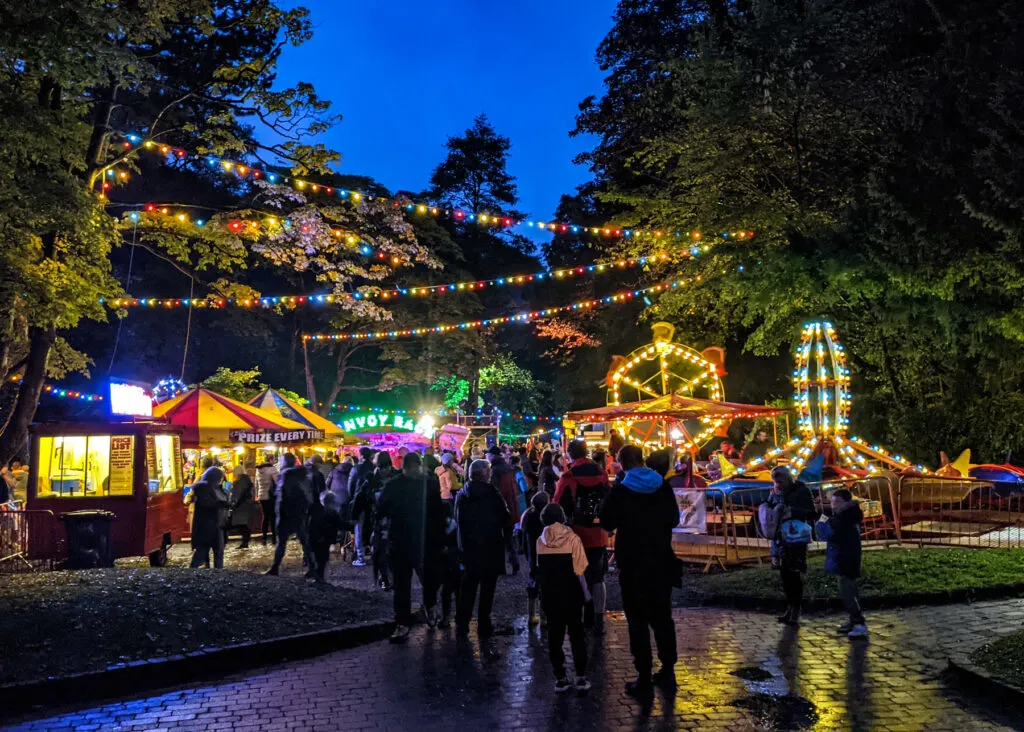
Matlock Bath Illuminations, or Venetian Nights, dates back to 1897, when it was an attempt to prolong the holiday season into the autumn by offering a spectacular display of illuminated boats, accompanied by fireworks. These have continued up to the present, with breaks for wars, floods and, of course, Covid-19. Especially in the 1920s and 30s there was strong competition for the prize for the best boat, and some of the remarkable winners can be seen on the Andrews pages at:
https://www.andrewsgen.com/matlock/pix/matlockbath_illuminations_boats.htm


 The Old Roads of Derbyshire