On the road to Dale

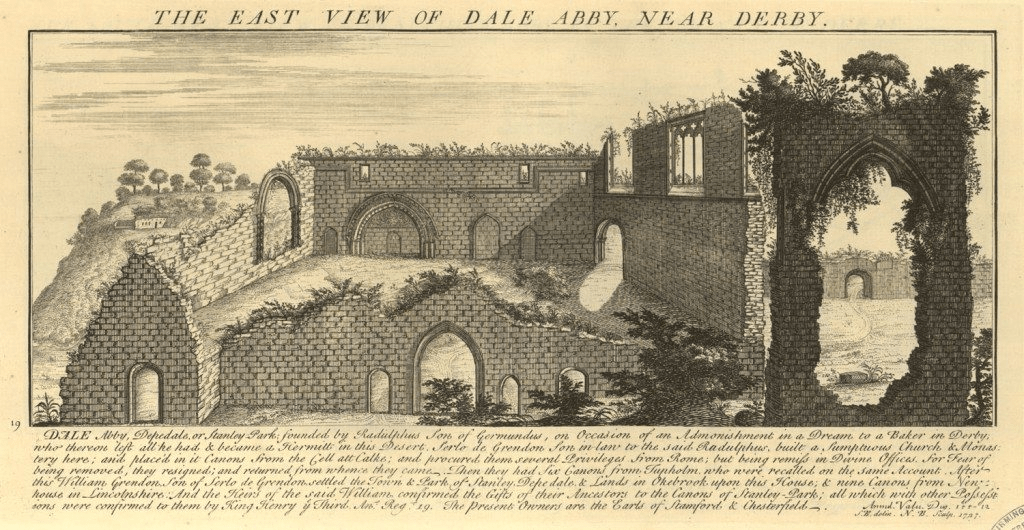
Compared with neighbouring Yorkshire, Derbyshire has hardly any visible remains of its abbeys. Even the location of Darley Abbey in Derby is uncertain, while Dale Abbey, between Ilkeston and Ockbrook, has just one solitary surviving arch (see below). The engraving above shows the state of the ruins in the eighteenth century, before the robbing of dressed stone had been completed. Yet at its height in the fifteenth century this abbey owned about 24,000 acres of land, throughout the county and beyond; endowments it had accumulated over the years. With only about 15 canons in residence, the job of administering these estates may have been given to lay people, but this task must have involved constant travelling. In addition, abbeys like Dale attracted pilgrims who came to pray before relics, in this case a phial of St Mary’s milk. For both reasons, Dale Abbey must have been sited on a good long-distance route.

The remains of the east window, Dale Abbey

The conventional view is that monasteries and abbeys were sited in remote, inaccessible places where the inmates could spiritually benefit from the tranquility of isolation. That may have been true at one time, but the running costs of both the abbey and its agricultural lands meant that two-way traffic steadily developed. In fact Dale was on the route of the Derbyshire Portway, linking it directly with Nottingham to the east, and to the northwest with Wirksworth and its estates at Griff Grange just beyond that town (‘grange’ suggests a monastic farm).

Dale church today

Dale Abbey was closed in 1538 (by William Cavendish) and its huge estates, consisting of churches and mills in addition to moors, woods and fields were sold off. By this time the influence of Protestantism was undermining the twin ideals of the monastic life and pilgrimage. The buildings were soon pillaged: some stained glass, for example, being taken to nearby Morley church. Today the village of Dale provides good walking, one of England’s few semi-detached churches (another survival from the Abbey) and a remarkable hermitage above in the woods, supposed to have been created by a Derby baker who sought a religious life there in the twelfth century.

Chaps with maps

Part of Speed’s Derbyshire map of 1611: Wirksworth in centre.

It is a mystery of history that maps in the modern sense, as aids to travel, did not appear until the early eighteenth century. A few maps survive from the Roman and medieval periods, but they seem to have been rare and would not have helped the traveller. Presumably wayfarers simply had to ask the way. The first county maps of England, and probably the first in Europe, were produced by Christopher Saxton in the 1570s, and these were plagiarised by John Speed, whose 1611 Derbyshire map is shown above. This might have been of some use to travellers, although roads are not shown: the dotted lines are boundaries of hundreds. However his map does show rivers, some bridges (e.g. Belper bridge), and the fenced estates of the wealthy. Although it has the modern convention of north at the top it is still semi-pictorial in style, with little mountains and water mills. Note the erratic spelling: two versions of Wirksworth!

The first practical map for travellers was Ogilby’s strip map of 1675. As can be seen above, this maps the route from Derby (top right) to Manchester (bottom left), and shows villages, side roads, hills and some inns. This map is part of Britannia, a book of 100 major routes in the kingdom, at the innovative scale of one mile to an inch. However, this is the only Derbyshire road in the book, and it was not until 1767 that the whole county was surveyed for Peter Perez Burdett’s map (below). Although far from perfect, this is an invaluable reference for historians, depicting in detail the county’s villages, forests, and, for the first time, the main roads.

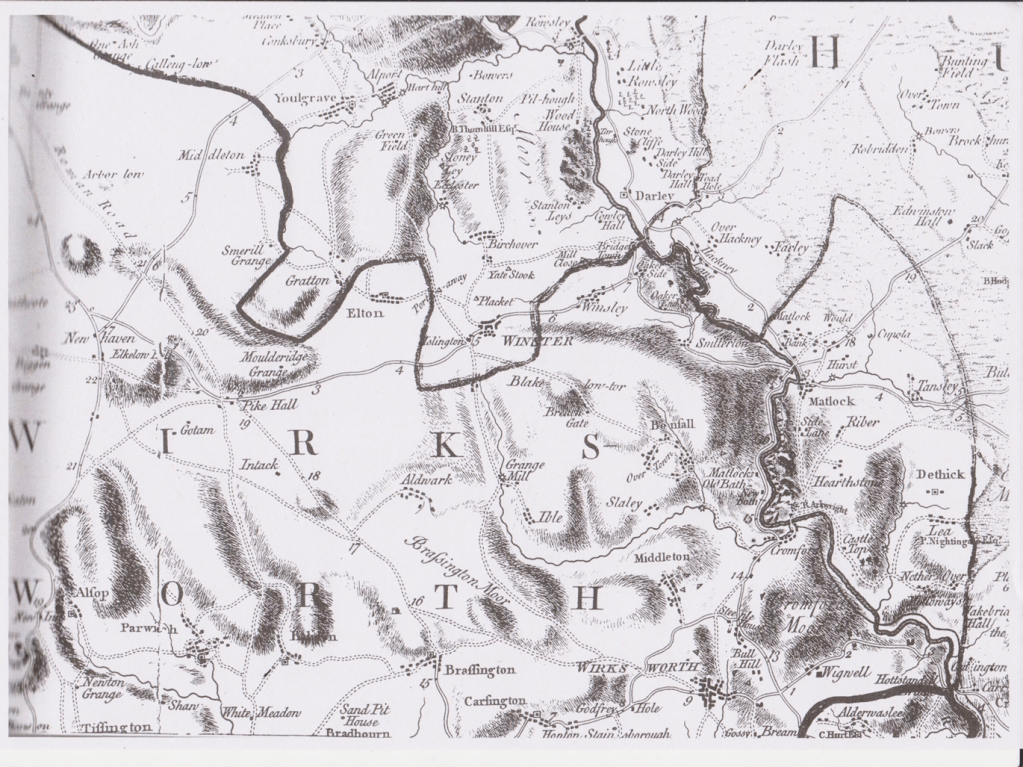
Burdett’s map of 1767 – the Derwent runs from top to bottom on right.

The map was revised in 1791 and so shows the turnpike roads (and mileages) as solid double lines. However, minor roads, lanes and paths are not marked. (The very thick black line is a hundred boundary). Upland is now shown by hatching, but it is obvious that the Via Gellia, west of Cromford, did not yet exist (or had not been recently surveyed). The names of some landowners are included, for instance Richard Arkwright at Cromford, and the maps were probably aimed at this class of customers, rather than ordinary travellers.

Ordnance Survey map of Youlgreave 1898: 25 inches = 1 mile

The first Ordnance Survey maps of Derbyshire, at a one inch to one mile scale, were not produced until 1840. Perhaps for the first time, accurate maps were available at a reasonable price. Later in the century larger scale maps were produced, such as the one above, which show every footpath, field and house, and so are a valuable resource for historians. Today we are so used to planning trips on cheap folding paper maps, or, increasingly map apps using GPS on our phones, that it’s easy to forget how recent these resources are. But perhaps the biggest mystery is how our ancestors moved around the country not only without maps, but without ever having seen a map in their lives?

“A fine lady upon a white horse …”

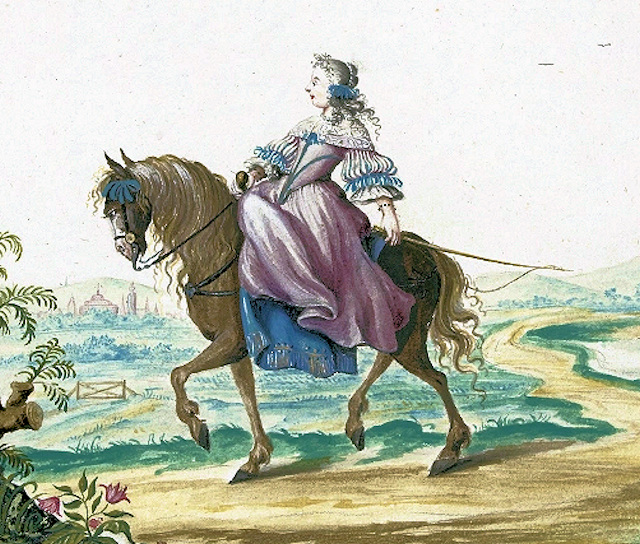
Woman riding side-saddle: No portrait of Celia appears to exist.

Celia Fiennes (1662-1741) was a well-connected lady who toured much of England on horseback around the end of the seventeenth century. Her journal provides a rare insight into the Peak District at this time, before turnpikes but when ‘tourism’ was just beginning. Although independent female travelers were rare at that time, her wealth allowed her to have two servants: an entourage that did not always protect her from the difficulties of travel. As the unmarried daughter of a Cromwell-supporting nobleman, Celia lived partly with a married sister in Hackney and seems to have traveled for both health and curiosity.

Woodcut of the old Buxton bathhouse

Like many more modern travelers Celia found much to complain of. At Buxton, where her party stayed at the Duke of Devonshire’s Buxton Hall, the beer was so bad that ‘very little can be dranke’. Worse were the bedrooms, which were overcrowded: ‘sometimes they are so crowded that three must lye in a bed’. Needless to say: ‘Few people stay above two or three nights it is so inconvenient’. It is easily forgotten that modern notions of privacy were quite foreign at this time. The main attractions were the bath and the water from St Anne’s Well. The former was about 40 feet long by 30 feet wide, and it was barely warm: ‘Just enough to open the pores of ones body’. Worryingly, the flow of water was weak, so that: ‘Its not capable of being cleansed after everybody has been in’. She must have questioned the health benefits of the process, but nevertheless plunged in.

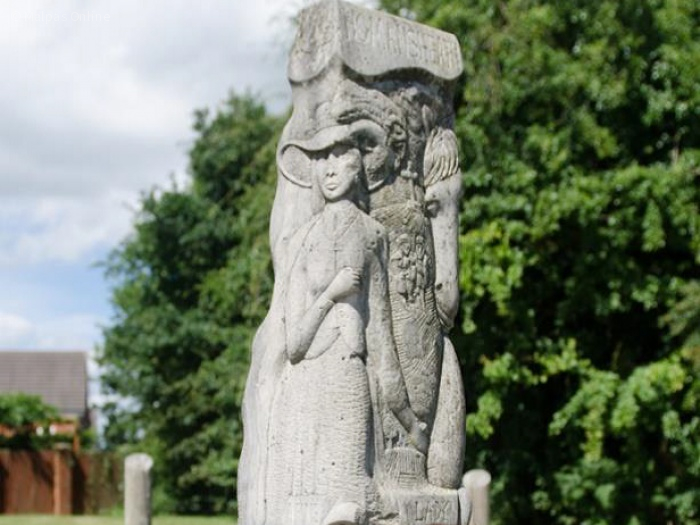
Memorial to Celia in the (suitably named) No Mans Heath, Cheshire

Celia Fiennes visited the so-called ‘Wonders of the Peak’ in the same way a modern tourist might tick off the local attractions in their guidebook. But equally interesting are her comments on travel generally, which she seems to have found extremely difficult in this area:

Indeed all Derbyshire is but a world of peaked hills, which from some of ye highest you discover ye rest like steeples or tops of hills as thick as can be, and tho’ they appear so close yet ye steepness down and up takes up yr time…

Even the guides couldn’t be relied on:

The country here about is so full of moore or quagmires and such precipices that one that is a stranger cannot travel without a guide, and some of them are put to a loss sometymes.

Her journals were not published in her lifetime, but eventually appeared in 1888 with the title Through England on a Side-saddle. The full text can be found at:

https://l4.tm-web-01.co.uk/lib/celia-fiennes-M171235.webp