Rain

Sir George Crewe of Calke with son John

It’s easy to assume that every extreme weather event – heatwave, drought or flood – must be the product of global warming. However, the storm that hit Derbyshire almost exactly 192 years ago, on the 26th of June 1830, could hardly have been caused by this. The event is recorded in the diary of Sir George Crewe of Calke Abbey, who describes how at 11.30 in the evening:

‘…the rain began to fall in torrents – I might say to descend in one sheet of water. Such rain I never heard before … Thus it continued, I should think, for at least an hour and a half‘.
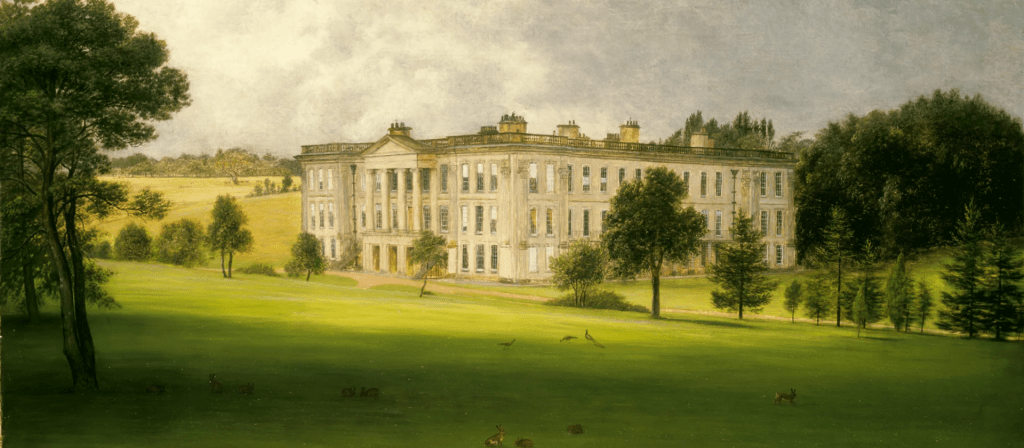
Calke Abbey

In the morning Sir George went downstairs and found that the house had been flooded overnight through the front door, with red mud all over the carpets. Outside the lawns were covered in mud and the drive had been swept clear, down to its foundations. As a magistrate he had to drive to the Petty Sessions in Ashby that morning, and he records the difficulty of getting there due to the washed-out state of the roads.

A nineteenth-century view of Swarkestone Bridge

His diary records that on July 13th he had to attend the Quarter Sessions in Chesterfield – a substantial journey on horseback of about 45 miles (he must have had to stay overnight). The route would have taken him over the ancient Swarkestone Bridge, which had fortunately survived the torrents. At the Sessions he was told that the county needed £7,000 for bridge repairs as a result of the downpour – in modern terms, nearly a million pounds. No less than six bridges on the Amber alone had been swept away. Clearly, even the best turnpike roads at this time were unsealed, and so liable to be washed out in the event of severe rain.

Dalesway

Onwards and upwards – bridge in Upper Wharfedale

I’ve just walked the Dalesway, an 80-mile route from Ilkley in Yorkshire to Bowness-on-Windermere in Cumbria. It took Rene and me seven days to walk the Way, averaging about 11 miles per day. Such a lengthy journey takes some organisation, because of the need to arrange overnight accommodation at the right intervals – not easy in the Pennines. But the experience – relatively unusual – gave me an insight into the lives of travellers in the pre-industrial world, who might be on the move for weeks, or even longer: people like drovers who would travel at the speed of their animals.

A break at Grassington

Walking in unknown country over long distances creates three main preoccupations. Firstly, am I on the right track? Getting lost is not just annoying, it also adds more miles to the day, and even with modern 1:25,000 maps and map apps it’s quite easily done! Secondly, travellers on foot need to concentrate on what’s under foot – boulders and bogs all need avoiding, and on some stretches this can demand your full concentration. Finally, you have to keep an eye open for threats, whether it’s a bad-tempered herd of bullocks or a menacing thunder cloud – and in the past these could have included footpads and robbers!

Railway viaduct at the head of Dentdale

As a result of all these, we found ourselves not just physically exhausted after a few days on the road but also mentally drained – rather surprising, as we had imagined that a trip like this would be quite relaxing! It certainly provides an insight into the historical experience, and fills me with admiration for the historic wayfarers strengths and resilience!

Love in the slow lane

The Long Engagement’ by Arthur Hughes (Birmingham Art Gallery)

Before the mid-twentieth century many homes were overcrowded, with a lack of privacy that would surprise younger people today. Furthermore, parents were often inclined to supervise their children’s indoor behaviour, so that most ‘courting’ took place out of doors, away from adult eyes. This applied equally to middle-class people: in the Hughes’ painting above a curate is meeting his fiancee in the woods, where ivy has grown over their initials carved into a tree, symbolising their lengthy enforced wait until he can afford to marry.

Path from Crich to Chadwick Nick

Most towns and villages would have had a ‘lovers’ lane’ where courting couples could find some privacy, as in the Crich footpath above, which still has boulders carved with sets of initials. Suitable venues would not be too far from habitation, nor the paths too rugged for girls dressed in their best! The situation is well-described by DH Lawrence, always an honest depictor of working-class life at the turn of the twentieth century, in ‘Sons and Lovers’, when Paul and Clara take the Clifton path by the River Trent:

He held her fast as he looked round. They were safe enough from all but the small, lonely cows over the river. He sunk his mouth on her throat, where he felt her heavy pulse beating under his lips. Everything was perfectly still. There was nothing in the afternoon but themselves.

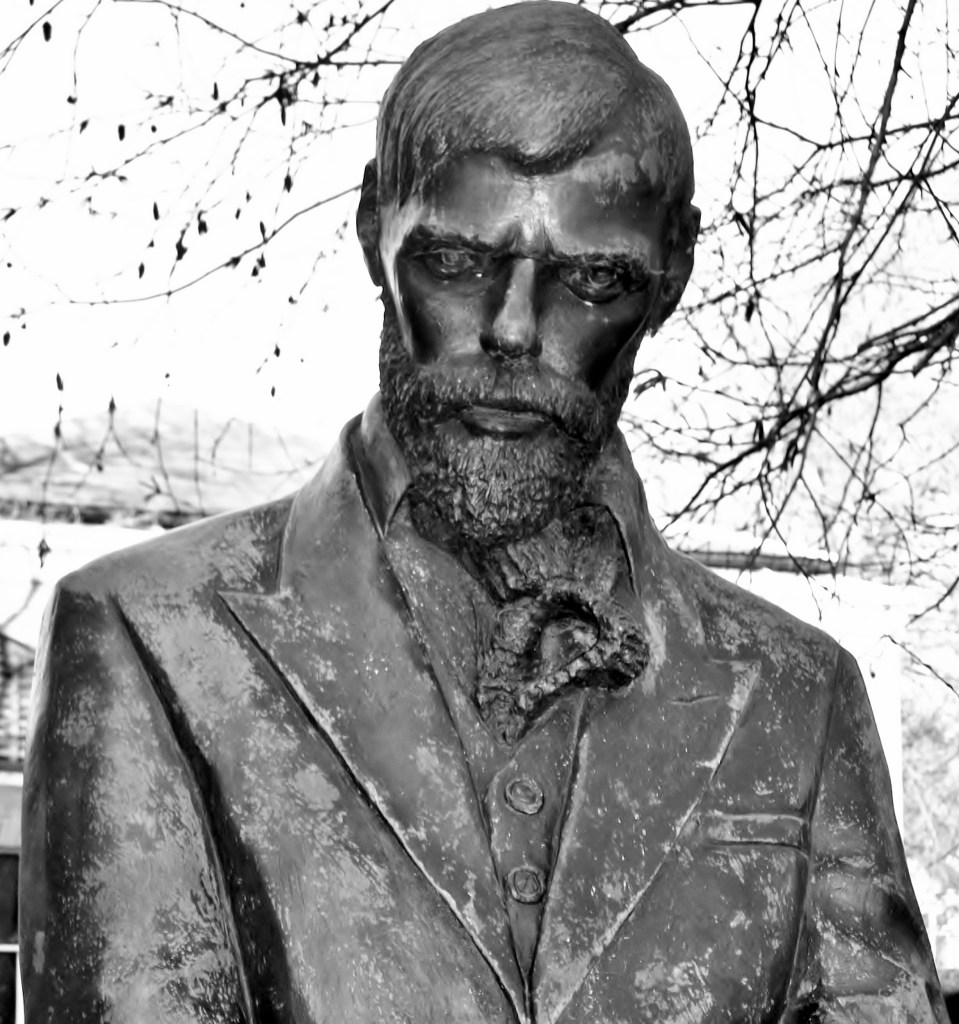
Statue of Lawrence at the University of Nottingham

Lawrence’s early stories and novels also give us a good idea of what were then acceptable distances for walking, either for work or pleasure. In 1905 public transport was limited and bicycles were only for wealthier people. On another occasion in ‘Sons and Lovers’ Paul and Clara are out in the hills after dark and she says that she needs to hurry back to the station to get the last train home to Nottingham. He says:

‘But you could easily walk it Clara, it’s only seven miles to the tram. I’ll come with you’.

It’s hard to imagine any contemporary lover thinking that an extra half hour with their darling was worth a two hour walk!