


Tramps on the roadside in Victorian times
In contrast with the rich and powerful, whose historical journeys were often recorded, we know very little about the thousands of people in the past who made a living from being on the move. Some may have been semi-criminals, but the great majority supported themselves by providing a service; moving goods to where they were wanted. Yet the stigma attached to itinerant workers persisted; they were often seen as a threat to the settled householder or shopkeeper. For some, such as the drovers, it could be a profitable business, while others had no choice but to beg from village to village, relying on the kindness of strangers.
Well into the twentieth century tramps were a familiar sight on our roads, with George Orwell providing an unusual glimpse of their lives in his Down and Out in Paris and London. Written in the 1930s, he describes the grim conditions in the ‘Spike’, where workhouse-style accommodation was provided by the local authorities. Today, of course, the volume of traffic on the roads makes old-style tramping impractical, so that the destitute sleep rough in cities, where there is more food, money and shelter.
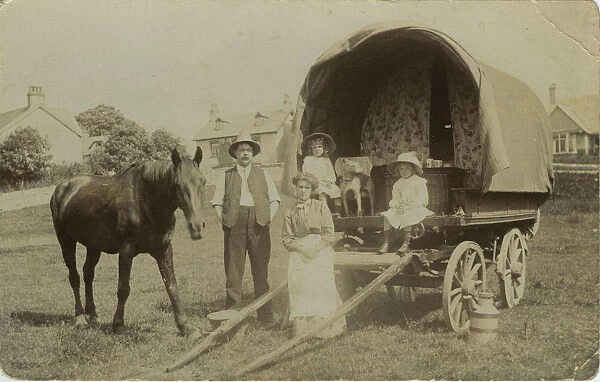
Gypsies, travellers or Roma are one marginal group that has attracted much interest and been heavily romanticised by writers such as George Borrow, while surviving into modern times. But others have been made redundant by the increase in personal mobility – we forget how isolated a Derbyshire village would have been up to the 1950s. Drovers were one of the most respected trades, responsible for the well-being of herds of valuable animals and their safe delivery to market. They would avoid turnpikes and use their own routes, with an overnight halt in an inn with grazing attached. Today it is difficult to trace droving roads, though place names such as Bullbridge may provide clues.

Pedlars (or travellers or hawkers) supplied the needs of isolated farms and cottages, in particular catering for women who could rarely visit a market town yet needed lightweight items such as sewing materials. They carried their goods in a pack, today commemorated in the name of the Hathersage pub, the Scotsman’s Pack. They must have been welcome visitors, but it is now hard to imagine how difficult their lives would have been, outdoors in all weathers and with the burden of the pack. Another significant group were the badgers or higglers, who bought goods such as eggs and butter from farmers and resold them at market. In theory they needed a licence to operate, so that for example in 1748 179 licences were issued at the Derbyshire Quarter Sessions, although many people may have operated unlicensed. As few, if any of these thousands of itinerant workers left a written record, tracing their lives is frustratingly difficult, but clearly their work was vital for the rural economy of the pre-motor age.


 The Old Roads of Derbyshire